
Quick answer
Free and real: Sunday liturgy at Anchiskhati (Shavteli Street 11), Sioni (Sioni Street) or Sameba in Avlabari. Arrive by 09:30, stand at the side, stay as long as you like. Staged and nightly: Ethno Tsiskvili in Dighomi, live song and dance every evening from 20:00 to midnight, about 100 GEL ($38) a head with food. Concert: Erisioni's new show at the Tbilisi Sports Palace on 30 October 2026, from 60 GEL ($23) on biletebi.ge. Best of all: a supra, if someone invites you.
- UNESCO proclaimed
- 2001
- Sunday liturgy
- 09:00-10:00
- Dinner show
- From 100 GEL
- Erisioni concert
- 30 Oct 2026
Most visitors hear Georgian polyphonic singing by accident: a table of men at the next restaurant finds three parts after the fourth toast, or chant drifts out of a church door on a Sunday walk. Both are better than any show. But if you have three days in Tbilisi and want to make sure it happens, this page is the list of places where it does, in the order we would send a friend: church first, then a concert if one is on, then a dinner show, and a supra above all of them.
What you are hearing is explained in our music and dance guide: three independent voices, a bass that holds or moves underneath, intervals that Western harmony avoided for centuries, and at least fifteen regional styles. UNESCO proclaimed the tradition a masterpiece of intangible heritage in 2001 and inscribed it on its Representative List in 2008. Its entry describes three types: the complex polyphony of Svaneti, the dialogue over a bass drone of Kakheti, and the contrasted, partly improvised three-part singing of the west. In Tbilisi you can hear all three in a week, because the city's choirs and ensembles draw singers from every region.
Sunday liturgy: the free option
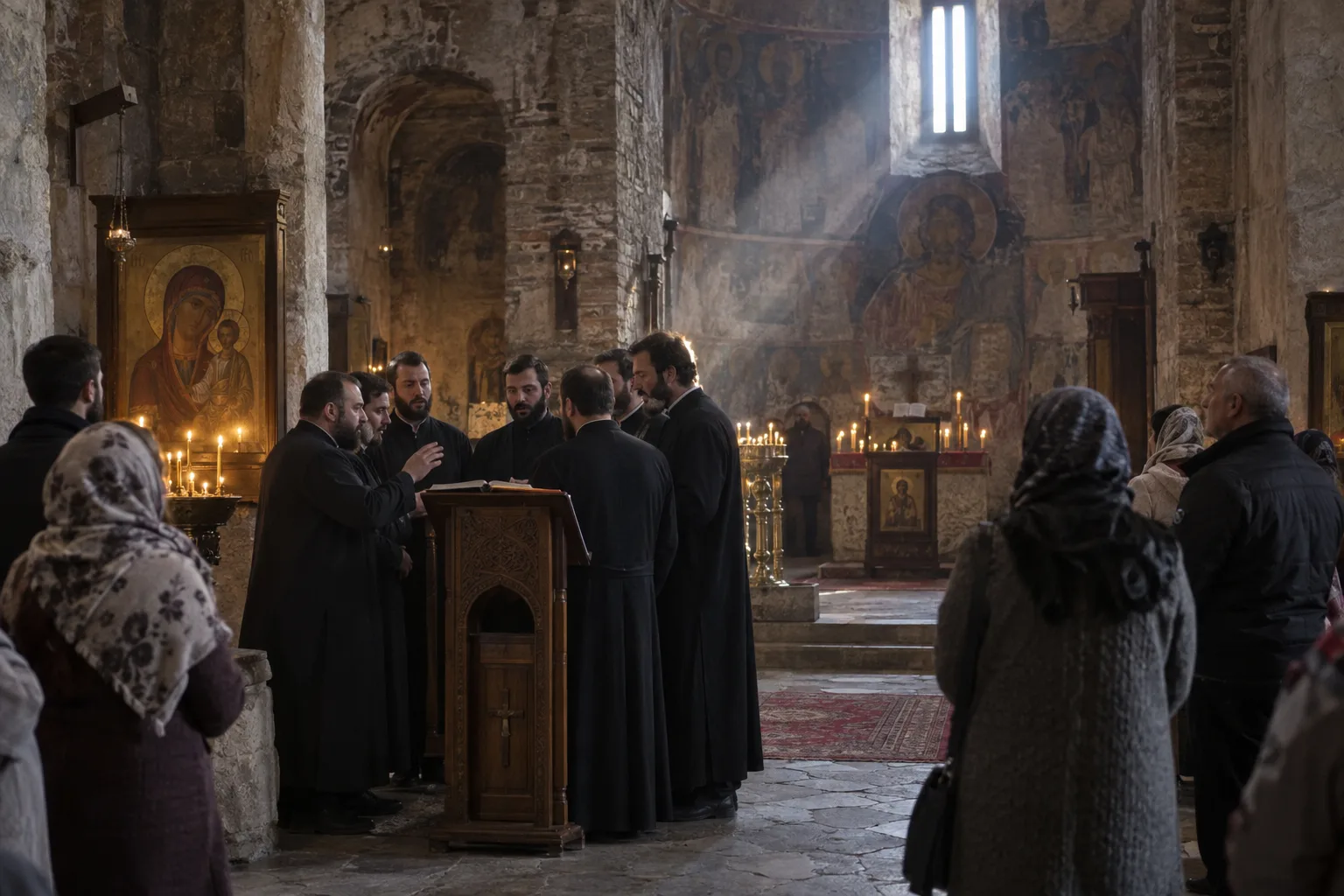
Georgian church chant is polyphonic, sung without instruments by a small group of men (sometimes women) standing at a lectern to one side of the altar. The Sunday liturgy is the main service of the week, and the three old-town churches below have choirs that people cross the city to hear. Nothing is ticketed, nobody checks who you are, and standing at the back for twenty minutes is normal.
Start times are the one thing we cannot pin to the minute: churches publish them on paper by the door, not online, and the Patriarchate's site was under reconstruction when we checked on 3 October 2026. Sameba's liturgy starts at about 10:00 on Sundays and its Saturday service at about 16:00 (confirmed by a March 2026 visitor guide and our own church etiquette research). Recent accounts of Anchiskhati put its Sunday liturgy at 09:00, running about two hours. The rule that works everywhere: be inside by 09:30 and you will hear the singing wherever you go.
| Church | Where | The singing |
|---|---|---|
| Anchiskhati Basilica | Shavteli Street 11, old town, a sixth-century basilica and the oldest church in the city | Home of the Anchiskhati Church Choir, founded in 1989 and the group that started the revival of old Georgian chant. Tiny interior, so the voices fill it; Sunday morning from about 09:00 |
| Sioni Cathedral | Sioni Street, old town, by the river. The seat of the Patriarch until Sameba was consecrated in 2004 | A larger space with room at the back. Sunday morning liturgy with chant; no published start time, so use the 09:30 rule |
| Sameba Cathedral | Elia hill, Avlabari, 600 m uphill from Avlabari metro; open 08:00 to 22:00 daily | The Patriarchate choir, whose singers include members of Ensemble Basiani, founded in 2000 as the Patriarchate's folk ensemble. Sunday liturgy from about 10:00, Saturday service about 16:00, matins and vespers daily |
| Kashveti Church | Rustaveli Avenue, opposite Parliament | The Aghsavali choir, founded in 2009 to sing the harder traditional chant, sings here. Central and easy to drop into on a Sunday walk |
Which to choose: Anchiskhati if the singing is the point, because the choir is the best known in the country and the room is small enough that you stand a few metres from it. Sameba if you want scale, a big choir and the Patriarch's own cathedral, with loan scarves and wrap skirts at the public entrance. Sioni if you are staying in the old town and want the shortest walk. All three are within fifteen minutes of each other on foot except Sameba, which is across the river and up a hill.
Concerts and the state ensembles
The polished version comes from the two national companies and a handful of state ensembles, and the catch is that they tour abroad for most of the year. On 3 October 2026 the picture was:
| Ensemble | What it is | In Tbilisi |
|---|---|---|
| Erisioni | The State Academic Ensemble of Georgian Song and Dance, founded 1885; its choir sings live with the dancers, and its predecessor ensemble recorded the Chakrulo on the Voyager record | New show "Georgian Treasure", Tbilisi Sports Palace, Friday 30 October 2026, 20:00, doors 18:30, 90 minutes, age 6+, from 60 GEL ($23), non-refundable, on biletebi.ge |
| Sukhishvili | The Georgian National Ballet, the bigger dance spectacle with an orchestra, in its 80th anniversary season | No Tbilisi date on sale. Touring the United States in October 2026 and Europe from January to March 2027 (sukhishvili.net) |
| Basiani | The Patriarchate's folk ensemble, now a state ensemble, the purest sound of the big names | No concert listed on tkt.ge or biletebi.ge. Hear its singers at Sameba on Saturday afternoon and Sunday morning instead |
| Rustavi Ensemble | The state folk ensemble that took Georgian song around the world from the 1960s | No concert listed. Its dancers appear in the dinner show at In the Shadow of Metekhi |
Tickets for anything in a hall sell on two sites, tkt.ge and biletebi.ge, both in English, both taking foreign cards. Search the ensemble name as soon as your dates are fixed; Tbilisi performances are few and the good seats go within days. The Erisioni concert above was the only folk-ensemble date on sale in the city when we looked, and the Sports Palace is at Khetagurov Street 26 in Vera, the address given on the ensemble's own site.
Dinner shows: nightly and staged
Three big restaurants stage a programme of polyphony and dance with dinner every evening in season. The performers are professionals, the food is decent to good, and the bill is 100 GEL ($38) and up a head with wine. It is the only option that runs every night of the week, which is why most short visits end up here.
Ethno Tsiskvili
Beliashvili Street 99, Dighomi, 30 to 40 minutes by taxi from the centre. Its own site, read on 3 October 2026, lists live music and Georgian dance every day from 20:00 to 00:00, the restaurant open 16:00 to 01:00 with the kitchen until 23:00. Book on +995 32 2 005 555 or [email protected]; it fills weeks ahead in summer.
Ethnographer
Beliashvili Street 105, next door, built as a museum of Georgian food. Dances nightly from about 20:00, roughly two hours in summer, per its pages as read on 7 September 2026 (the site itself was down on 3 October). Book by phone or Facebook three to five weeks ahead in peak season and ask for a table near the stage.
In the Shadow of Metekhi
Ketevan Tsamebuli Avenue 29, Avlabari, on the river with the old town across the water. Nightly from 20:00, about 90 minutes, with dancers from the Rustavi ensemble and singing waiters on Fridays (read 7 September 2026). The most central of the three; book by phone or Facebook.
Is the dinner worth it
Yes, once, for the dancing: nowhere else shows you Kartuli and the sword dances every night. For the singing alone, no. A dinner-show set is three or four songs between dances, amplified, in a hall of 300. Hear the singing in a church or at a supra and come here for the show.
The supra: where Georgians first hear it
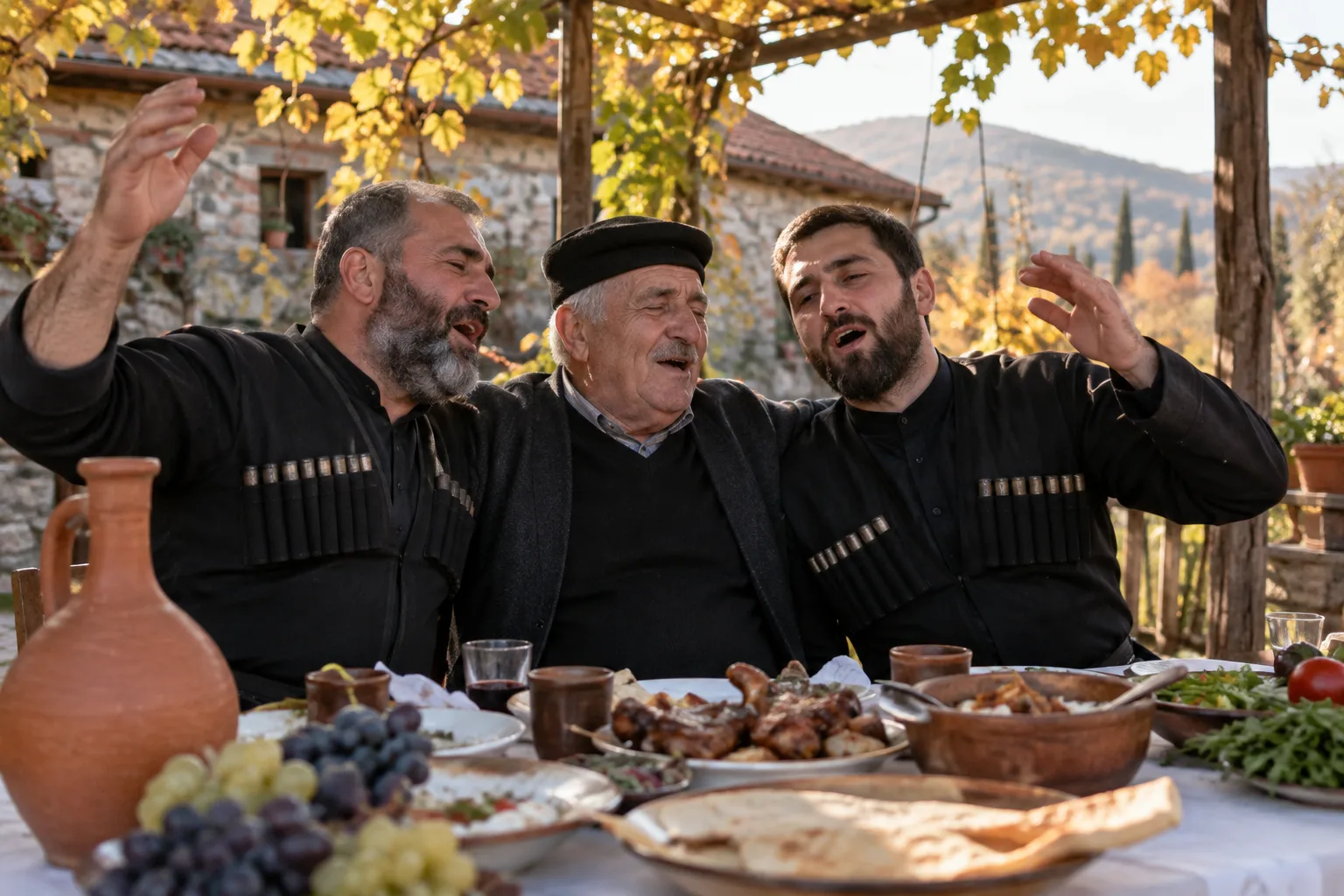
Every Georgian singer learned the songs at a table, not in a hall. Somewhere in the third hour of a supra, after the tamada's toast to the dead and before the one to the women, someone starts Mravalzhamier and two others find the lower parts. It is the Kakhetian style from UNESCO's description, two ornamented voices over a drone, and at a wedding the drone can be fifty men. No show reproduces it, and no ticket buys it.
How to get invited: stay in a guesthouse rather than a hotel, say yes to the host's wine, and go to Kakheti during the harvest in September and October, when families press grapes and sing while they do it (our rtveli guide explains how to join one). In Tbilisi itself, eat late at an old-fashioned restaurant with big tables, sit near the Georgian parties and wait. Friday and Saturday after 22:00 is when it happens.
The songs have words, and the words are what the table is listening to: Mravalzhamier is a wish for many years, Chakrulo is a Kakhetian vow before a fight, Shen khar venakhi is a hymn to the vine. The titles on a concert programme and a church service sheet are printed in Georgian script, which takes an afternoon to learn; EasyGeorgian's alphabet course gets you reading them before the first concert.
The folk instrument museum
For the instruments behind the dances, the State Museum of Georgian Folk Songs and Musical Instruments sits at Samghebro Street 6 on the lane up to Narikala, open 11:00 to 18:00 and closed on Mondays (hours per In Your Pocket; the museum's own listing on georgianmuseums.ge could not be reached on 3 October 2026, so confirm at the door). The collection runs from the panduri and chonguri lutes to the chiboni bagpipe and a room of mechanical European instruments, with early recordings of the songs. Half an hour is enough, and it pairs well with the baths below it.
Mistakes to avoid
| Mistake | Do this instead |
|---|---|
| Turning up at Anchiskhati at 11:00 on Sunday | The liturgy is over by then. Be inside by 09:30; the chant is sung through the whole service, so twenty minutes at any point works |
| Expecting a concert on any given night | The ensembles tour abroad most of the year. Check tkt.ge and biletebi.ge for your dates; if nothing is on, the dinner shows run nightly |
| Judging the singing by the dinner show | A restaurant set is amplified and short. Hear it in a church or at a supra before you decide what you think of it |
| Filming the choir in church | It is worship, not a performance. No photos of the singers, no flash anywhere, and none at all inside Sameba |
| Booking Dighomi for a Monday in January | The restaurant programmes thin out in winter. Phone first; the venues answer in English |
| Leaving a supra when the singing starts | That is the part you came for. Stay, and when they hand you the bass line, hum it |
Polyphonic singing in Tbilisi: questions
Where can I hear Georgian polyphonic singing in Tbilisi for free?
What time is Sunday liturgy at Anchiskhati and Sameba?
Is there a Georgian folk concert in Tbilisi in October 2026?
Which Tbilisi restaurants have live Georgian singing and dancing?
Is the dinner show worth it?
Can I take photos or record the singing in church?
Keep planning

Culture
Georgian Music and Dance: Polyphony, Kartuli and Live Shows
Georgian polyphonic singing and dances like Kartuli and Khorumi explained, plus where to see them in Tbilisi in 2026: ensembles, dinner shows and churches.
18 min read
Culture
Georgia Church Dress Code and Etiquette (2026): What to Wear
How to visit Georgian churches and monasteries respectfully: what women and men should wear, how strict it really is, candles, photos, services and common mistakes.
12 min read
Culture
The Georgian Supra: Feast Rules, Toasts and What to Expect
What happens at a Georgian supra: the tamada, how a round of toasts works, the wine and food, keipi against kelekhi, and how a first-time guest gets through it.
13 min read