Quick answer
The metro runs from about 06:00 to midnight every day, including holidays. Tap a contactless bank card or a 2 GEL Metromoney card on the turnstile once; a ride is 1 GEL (about $0.40, roughly 1.50 GEL on a foreign card) to any station and includes 90 minutes of free transfers to buses. Line 1 (red on the maps) runs north to south-east through Didube, Station Square, Rustaveli, Liberty Square, Avlabari and Samgori; Line 2 (green) branches at Station Square towards Vake and Saburtalo. There is no metro to the airport: take bus 337 to Avlabari or Station Square, 1 GEL.
- Fare
- 1 GEL
- Hours
- 06:00-24:00
- Stations
- 23
- Interchange
- Station Sq.
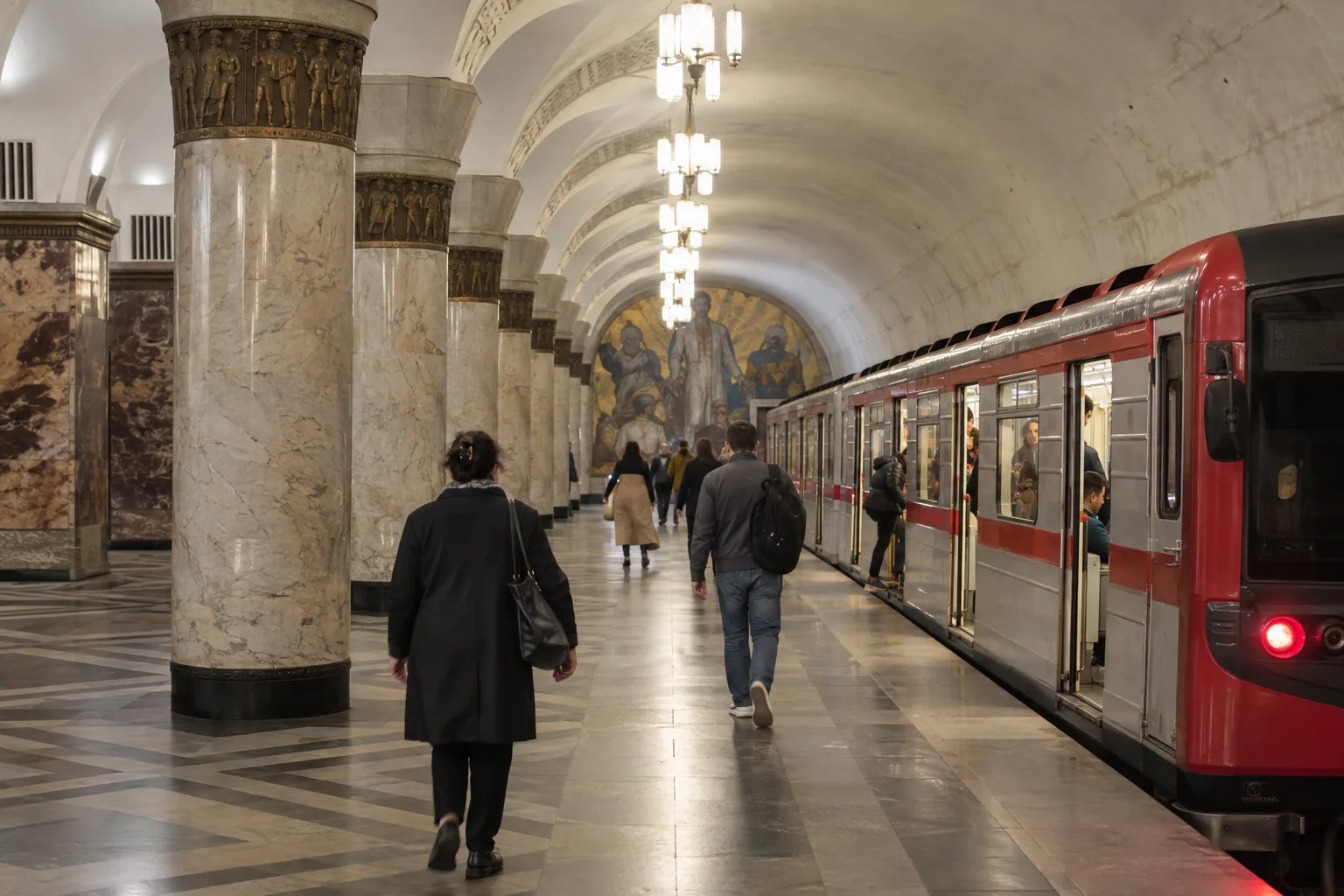
Tbilisi's metro opened on 11 January 1966, the fourth in the Soviet Union, and it still looks the part: deep stations with marble pillars, fast escalators and Soviet-built carriages that are being replaced from 2027. It carries around half a million people on a weekday and it is the fastest way across the centre between 08:00 and 20:00, when the streets above are jammed. Our public transport guide covers the buses, cable cars and the whole ticketing system; this page is the metro alone, station by station, for anyone who has just arrived and wants to use it without a wrong turn.
The map
Two lines, drawn below in the order the stations come. On the official map and the platform signs Line 1 is red and Line 2 is green; the signs at every station show the terminus of each direction, so on Line 1 you follow "Akhmeteli Theatre" to go north and "Varketili" to go south-east, and on Line 2 "State University" takes you out towards Vake and Saburtalo, "Station Square" brings you back.
The two lines meet only at Station Square, under the central railway station. The Line 1 hall is signed Station Square 1 and the Line 2 hall Station Square 2; a corridor of about 50 metres links them, and at rush hour that corridor is the one crowded spot in the whole system. Nothing else interchanges, so a trip from Avlabari to Vake means riding Line 1 to Station Square, walking through, and taking Line 2 out to Technical University.
Hours and frequency
The system runs from a little before 06:00 to midnight, seven days a week, with no reduced timetable on Sundays or public holidays. Trains come every few minutes at peak (the peak interval quoted for the system is about two and a half minutes) and stretch to around ten or twelve minutes late in the evening; if the platform is empty after 23:00, wait, another train is coming. The last trains leave the end stations around midnight, so after a late dinner in the old town you can still make it from Liberty Square if you are at the turnstile well before then. After that it is a Bolt: 4 to 7 GEL for a short ride across the centre.
Fares and how to pay
Everything below is the Tbilisi Transport Company's own standard tariff, read on ttc.com.ge on 25 September 2026, plus the foreign-card figure that readers report. Conversions use the National Bank of Georgia rate of 2.62 GEL to the dollar on the same day.
Metro fares, September 2026
| Item | Price | Details |
|---|---|---|
| One ride, any distance | 1 GEL | About $0.40 by Metromoney or bank card; includes 90 minutes of metro, bus and minibus transfers |
| One ride on a foreign bank card | about 1.50 GEL | The 1 GEL fare plus your bank's conversion; the 90-minute window still applies |
| Metromoney card | 2 GEL | Cashier desk in every station or a Bank of Georgia express branch; keep the receipt to replace a lost card |
| One-day unlimited pass | 3 GEL | Blue subscription card only, not Metromoney |
| One-week unlimited pass | 20 GEL | Subscription card only; pays off from the third day of heavy riding |
| One-month unlimited pass | 40 GEL | Subscription card only; 100, 150 and 250 GEL for 3, 6 and 12 months |
Prices checked September 2026. Ranges reflect season and operator.
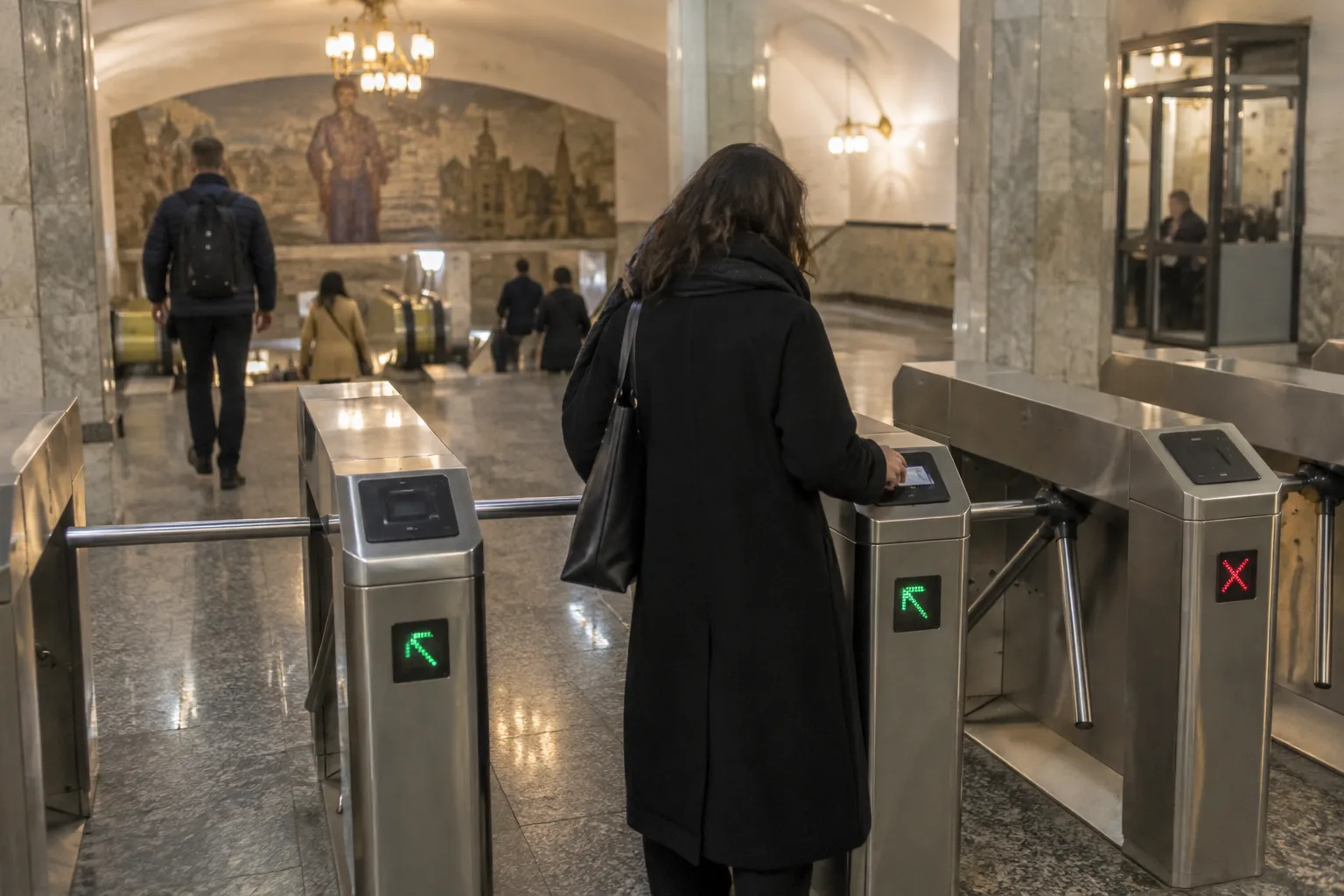
The 90-minute rule is the part worth understanding. One tap on the metro turnstile starts a 90-minute window in which every further metro, bus or minibus ride is free, as long as you paid with Metromoney or a bank card. Pay through the operator's mobile app, or in cash on the few buses that still have a cash machine, and the operator's tariff says plainly that the window does not apply. So a bank card is not just convenient, it is the cheap option. You tap on entry only; there are no exit gates and nothing to tap when you leave.
- 1
Two days in town: tap your own card
A contactless Visa or Mastercard, or the same card in a phone wallet, works at every turnstile. Expect about 1.50 GEL a ride after your bank adds its conversion. Use one card consistently so the 90-minute transfers chain together.
- 2
Three days or more: buy a Metromoney card
The white card is sold at the cashier window inside any station (the desk with the MS sign, not the orange Bank of Georgia counter) for 2 GEL, refundable within 30 days with the receipt. Top it up there with cash, or at the orange Bank of Georgia payboxes on the street. One card can pay for up to three people: tap it once per person as you pass.
- 3
A week of riding every day: the 20 GEL pass
The blue subscription card, sold at the same desks, carries the 3 GEL day and 20 GEL week passes. It does not do the 90-minute transfers or the Rike cable car, which is why we only suggest it for a long stay with a daily commute.
Every station and what it is for
Sixteen stations on Line 1 from north to south-east, then the seven on Line 2 from the interchange outwards. The ones a visitor uses are in bold; the rest are residential districts you will only see if you are staying there or curious. Neighbouring central stations are a couple of minutes apart; at the operator's average speed of 33 km/h, Didube to Samgori across the whole centre is roughly 20 minutes.
Line 1: Akhmeteli-Varketili (red)
| Station | What it is for |
|---|---|
| Akhmeteli Theatre | Northern terminus, in Gldani, the big housing district. Named after the theatre next to it; opened 1989 with a single entrance, so it is crowded at peak |
| Sarajishvili | Gldani. Residential |
| Guramishvili | Guramishvili Avenue, Nadzaladevi district. Residential |
| Ghrmaghele | Residential |
| Didube | The marshrutka yard for Kazbegi (20 GEL), Mtskheta (2 GEL), Gori, Borjomi, Kutaisi (25 GEL) and Batumi is beside the station. Also the OmniBus stop for Kutaisi Airport coaches |
| Gotsiridze | Didube district. Renovated in 2023 with step-free access, one of the few stations that has it |
| Nadzaladevi | Residential |
| Station Square | Under the central railway station: trains to Batumi and Kutaisi, the airport bus 337 terminus, the Georgian Bus coaches from Kutaisi Airport, the city's biggest street market, and the only interchange with Line 2 |
| Marjanishvili | The left-bank restaurant streets, Fabrika, the Dry Bridge market and Dedaena Park; Aghmashenebeli Avenue runs past the exit |
| Rustaveli | The top of Rustaveli Avenue: Parliament, the Opera and the Mtatsminda cable car lower station. The deepest station, with the longest escalator |
| Liberty Square | Freedom Square itself, the old town, Sololaki, the National Museum and the start of Rustaveli Avenue. Formerly Lenin Square |
| Avlabari | Sameba cathedral, Rike Park and the cable car up to the Narikala ridge, the sulfur baths on foot. Bus 337 from the airport stops outside, and the Yerevan marshrutkas leave from the car park beside the station |
| 300 Aragveli | Isani district by the river, named for the 300 soldiers from the Aragvi valley who died defending Tbilisi at Krtsanisi in 1795 |
| Isani | Isani district. The nearest metro to Ortachala bus station (international coaches to Yerevan and Baku), which is a bus or a short Bolt from here |
| Samgori | The Navtlughi terminal for Kakheti vans (Sighnaghi 15 GEL, Telavi) is beside the station, not at Didube and not at Ortachala |
| Varketili | South-eastern terminus. Under rehabilitation since July 2025 but open with full 06:00 to midnight hours since 16 March 2026; the upper hall works are due to finish by 30 December 2026 |
Line 2: Saburtalo (green)
| Station | What it is for |
|---|---|
| Station Square | Line 2 starts here; the Line 2 hall is Station Square 2, one corridor from Line 1 |
| Tsereteli | Tsereteli Avenue and the Dinamo Arena, the national football stadium |
| Technical University | The stop for Vake: Vake Park, the Chavchavadze Avenue cafes and, by bus or on foot, the Turtle Lake cable car |
| Medical University | Vazha-Pshavela Avenue and the Saburtalo shops |
| Delisi | Saburtalo. Residential |
| Vazha-Pshavela | Upper Saburtalo, opened 2000 |
| State University | Western terminus, opened 2017 after a build that started in 1985. Tbilisi State University's high-rise campus; the Bagebi to University ropeway, a municipal cable car on the same 1 GEL tariff, runs from near here |
Station names are announced and written in Georgian and English on the platforms and in the carriages, and above ground every entrance is marked with a red letter M. Where the name has changed since Soviet times the old one is gone from the signs, but you will still hear older residents say "Lenin Square" for Liberty Square and "26 Komisari" for Avlabari.
Using it without a wrong turn
- 1
Find the entrance
A red M on a post or over a doorway, often at the top of a stairway into an underpass. Most stations have a single entrance hall with several staircases up to the street, so if you come out on the wrong side of a big road, cross by the underpass rather than the traffic.
- 2
Tap and take the escalator
Turnstiles are inside the hall. Tap once. The escalators at the deep central stations are long and move faster than the ones you are used to: hold the rail, stand on the right, walk on the left. At Rustaveli the ride is about 120 metres of escalator, which takes well over a minute.
- 3
Read the direction sign
Each platform end carries the name of the terminus in that direction. Line 1: Akhmeteli Theatre is north (Didube, Station Square), Varketili is south-east (Avlabari, Samgori). Line 2: State University is outbound, Station Square is back to the centre.
- 4
Count the stops
Screens and announcements name the next station in both languages. Phone signal works on the platforms and drops in the tunnels, so load your map before you go down.
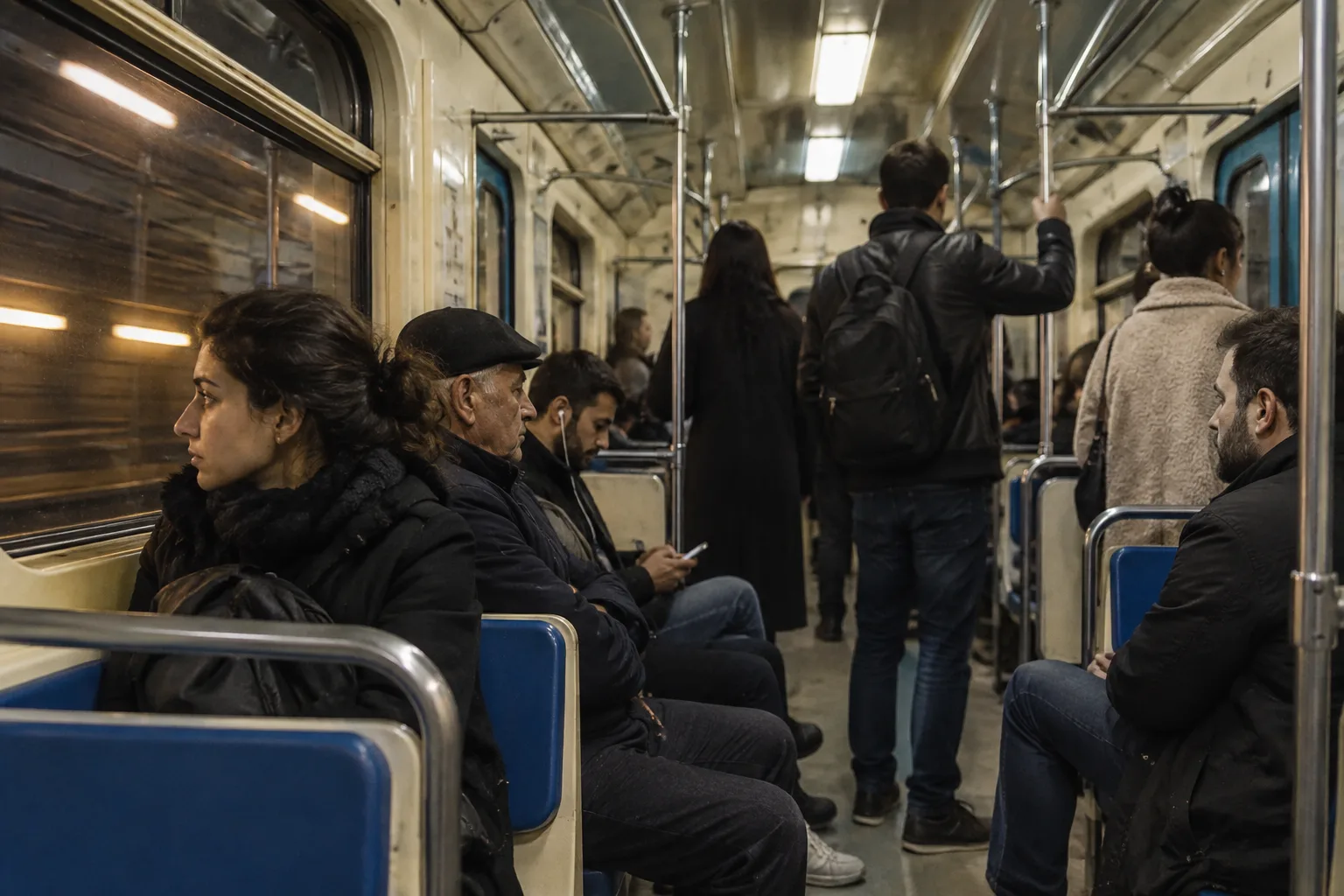
A few things to know before you are standing there. Photography of the platforms is officially not allowed and the guards will say so if you set up a camera; a phone snap of a mosaic is generally ignored. There are no toilets anywhere in the system. Escalator etiquette is strict: stand right, and expect people to walk past you on the left at speed. Luggage is fine off-peak; a big suitcase at 09:00 at Station Square is not. Step-free access exists at a handful of stations (Gotsiridze since its 2023 renovation), and the rehabilitation programme funded by the European Bank for Reconstruction and Development is meant to add lifts to around a dozen more by 2029. Until then, anyone who cannot manage stairs and long escalators should plan on the buses, which are low-floor, and on Bolt.
The airport, the stations and Didube
There is no metro to Tbilisi International Airport and no railway link either; the third line drawn up in 2018 to run from Samgori out towards the airport was never started. The 1 GEL answer is bus 337, which leaves the terminal from 06:59 to 22:59 and runs to Avlabari, Freedom Square and Station Square, so it drops you at the metro at either end. After 23:00, or with a family and bags, a Bolt is 15 to 25 GEL by day and 30 to 40 at night, and a GoTrip driver was 54 GEL per car for up to three people when we read gotrip.ge on 25 September 2026. For the two intercity yards the metro is exactly right: Didube station opens onto the marshrutka yard for everywhere north and west, and Samgori onto the Navtlughi terminal for Kakheti, both described in our bus stations guide.
Maps and data underground
The whole planning system you need is Google Maps: choose transit and it names the line, the direction and the number of stops, and it knows the buses that connect at the far end because every Tbilisi bus reports its position live. That only works with data, so sort a SIM or eSIM before you go looking for a platform. We install an Airalo eSIM at home for the airport run and the first day; the plans below are what airalo.com showed on 25 September 2026, the same prices as when we re-read them on 16 September. For a week or more, a Magti SIM in town is cheaper per gigabyte, as our SIM card guide explains.
What is changing
The metro is mid-way through its biggest overhaul since it opened. The rolling stock is the visible part: the 197 Soviet-built cars from 1974 to 1991 are being replaced by 111 new cars from the Chinese manufacturer CRRC, ordered in 2025 as 14 four-car and 11 five-car trains, air-conditioned, with walk-through gangways and room for up to 280 people a car. CRRC showed the first train in early September 2026; it is due in Tbilisi in the last quarter of 2026 and enters service on Line 1 in 2027, with the rest arriving in batches to 2031. The stations are the slower part. A European Bank for Reconstruction and Development loan is paying for the design and rehabilitation of a dozen stations over about five years, Varketili being the first and the one that overran, and lifts and step-free routes are part of that brief. Expect hoardings and the occasional closed entrance; the trains keep running throughout.

Mistakes to avoid
- Going to Didube for Kakheti. The Sighnaghi and Telavi vans leave from Navtlughi, beside Samgori station at the other end of Line 1. Didube is for Kazbegi, Mtskheta, Gori, Borjomi, Kutaisi and Batumi.
- Buying the blue card when you wanted the white one. The blue subscription card carries the passes but not the 90-minute transfers or the Rike cable car. Metromoney is the white card, 2 GEL, at the cashier window.
- Paying by app or cash and expecting free transfers. The operator's tariff excludes both from the 90-minute window. Tap a card.
- Looking for a train to the airport. There is none. Bus 337 from Station Square or Avlabari, 1 GEL, until about 23:00.
- Standing on the left of the escalator. You will be asked to move, quickly.
- Arriving at the turnstile at 00:05. The system closes at midnight and the last trains have already left the end stations.
Frequently asked questions
What are the Tbilisi metro hours?
How much does the Tbilisi metro cost in 2026?
Can I use my credit card on the Tbilisi metro?
Where do I buy a Metromoney card?
Is there a metro to Tbilisi Airport?
How many stations does the Tbilisi metro have?
Keep planning

Practical Info
Tbilisi Metro and Buses 2026: Hours, Fares, Cards and Stops
Tbilisi's metro and buses in 2026: 1 GEL a ride, metro hours 06:00 to midnight, paying by bank card or Metromoney, free transfers, and the stops visitors need.
14 min read

Practical Info
Tbilisi Airport to City: Bus 337, Bolt and Transfers 2026
From Tbilisi Airport to the city in 2026: bus 337 for 1 GEL until 23:00, Bolt fares, fixed-price drivers from 54 GEL, and why the airport train is not running.
11 min read
Destinations
Tbilisi for First-Timers: What to Know Before You Go (2026)
Your first trip to Tbilisi in 2026: airport to city, which area to sleep in, what to see and skip, where to eat, the baths, and prices read this month.
14 min read