
Quick answer
Base yourself in Kutaisi, 72 km away. Take the 10 GEL marshrutka from the central bus station (hourly 08:00 to 16:00), get off at Katskhi Pillar on the way, flag the next van into Chiatura, ride the new cable cars for 50 tetri each and the free 1966 Sashevardno line, walk out to Mgvimevi convent and catch the 15:00 van back. A GoTrip driver does the same loop with no waiting from 115 GEL (about $44) per car each way. From Tbilisi it is 186 km and a long day: drive it, hire a driver from 225 GEL, or take the Didube van and sleep in Kutaisi.
- From Kutaisi
- 72 km
- From Tbilisi
- 186 km
- Cable car
- 50 tetri
- Driver from
- 115 GEL
Chiatura is not pretty and that is the point. Manganese was found in the hills here in 1879, by 1905 the mines supplied around 60 percent of the world's output, and the town that grew up on both sides of the Qvirila gorge solved its vertical geography with an aerial ropeway in 1954, then kept adding lines until miners commuted by cabin. The rusting Soviet network made Chiatura famous with photographers. It was shut down on safety grounds and replaced in September 2021 by four French-built gondola lines, and since late 2024 one of the originals has been running again on new cable. Add Katskhi Pillar, five kilometres out on the Kutaisi road, and Mgvimevi, a working nunnery carved into a cliff at the edge of town, and you have a full day that looks like nowhere else in Georgia. Our Kutaisi guide covers the base; this page is the trip itself.
Kutaisi or Tbilisi, in one table
| Starting from | How it works and what it costs |
|---|---|
| Kutaisi, by marshrutka | 10 GEL (about $4) each way, about 2 hours, hourly from 08:00. Stop at Katskhi on the way in. Last van back around 15:00, so the day is 08:00 to 17:00 and tight for Mgvimevi |
| Kutaisi, with a driver | GoTrip from 115 GEL (about $44) per car each way, 1 hour 20 minutes, stops at Katskhi and Mgvimevi included. The whole loop with no timetable, best for two to four people |
| Kutaisi, on a tour | From $29 a seat for 7 to 8 hours covering the pillar, the cable cars and usually Mgvimevi. The solo traveller's version of the driver |
| Tbilisi, by marshrutka | About 20 GEL (about $8) from Didube, 2.5 to 3.5 hours each way. Doable, but you arrive at 10:30 at best and leave by 16:00. Better as a stop on the way west with a night in Kutaisi |
| Tbilisi, with a driver or car | GoTrip from 225 GEL (about $86) per car each way, 2 hours 36 minutes; a rental car does it in the same time on paved road. Leave by 08:00 and it is an 11-hour day |
| Overnight in Chiatura | One small hotel beside City Hall and thin restaurant options. Worth it only if you want the old stations at dawn or the road on to Racha |
The plan for one day
- 1
Katskhi Pillar, 09:00 to 10:15
Coming from Kutaisi the pillar is just off the highway before Chiatura. Drive or walk the sealed road to the marked viewpoint first, then follow the path down to the monastery at the base. Allow an hour. Katskhi church, a cylindrical domed church of 1032, is two minutes further along the road.
- 2
Chiatura new cable cars, 10:30 to 12:00
Start at the Central Cable Car Station on the south bank next to the Cultural Centre. Ride the Sanatorium line for the view and the Naguti line because it is the longest; 50 tetri a ride by bank card or Metromoney.
- 3
Sashevardno, the 1966 line, 12:00 to 12:45
Cross the bridge to the open-air station by City Hall. It is free and runs on demand 10:00 to 18:00. At the top, walk out to the piazza viewpoint with the flag, 10 to 15 minutes each way.
- 4
Lunch and the town, 12:45 to 14:00
Chiatura has a couple of cafes near City Hall and a family restaurant near the Lezhubani upper station that caters to groups and wants a day's notice. Then the old station with the red gondola by the bus stop, the theatre and the museum (5 GEL, 10:00 to 18:00).
- 5
Mgvimevi convent, 14:00 to 15:00
Two kilometres east on the Sachkhere road, a 20-minute walk from City Hall. The stairs from the highway take 15 minutes. Open 10:00 to 18:00 in summer, 11:00 to 16:00 in winter; skirts and headscarves for women, long trousers for men, wraps provided.
- 6
Home
Marshrutka people need to be on the 15:00 van, which means skipping Mgvimevi or doing it before lunch. Driver and car people leave whenever they like; the road to Kutaisi is 1 hour 20 minutes.
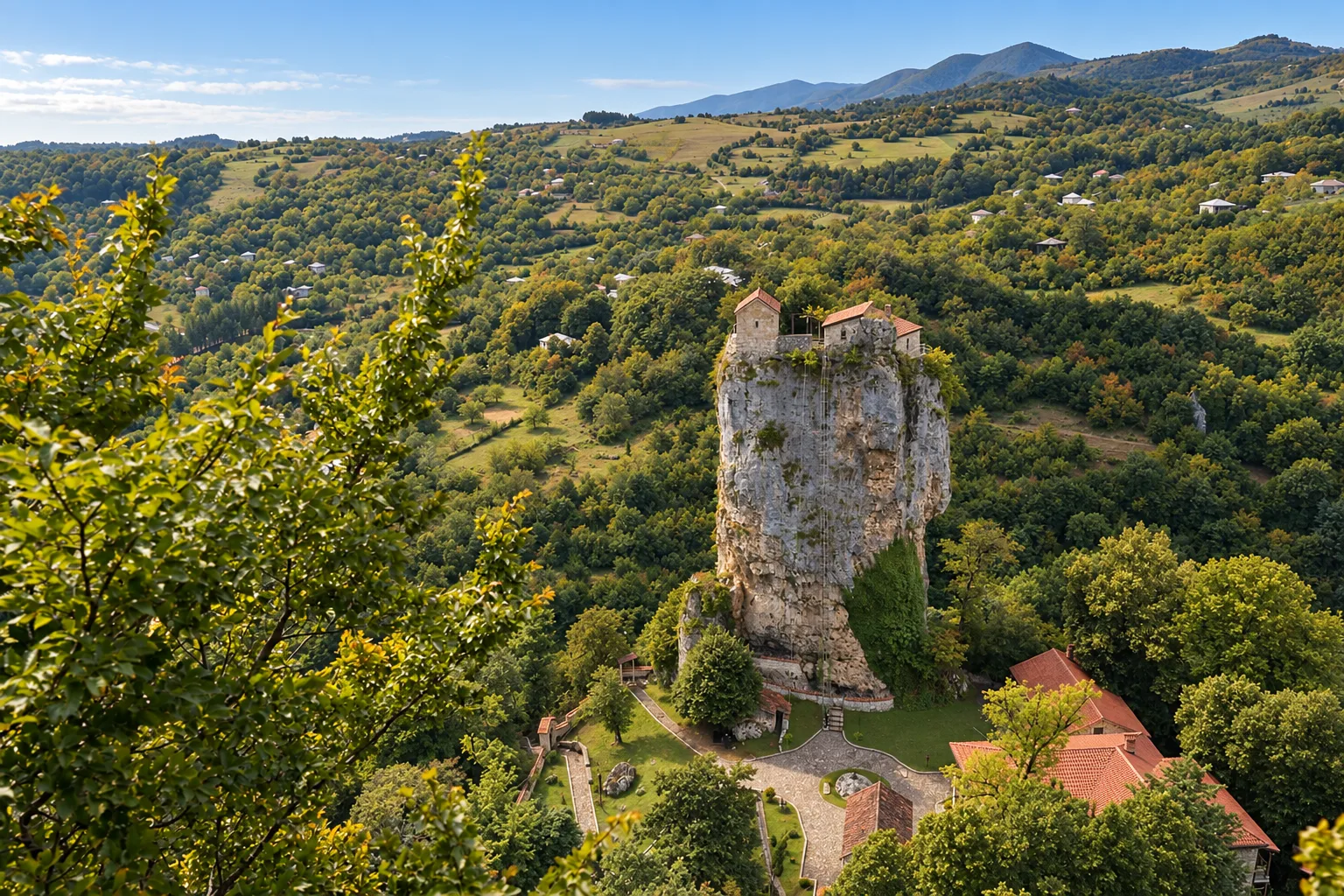
Katskhi Pillar
The rock is a limestone monolith about 40 m high in the village of Katskhi, five kilometres from Chiatura, with a flat top of roughly 150 square metres and a small church on it. Nobody climbed it in recorded history until July 1944, when a party led by the mountaineer Alexander Japaridze and the writer Levan Gotua went up and found the ruins of a hermitage; excavations in 2006 dated the buildings to the 9th or 10th century, with a wine cellar that rather undermines the idea of extreme asceticism. Religious life came back in 1995 with a monk from Chiatura, Maxime Kavtaradze, who lived on the summit for around two decades and came down by the iron ladder a couple of times a week. The chapel on top was restored between 2005 and 2009, and since 2012 visitors have not been allowed to climb, for safety reasons. That is the Wikipedia version, which matches what the monks at the base will tell you.
What you can do is walk up to the base. The cloister complex there, with the newer church of Simeon Stylites, the remains of an old wall and belfry, a small museum and a gift shop run by the monks, is open daily from 09:00 to 20:00. The better view is from further back: a sealed side road off the highway leads to a marked viewpoint, and a footpath continues from it down to the pillar. A marked trail also goes on up the plateau if you want to look down on the church from above. Modest dress applies as at every Georgian monastery, and our church dress code guide explains exactly what that means.
Chiatura's cable cars
There are two systems now, and you want both. The four new lines, built by the French firm Poma and opened in September 2021, all leave from the Central Cable Car Station on the south side of the Qvirila next to the Cultural Centre, and between them cover almost 3.5 km of cable. The gondolas are enclosed, seat eight to ten and hang from proper pylons, so this is public transport, not a dare. The fare is 50 tetri (about 19 cents) one way, children under six free, and the lines run daily from 08:00 to 22:00. Paper tickets are gone: tap a bank card at the gate, or buy a Metromoney card, the same white card as the Tbilisi metro, at the desk under the Central Station.
| Line | Length and where it takes you |
|---|---|
| Sanatorium | 862 m south-east from the top floor of the Central Station to the highest upper station, beside the fenced-off Former Pioneer Palace and a small amusement park with a Ferris wheel. The best panorama |
| Mukhadze | 640 m, the shortest, from the annex station across the footbridge. Passes directly over the railway station and ends among the apartment blocks near the hospital |
| Lezhubani | 845 m north-west across the valley, over the roof of one of the old stations by the market. Blue metal upper station; the family restaurant is up here |
| Naguti | 1,081 m, the longest, west into the Naguti district near the highway from Kutaisi. The war memorial at the town entrance is a 15-minute walk from the upper station |
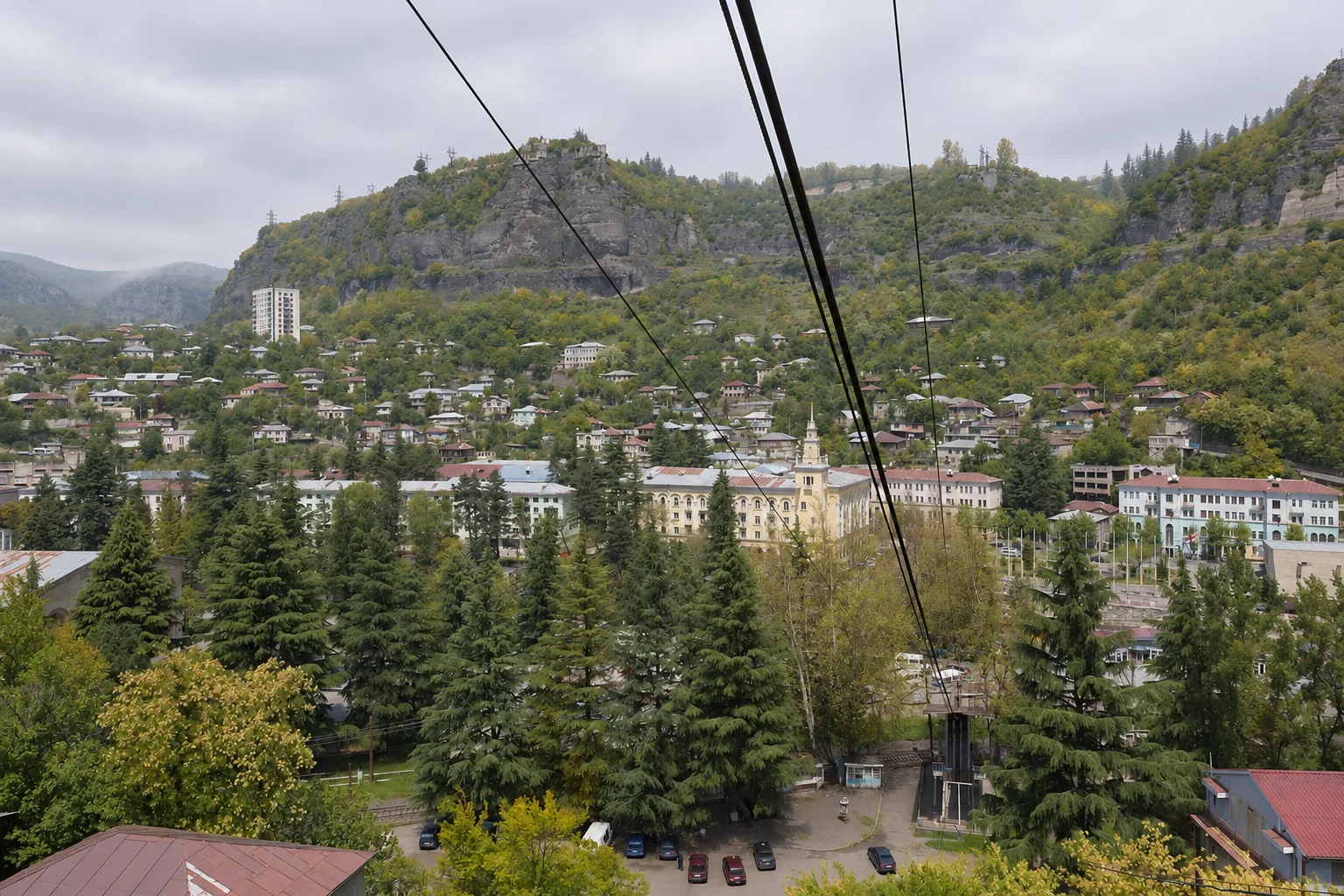
The second system is the one everybody came for before 2021. The Sashevardno ropeway of 1966, which links the centre with the Upper Rgani district, was the first of the Soviet lines to be restored and reopened in late 2024 with two new gondolas, new cable and new machinery. It climbs 186 m over a 249 m line at a 48-degree pitch, which makes it one of the steepest passenger cable cars anywhere, and at times it feels closer to a funicular scraping up the cliff. It leaves from the small open-air station at the end of the bridge by City Hall, is completely free, and runs on demand between 10:00 and 18:00 every day. At the top, walk across the vacant lot to see the original winding gear lying where it was dumped, then 10 to 15 minutes further to a new viewpoint square with a large Georgian flag. The station building next door, the one with the Stalin and Lenin profiles in river-stone mosaic on its facade, was being renovated when we last checked, together with a second original line to Perevisa that was due to reopen in 2026. We have not been able to confirm it is running, so treat it as a bonus if it is.
The old stations and the town
Even with the cabins gone, the Soviet station buildings are the reason photographers still come. The one to see first is beside the bus stop in the centre, reached from the bus station by a pedestrian underpass: a split cantilevered roof, arched windows and two sculptural staircases, with a single red gondola still hanging in mid-air above the street where people sell grapes from car boots. Across the river near the First Public School stands a much taller windowless concrete tower of a station from the 1960s. On the road out past Mgvimevi towards Sachkhere there are three more: a junction station where two lines from opposite ridges met, with a bas-relief of musicians and dancers on the bus shelter under it, a green-and-white one 700 m further on with its drive wheels still strung, and an upper station in the village of Itkhvisi, 4 km up a concrete lane past a mine. The three-way interchange that stood where the Central Station now is was demolished; there is a photograph of it in the museum.

The rest of the centre is an hour's walk. The 1976 railway station opposite the theatre now has a shop in its front half and sees one train a day. The Akaki Tsereteli theatre of 1949, named for the poet who found the manganese, still performs and carries a frieze of Stalin among workers high on its facade. The Local Lore Museum moved out of the Cultural Centre a couple of years ago and now sits at the end of the long curved arcade building on the north bank, above the tourist information office: two rooms, the second of them the mining history with 1920s photographs, lamps and helmets, open daily 10:00 to 18:00 for 5 GEL cash. Look for the blue Soviet mosaics on the Mining Institute, the First Public School and a kindergarten a street uphill, and if you have a car, the indoor pool at the Temur Maghradze stadium on the south-west edge of town has two wall mosaics that the staff will show you if you ask nicely. Chiatura has about 12,000 people, plenty of ATMs and shops, and a very small number of places to eat, so plan lunch rather than expect it.
Mgvimevi convent
Mgvimevi means "of the cave", and that is what it is: a monastery founded in the second half of the 13th century by Rati, the eristavi of Racha, in a large natural cave in the cliff at the eastern edge of Chiatura on the Sachkhere road. The main church is a two-nave basilica of the Nativity of the Mother of God built out from the rock, with an 18th-century painted iconostasis and fresco portraits of Rati and his family in the north nave; opposite it across the cave mouth is the small hall church of St Catherine with a ram's head carved on its east wall. It is on Georgia's list of monuments of national significance, and since 2014 it has been a working nunnery again.
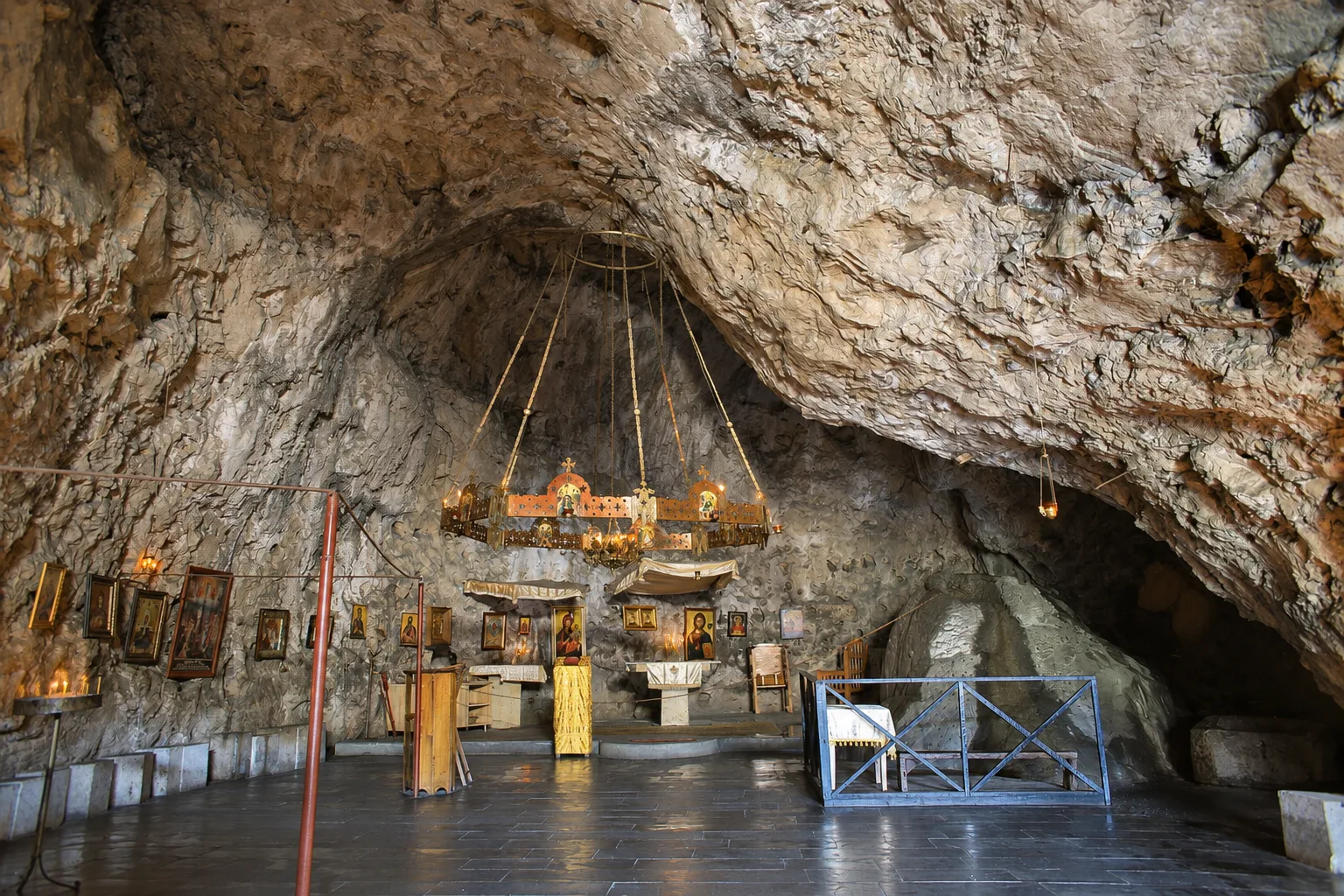
Getting in takes a little looking. The entrance is a staircase that starts beside a small shop on the highway, marked with a church sign that is easy to miss, and there is a petrol station opposite where drivers park. The climb takes about 15 minutes and ends inside the cave, which is cool and damp whatever the weather outside. Hours were 10:00 to 18:00 in summer and 11:00 to 16:00 in winter in a May 2026 report. The dress rule is stricter than at most Georgian churches: women need a skirt and a headscarf, trousers are not accepted, men need long trousers, and wraps and scarves are lent at the entrance. It is a 20-minute walk or a two-minute drive from City Hall.
Getting there from Kutaisi
Marshrutkas leave Kutaisi's central bus station for Chiatura roughly every hour between 08:00 and 16:00, cost 10 GEL (about $4) and take about two hours including a short stop in Zestaponi. City bus 1 from the Colchis Fountain gets you to the bus station. Take one of the first vans; the driver drops you on the main street. Coming back, vans leave from the central bus station up the hill and from the smaller stand at the end of the bridge, and the last direct one goes at around 15:00, though in summer Batumi-bound vans passing through Kutaisi sometimes run later. Times and fares are from a May 2026 report and match what our marshrutka guide found on other Imereti routes this year; confirm the last departure when you arrive.
There is also a train, once a day, and it is only useful in one direction. The Kutaisi to Sachkhere service leaves Kutaisi I at 05:50 and reaches Chiatura about 3.5 hours later for 50 tetri paid at the desk or on board; the return leaves Chiatura at 11:30, too early to be any use. It does not run in winter (in 2025 it resumed on 25 March). Our trains guide lists it with the other commuter services.
For two or more people a driver is the version we would book. GoTrip's fixed prices are per car, shown before you confirm, with no deposit and unlimited stops, so Katskhi and Mgvimevi cost nothing extra and you are not watching the clock for the 15:00 van. The cheapest Kutaisi to Chiatura listing on 26 September 2026 was a six-seat Nissan Quest at 115 GEL, and the return leg was listed at the same price. The route is 72 km and 1 hour 20 minutes each way.
Getting there from Tbilisi
Direct vans leave the Nige bus station inside the Didube complex every hour from 07:00 to 19:00 for about 20 GEL (about $8) and take 2.5 to 3.5 hours depending on the route the driver takes; our bus stations guide explains how to find the right yard at Didube. A van to Zestaponi from the same station (hourly from 06:00, 15 GEL) and a change there is the fallback. That gets you to Chiatura by late morning and back on the road by mid-afternoon, which is enough for the cable cars and the town but not for the pillar and Mgvimevi as well. The honest advice is to treat Chiatura as the first stop on a westward trip: van to Chiatura, van on to Kutaisi in the afternoon, and Kutaisi's caves and canyons the next day.
With your own car it works as a long day. It is 186 km and about 2 hours 36 minutes on paved road via the Rikoti highway and Zestaponi, so leaving Tbilisi at 08:00 puts you at Katskhi by 11:00 and home by 20:00. Every road on this page is fine in a standard rental, and Localrent, which we rent through, lists Tbilisi cars with no deposit; our car rental guide covers the terms. A GoTrip driver from Tbilisi was listed from 225 GEL (about $86) per car each way on 26 September 2026, which for a family beats four seats on the van once you count the time saved; the site does not list Katskhi as a destination, so book to Chiatura and tell the driver where to stop. This is also the trip that separates the rest of our off the beaten path list from Chiatura: this one you can do without a 4x4 or a driver.
Day tours
The Kutaisi tour market for Chiatura is busy and cheap, and for one person it is the closest thing to the driver at a quarter of the price. We plan our own days and have not taken these, so compare what matters: whether Mgvimevi is included (not all of them go), how long you get in Chiatura, the group size and where the pickup is. These four were live on GetYourGuide on 26 September 2026 with the prices shown on each listing page.
What the day costs
Chiatura and Katskhi prices
| Item | Price | Notes |
|---|---|---|
| Marshrutka, Kutaisi to Chiatura | 10 GEL | Hourly 08:00 to 16:00, about 2 hours |
| Marshrutka, Tbilisi (Didube) to Chiatura | about 20 GEL | Hourly 07:00 to 19:00, 2.5 to 3.5 hours |
| Train, Kutaisi I to Chiatura | 50 tetri | 05:50 departure, not in winter |
| New cable cars, one ride | 50 tetri | Bank card or Metromoney; under-sixes free |
| Sashevardno cable car | Free | On demand 10:00 to 18:00 |
| Local Lore Museum | 5 GEL | Cash, daily 10:00 to 18:00 |
| Katskhi Pillar and Mgvimevi | Free | Donations welcome; dress code applies |
| Taxi, Chiatura to Katskhi | 10-15 GEL | One way, May 2026 report |
| GoTrip driver, Kutaisi each way | from 115 GEL | Per car, stops included |
| GoTrip driver, Tbilisi each way | from 225 GEL | Per car, stops included |
Prices checked September 2026. Ranges reflect season and operator.
So a marshrutka day from Kutaisi with two cable car rides, the museum and a taxi to the pillar comes to roughly 35 GEL (about $13) a head before lunch. Two people with a GoTrip driver pay about 230 GEL for the car plus the same small change, about 120 GEL (about $46) each, and get the pillar viewpoint, Mgvimevi and the far stations without a single wait. The sums are ours from the prices above; the NBG rate on 26 September 2026 was 2.61 GEL to the dollar.
Onward: Sachkhere and Racha
Sachkhere, 20 minutes north, has a 1904 stone railway station, Modinakhe castle on its hill, a museum to Akaki Tsereteli and a couple of Soviet mosaics, and municipal bus 3 runs there from the Central Cable Car Station hourly on the hour from 08:00 to 20:00. From Sachkhere a newer sealed road climbs over the mountains to Oni, which makes Chiatura a good first day on the way into Racha if you have a car: quiet, scenic, and at its best in October.
Mistakes to avoid
- Going on a foggy day. Low cloud fills the Qvirila valley and hides both the cables and the pillar. Rain is fine; fog is not. Check the forecast the night before and swap the day if you can.
- Doing Katskhi on the way back. The vans towards Kutaisi fill up by mid-afternoon, and a full van will not stop for you at the roadside. Stop at the pillar in the morning.
- Turning up in trousers at Mgvimevi. Women are asked to wear a skirt, and the wraps at the entrance are the fix, not a formality. Men need long trousers, not shorts.
- Missing the 15:00 van. After it, your options from Chiatura are a passing Batumi van in summer, a taxi to Zestaponi, or a night in the hotel by City Hall.
- Expecting a cafe on every corner. Book the family restaurant a day ahead or carry lunch. There is nothing to eat at Katskhi or Mgvimevi.
- Trying to enter the old stations. The gangways are boarded off, the floors are rotten and the Pioneer Palace is fenced. Photograph them from outside.
- Assuming the Perevisa line is open. It was due in 2026 and had not been confirmed running when we checked. Sashevardno is the restored line you can ride.
Frequently asked questions
Is Chiatura worth visiting?
How do I get from Kutaisi to Chiatura?
Can you climb Katskhi Pillar?
How much do the Chiatura cable cars cost?
Can I do Chiatura as a day trip from Tbilisi?
Is there a train to Chiatura?
Keep planning

Destinations
Kutaisi Travel Guide 2026: Things to Do, Day Trips, Costs
How to visit Kutaisi in 2026: Bagrati, Gelati (weekends only for now), the Green Bazaar and cable car, day trips to caves and canyons, transport and prices.
14 min read

Destinations
Off the Beaten Path in Georgia: 12 Places Tourists Miss
Twelve places in Georgia most visitors skip: Chiatura's cable cars, Vashlovani's badlands, Abastumani's observatory and more, with fees and roads checked in 2026.
16 min read
Travel
10 Best Day Trips from Tbilisi: Vans, Drivers, Tours (2026)
Ten day trips from Tbilisi ranked, with the van fare, the fixed driver price and the tour price for each, read in September 2026, and which deserve a night.
16 min read