Georgia is full of churches that make people stop mid-sentence. A hilltop monastery above a river junction. A tiny chapel stuck on a rock pillar. A candlelit stone interior that smells like wax, incense, and old history. Naturally, most visitors want to go inside.
What catches people out is that Georgian churches are not styled as museum pieces for tourists. They are active Orthodox spaces with real rules, real worshippers, and a very Georgian tolerance for ambiguity. One church will wave you in. Another will give you the look. A grandmother near the candle stand may become the unofficial border police of modesty.
This guide is the practical version: what women should wear, what men should wear, how strict the rules actually are, when you can take photos, how candles work, and which mistakes make visitors look clueless. It is written for normal travelers who want to be respectful without overcomplicating the whole thing.
How strict is it really?
The short answer: stricter than in most Western European churches, looser than the internet sometimes claims.
You'll see blog posts making it sound as if every Georgian monastery runs on a military uniform code. That is not quite true. Enforcement varies a lot. Big tourist-heavy places such as Jvari or Svetitskhoveli often see so many visitors that the staff have settled into pragmatic tolerance. Small convents, active monasteries, and more conservative sites can be much stricter.
The best way to think about it is this: Georgia expects modesty first, perfect rule-following second. If you show up visibly trying — covered shoulders, covered knees, calm behavior, no beachwear nonsense — you are unlikely to have trouble. If you arrive in shorts, a crop top, and the energy of someone wandering into a bar on the way to brunch, yes, this may go badly.
There is also a difference between allowed and approved. Sometimes you will be let in while still looking slightly wrong by local standards. That doesn't mean the standard disappeared. It just means nobody wanted an argument with a tourist in July.
The easiest way to get this right
Carry one lightweight scarf in your bag and dress for covered shoulders and knees on church-heavy days. That solves about 80 percent of the problem before it starts.
What women should wear in Georgian churches
This is the part most visitors worry about, mostly because the rules are more visible for women than for men.
In practice, women should aim for four things:
| Item | Best Choice | Usually Fine | Avoid |
|---|---|---|---|
| Hair | Headscarf | Loose scarf draped over head | Bare head at stricter monasteries |
| Legs | Long skirt or dress | Trousers with wrap skirt provided at entrance | Shorts, short skirts |
| Shoulders | Covered with sleeves or shawl | T-shirt sleeves | Tank tops, spaghetti straps |
| Fit | Loose, simple clothing | Regular travel clothes if modest | Very tight, sheer, or revealing clothes |
Head covering: this is the one visitors forget most. In many Georgian churches, especially convents and active monasteries, women are expected to cover their hair. The good news is that “cover” is often interpreted generously. A light scarf loosely draped over the head is usually enough. You do not need a complicated, perfectly pinned Orthodox setup unless you are attending a serious service and trying to blend in.
Leg covering: bare knees are the second common issue. In stricter places, women in trousers may still be asked to tie a wrap skirt over them. In more relaxed churches, modest trousers might pass. Shorts are the obvious bad idea. Tiny denim festival survivors are worse.
Shoulders: cover them. This is the simplest rule on the whole page. Bring a scarf or light overshirt if you're traveling in summer.
Overall vibe: modest and calm wins. Georgian church dress code is not about fashion theory. It is about showing you understand you are entering a sacred place.
What men should wear in Georgian churches
Men get an easier ride, but not a free pass.
The main rules are straightforward: no shorts, no sleeveless tops, no bare chest, and remove your hat before entering. If you are wearing long trousers and a normal shirt or T-shirt, you are probably fine almost everywhere.
This catches men out mostly in summer, because Georgia gets brutally hot in places like Tbilisi and Kakheti. You spend all day dressed for survival, then suddenly stop at a monastery and realize your outfit says beach volleyball, not medieval Christianity.
If church visits are part of the plan, wear lightweight trousers instead of shorts. Linen or thin cotton solves the problem without making you feel boiled alive. For tops, normal short sleeves are fine. Tank tops are not. Baseball caps come off at the door.
One of the stranger little visual differences for visitors is that women are expected to cover their heads while men are expected to uncover theirs. That is normal in Orthodox settings. Do not overthink it. Just take the cap off.
Good men’s church outfit
Lightweight trousers, closed shoes or decent sandals, plain shirt or T-shirt, hat removed at the entrance.
Bad men’s church outfit
Athletic shorts, tank top, sunglasses on head, loud tourist energy, phone in hand like you are entering a theme park.
Do churches provide scarves and wrap skirts?
Often, yes. Always, no.
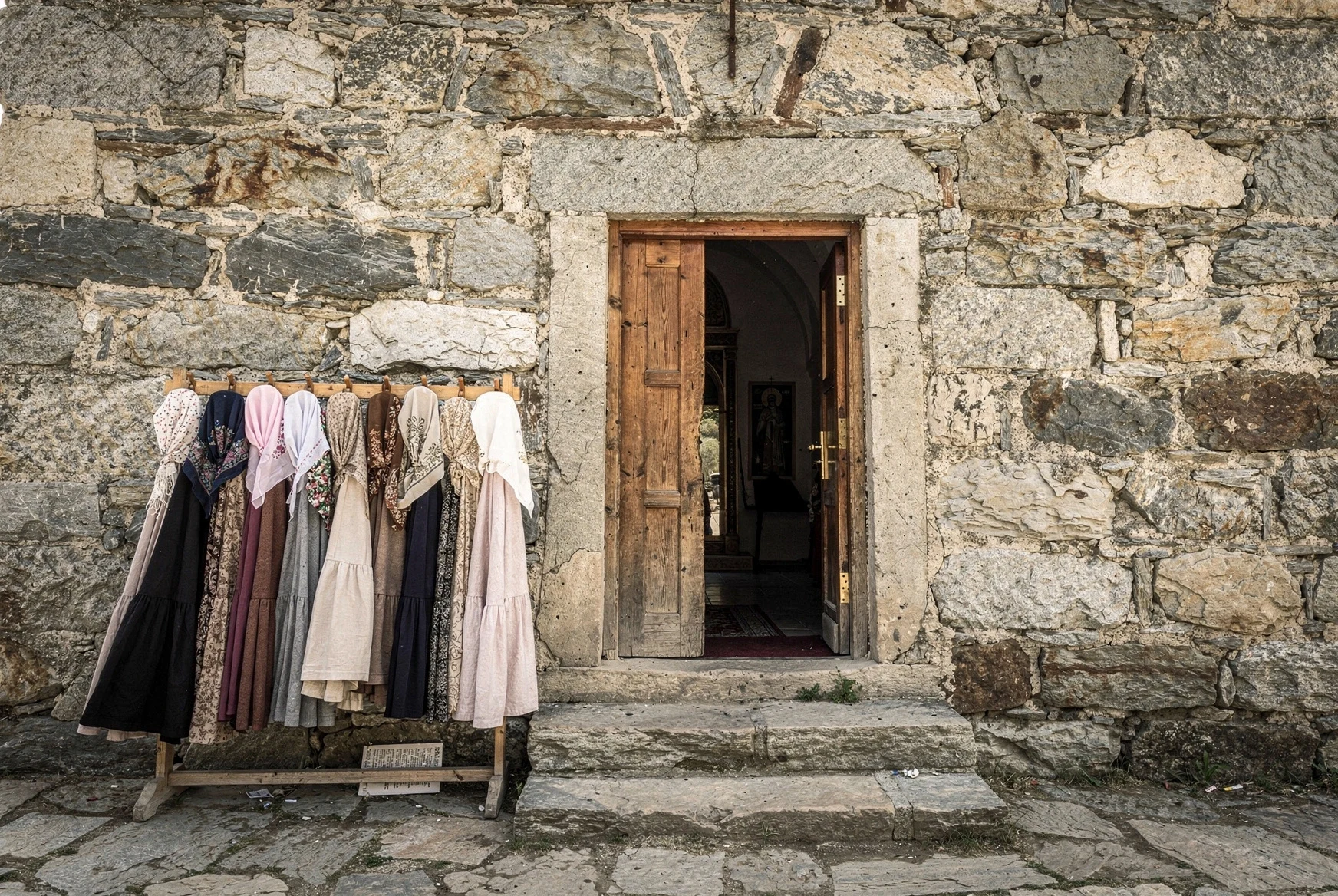
Many of Georgia's most-visited churches keep a rack of spare headscarves and wrap skirts by the entrance. You tie the skirt around your waist over your trousers, throw the scarf over your head, go inside, and return them when you leave. It is a very practical system and one of those quietly useful local realities the internet tends to dramatize.
But don't rely on it blindly. Supplies may be limited, weather-beaten, missing, or simply not there that day. Smaller monasteries are less predictable. Busy places can run out. Some visitors are also understandably not thrilled about using a communal scarf in peak summer heat.
If you know you're going to visit multiple churches, bringing your own scarf is just easier. A light cotton scarf weighs nothing and saves the whole ritual of hunting for the least alarming shared one on a hook.
The biggest mistakes tourists make
Most church mistakes in Georgia are not malicious. They are just very obvious.
Mistake one: assuming every church is basically a museum. It isn't. Somebody may be praying, crossing themselves, lighting candles for the dead, or attending part of a service. The fact that you arrived from a day trip van does not magically change that.
Mistake two: treating the entrance basket like the whole solution. If you are wearing something fundamentally inappropriate, one borrowed scarf does not turn a club outfit into respectful attire.
Mistake three: talking at normal volume. Georgian church interiors are often small, stone, and echo-heavy. Whispering is enough. Full tourist briefing voice is too much.
Mistake four: walking everywhere without watching locals. Orthodox churches have spatial logic. There are places where people stand, pray, kiss icons, and light candles. If you are unsure what to do, stop and observe for thirty seconds. That alone prevents half the awkwardness.
Mistake five: flash photography. It looks bad. It feels rude. It is often prohibited. Ancient frescoes have had a difficult enough millennium already.
Mistake six: entering during an active service and trying to behave like it's a sightseeing slot. If liturgy is happening, move quietly, stay to the side or back, keep the phone away, and do not drift around as if you are scanning an Airbnb.
The grandmother rule
If an older Georgian woman near the entrance gestures that you need a scarf, longer skirt, quieter voice, or a different candle tray, just follow the instruction. She may not work there officially. That changes nothing.
Candles: how they work without making it weird
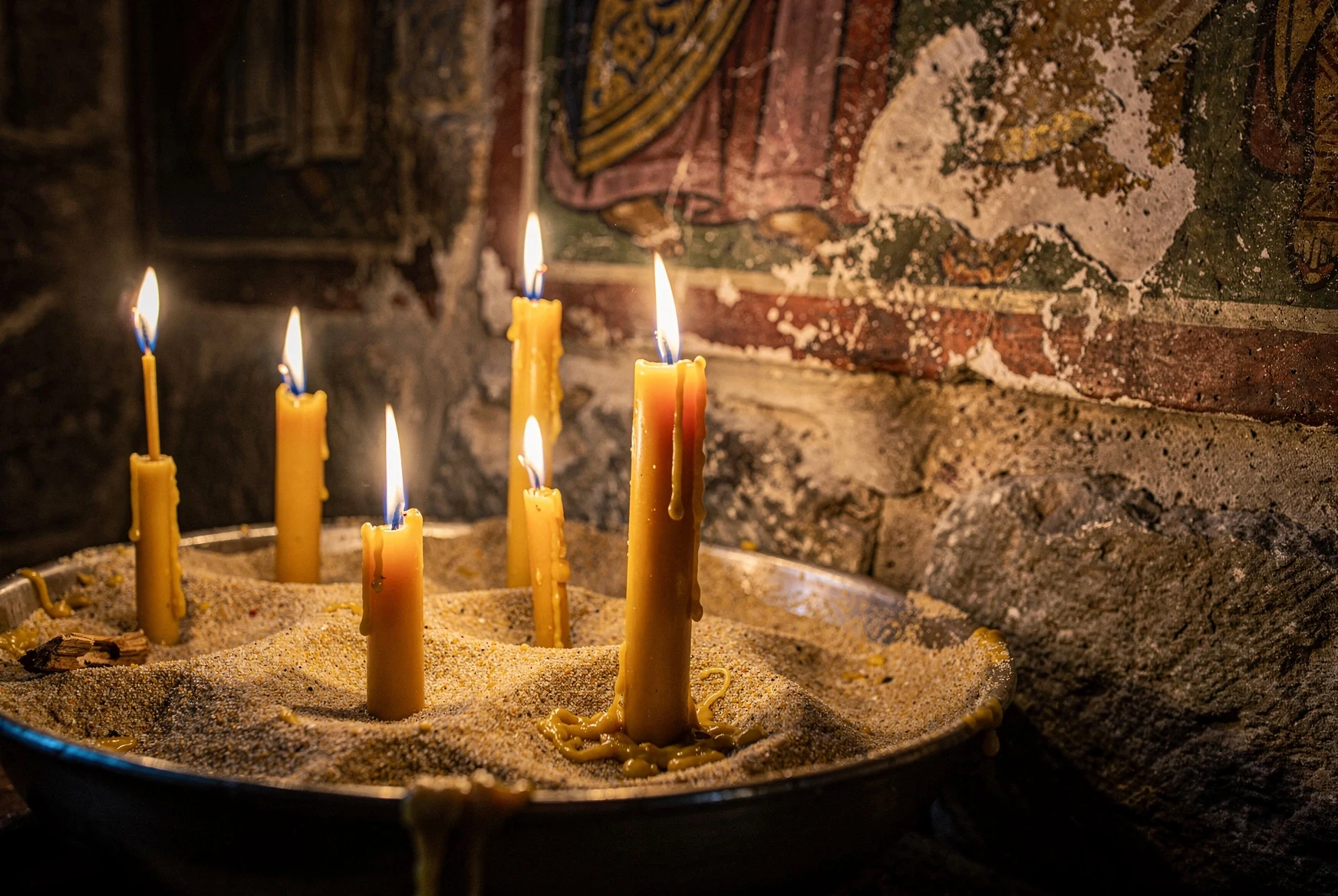
Lighting candles in Georgian churches is common, and visitors are usually welcome to do it. Small beeswax candles are often sold near the entrance for a token amount. Sometimes a box is there with no clear system and you just leave coins. Georgia can be charmingly analog like that.
The main point to know is that there may be separate places for candles for the living and candles for the dead. This matters more to believers than it may seem to a tourist, so don't freestyle it.
| Situation | What to do |
|---|---|
| You see two candle trays | Watch locals first. One is usually for the living and one for the dead. |
| You are unsure which tray is which | Ask quietly or wait and copy what locals do rather than guessing confidently. |
| The candle will not stay lit | Nobody is judging you spiritually. Try again and move on. |
| You do not want to participate | That is completely fine. Just stand respectfully and observe. |
You do not need to cross yourself or imitate Orthodox rituals if that is not your tradition. Respect matters more than performance. Nobody needs you improvising theology under pressure.
Photos and phone etiquette
Outside: usually fine. Inside: maybe. During services: mostly no, or at least very much not advised.
Some Georgian churches are relaxed about interior photos as long as there is no flash. Others have clear signs or staff indicating no photos. Sometimes there is no sign, but the mood still says no. If a church is quiet and active, and worshippers are praying nearby, it is smarter to skip the photo than to test the boundaries.
What definitely looks bad:
Do
Silence your phone, take one or two quiet non-flash shots if clearly allowed, and put the device away quickly.
Don’t
Talk on speakerphone, film yourself narrating, use flash, or block people trying to pray because you need the perfect candle photo.
There is also a practical reason not to overdo photography: many Georgian churches are dark inside. Your phone photo will often be mediocre anyway. Sometimes the best move is to look properly, then take the exterior shot later.
What if you arrive dressed wrong?
First: don't panic. This is not a criminal event. It is a clothing problem.
If there are scarves and wrap skirts available, use them. If not, decide quickly whether adjusting with what you have is realistic. Maybe your shawl can cover shoulders. Maybe you have a scarf in the bag. Maybe you do not, and this one church becomes an exterior-only visit.
The mistake is not being underprepared. The mistake is insisting on entry like the rules are unreasonable and should bend around your day trip. Georgia is many things, but it is not especially interested in lecturing its monasteries into modern tourist policy.
On a practical level, if you are spending a day around places like Mtskheta, Kakheti monasteries, Gergeti, Bodbe, Alaverdi, or Gelati, just dress for church compatibility from the beginning. It removes friction and makes the day smoother.
Services, monks, and nuns: how to behave when the place is clearly active
Some Georgian churches feel semi-touristic. Others very clearly do not. If you arrive and hear chanting, see clergy moving through incense smoke, or notice worshippers kissing icons in a slow line, that is your cue that you are entering active religious space, not casual sightseeing mode.
In those moments:
Good behavior
Stand quietly near the edge, move slowly, wait before taking any photo, and leave if your presence feels intrusive.
Bad behavior
Walking through the middle, chatting, staring at monks like they are performers, or trying to get clever close-up videos of prayer rituals.
Monks and nuns in Georgia are often polite but not there for your travel content. Some may answer simple questions outside a service. Some will not. Don't push it. This is one of those places where restraint earns more respect than enthusiasm.
Best pack list for church-heavy days
If you're planning a day built around monasteries, sacred sites, or a road trip with multiple church stops, bring these:
For women
Light scarf, long skirt or easy church-appropriate outfit, water, and a layer for mountain wind or cooler interiors.
For men
Lightweight trousers, shirt with sleeves, hat for outside but not inside, and enough patience for slow, respectful stops.
The deeper trick is not just packing the right items. It is planning the day so you are not doing frantic costume changes in dusty parking lots while your driver waits.
Which churches tend to be stricter?
There is no perfect national strictness map, but some patterns are real.
Convents tend to be stricter than large urban cathedrals. Remote active monasteries tend to be stricter than heavily touristed landmarks. Places known for pilgrimage, such as Bodbe, can be more conservative in atmosphere than visitors expect from the guidebook photos. Major cathedrals in busy areas may be more flexible simply because they deal with a constant stream of outsiders.
The practical conclusion is not to memorize a list. It is to assume stricter rules whenever a site feels more devotional than touristic. If you are prepared for the stricter end of the range, you are fine everywhere.
Frequently asked questions
Can women wear trousers in Georgian churches?
Sometimes yes, sometimes not. In stricter churches, women in trousers may still be expected to tie a wrap skirt over them. If you want the low-friction option, wear or carry something that covers the legs in a clearly modest way.
Do women always need a headscarf?
Not always enforced, but often expected. At more conservative monasteries it is best to assume yes. Carrying a scarf is the easiest solution.
Can men wear shorts if it is very hot?
That is the exact situation in which men keep trying to wear shorts, and the answer is still generally no. Choose light trousers instead.
Can non-Christians go inside?
Yes. Visitors of any background are generally welcome as long as they behave respectfully and follow the dress expectations.
Can I take photos inside Georgian churches?
Sometimes, but not always. No flash. No photos during services unless it is clearly acceptable. When uncertain, skip it or ask quietly.
What if I only want to look quickly?
The rules do not soften because your visit is brief. If you are going inside, go in properly.
Bottom line
Georgian church etiquette is not mysterious once you strip away the forum drama. Dress modestly. Women should expect to cover hair, shoulders, and knees in many churches. Men should wear long trousers and uncover their heads. Keep your voice down. Don't over-photograph active worship. Follow local cues when candles or movement patterns are unclear.
That is really it.
If you do those things, church visits in Georgia become much better. You stop worrying about whether you are offending someone and start actually noticing the place: the old stone, the smoke-darkened icons, the chant drifting through the nave, the way religion here is still lived rather than staged for visitors.
And that, frankly, is more interesting than another rushed exterior photo ever was.
Written by The Georgian Guide Team
After years of visiting churches and monasteries across Georgia, we've learned that the actual rules are less theatrical than the internet makes them sound and more practical than first-time visitors expect. This guide is built from real on-the-ground church days, not copy-pasted etiquette fluff.
Last updated: March 2026.
Related Articles
Churches & Monasteries in Georgia
The major sacred sites, what matters, and how to plan your visits well.
Georgian Culture & Etiquette
The wider social rules around hospitality, homes, greetings, and everyday behavior.
Mtskheta Guide
The easiest high-value church day trip from Tbilisi, with Jvari and Svetitskhoveli.
Kazbegi & Stepantsminda Guide
For Gergeti Trinity Church, mountain weather, and one of Georgia's iconic church settings.