Mtskheta is where Georgia began. Not metaphorically — literally. This small town 25 kilometers north of Tbilisi was the capital of the Iberian Kingdom from the 3rd century BC, and it's where Christianity arrived in Georgia in 337 AD. It has been continuously inhabited for roughly 3,000 years. UNESCO listed its monuments in 1994. Georgians call it the "Second Jerusalem." Every guidebook says you have to visit. For once, the guidebooks are right.
But here's the thing most visitors get wrong: they spend 90 minutes here. They arrive on a tour bus, snap photos of Svetitskhoveli Cathedral, buy churchkhela from a street vendor, and leave. Mtskheta deserves more than that. Not because it's massive — the old town is walkable in 20 minutes — but because its significance runs so deep that rushing through it is like speed-reading the first chapter of a 3,000-year-old book.
This guide covers everything: the major monuments, the hidden ones, how to actually get here without overpaying, where to eat, and the honest truths about visiting — including why you probably don't need a full day.
Quick Facts
Why Mtskheta Matters
To understand Georgia, you have to understand Mtskheta. This isn't tourist-board hyperbole. Mtskheta was the capital of the Kingdom of Iberia (Kartli) — not to be confused with the Iberian Peninsula — from around the 3rd century BC until King Dachi moved the capital to Tbilisi in the 5th century AD. Even after losing its political role, Mtskheta remained the spiritual heart of Georgia. The head of the Georgian Orthodox Church, the Catholicos-Patriarch, was based here for centuries. Major coronations and royal burials happened here.
The big moment came in 337 AD (some sources say 326), when Saint Nino converted King Mirian III and Queen Nana to Christianity, making Georgia one of the first countries in the world to adopt it as a state religion. That conversion happened here, in Mtskheta. Svetitskhoveli Cathedral was built on the spot where Georgia's most sacred relic — the Robe of Christ — is said to be buried.
So when Georgians say this place is sacred, they mean it on a level that's hard to overstate. This is their Canterbury, their Vatican, their Jerusalem — except it's all crammed into a town of about 8,000 people next to a highway.
What to See
Jvari Monastery
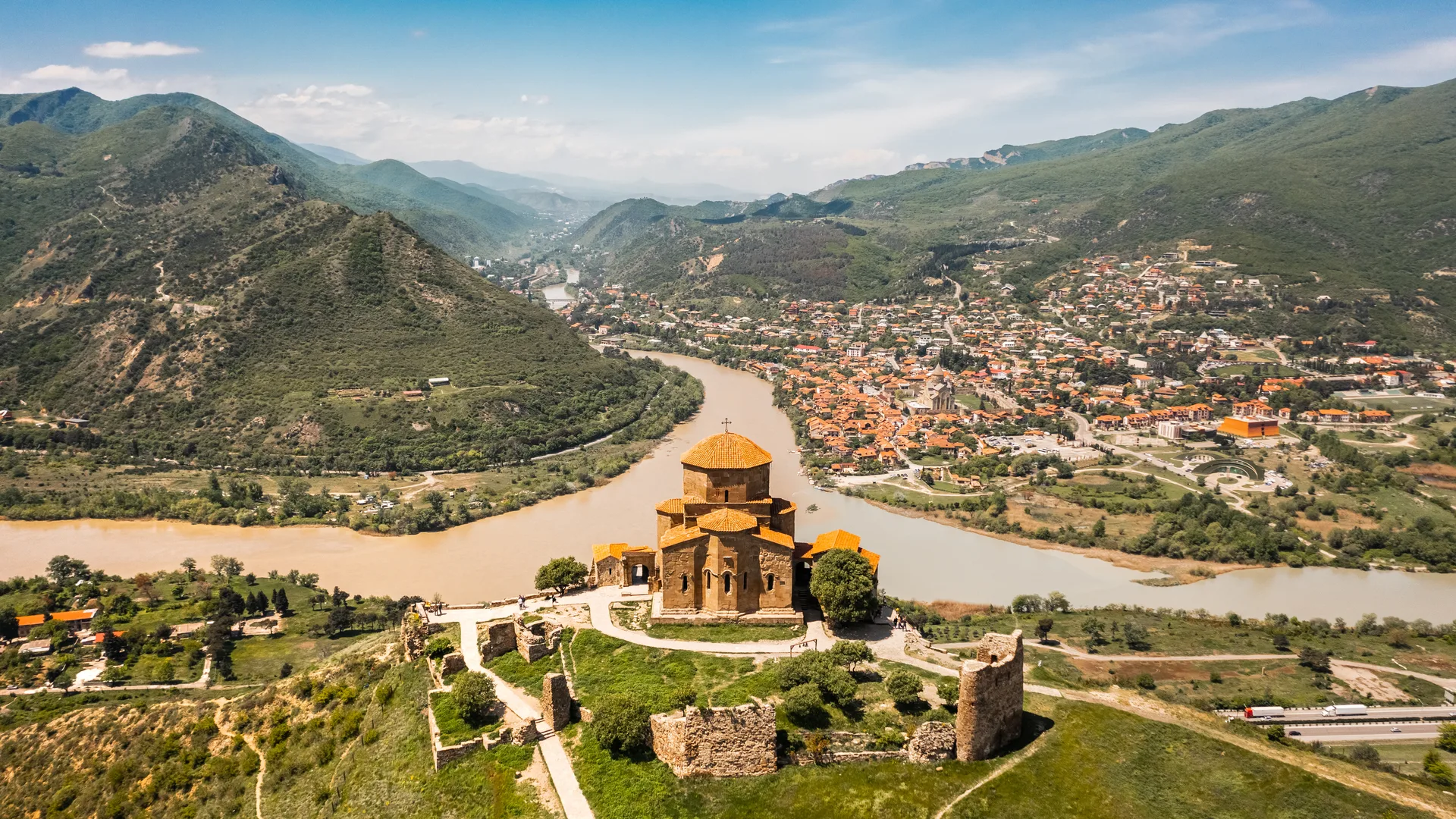
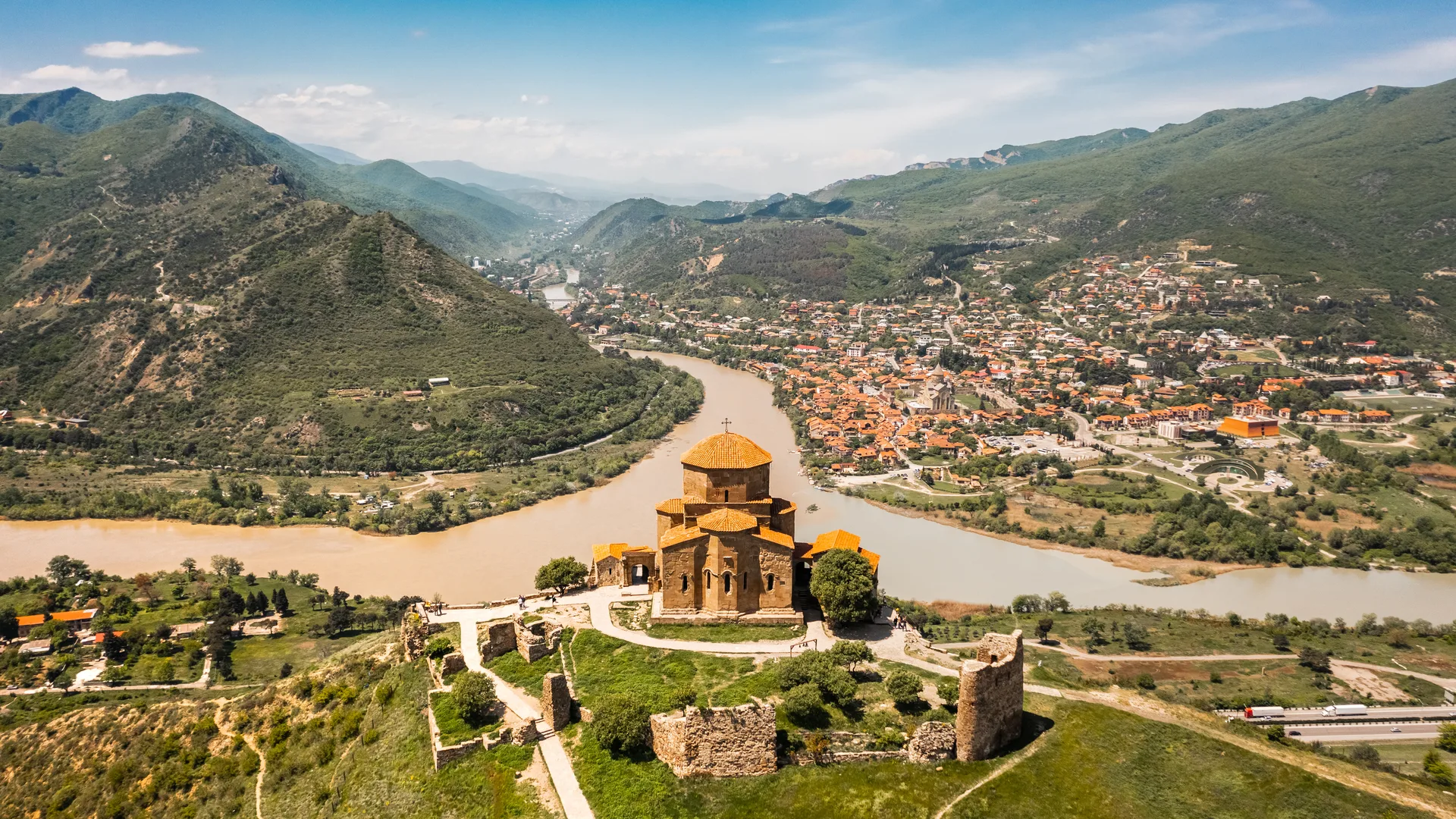
Start here. Jvari sits on a rocky hilltop above Mtskheta, right where the Aragvi and Mtkvari (Kura) rivers meet. The 6th-century monastery — built between 585 and 604 AD — is one of the earliest examples of the Georgian cross-dome architectural style that influenced church building across the Caucasus for centuries. It's a compact, austere building. No frescoes, no gold. Just stone, light, and a wooden cross inside marking the spot where Saint Nino supposedly erected the first cross in Georgia.
The real draw is the view. From Jvari's terrace, you look straight down at the river confluence — the pale green Aragvi meeting the brown Mtkvari — with Mtskheta and Svetitskhoveli spread out below. On a clear day, with the Caucasus foothills in the background, it's one of the best views in Georgia. The Russian poet Lermontov wrote about it in 1839. It hasn't changed much.
Getting to Jvari
Jvari is 4 km from Mtskheta's center, up a winding road with no sidewalk. You can't walk it comfortably. Take a taxi (10–15 GEL round trip with a 15-minute wait), go with a tour, or drive. There's no public transport to Jvari itself.
Svetitskhoveli Cathedral
Svetitskhoveli is the big one. The current cathedral dates to the 11th century (built 1010–1029 by architect Arsukidze), but a church has stood on this site since the 4th century. The name means "Life-Giving Pillar" and refers to a legend about a cedar tree that grew from the spot where Christ's robe was buried, producing a miraculous healing liquid. You'll see a small stone structure inside the cathedral that marks the pillar's supposed location.
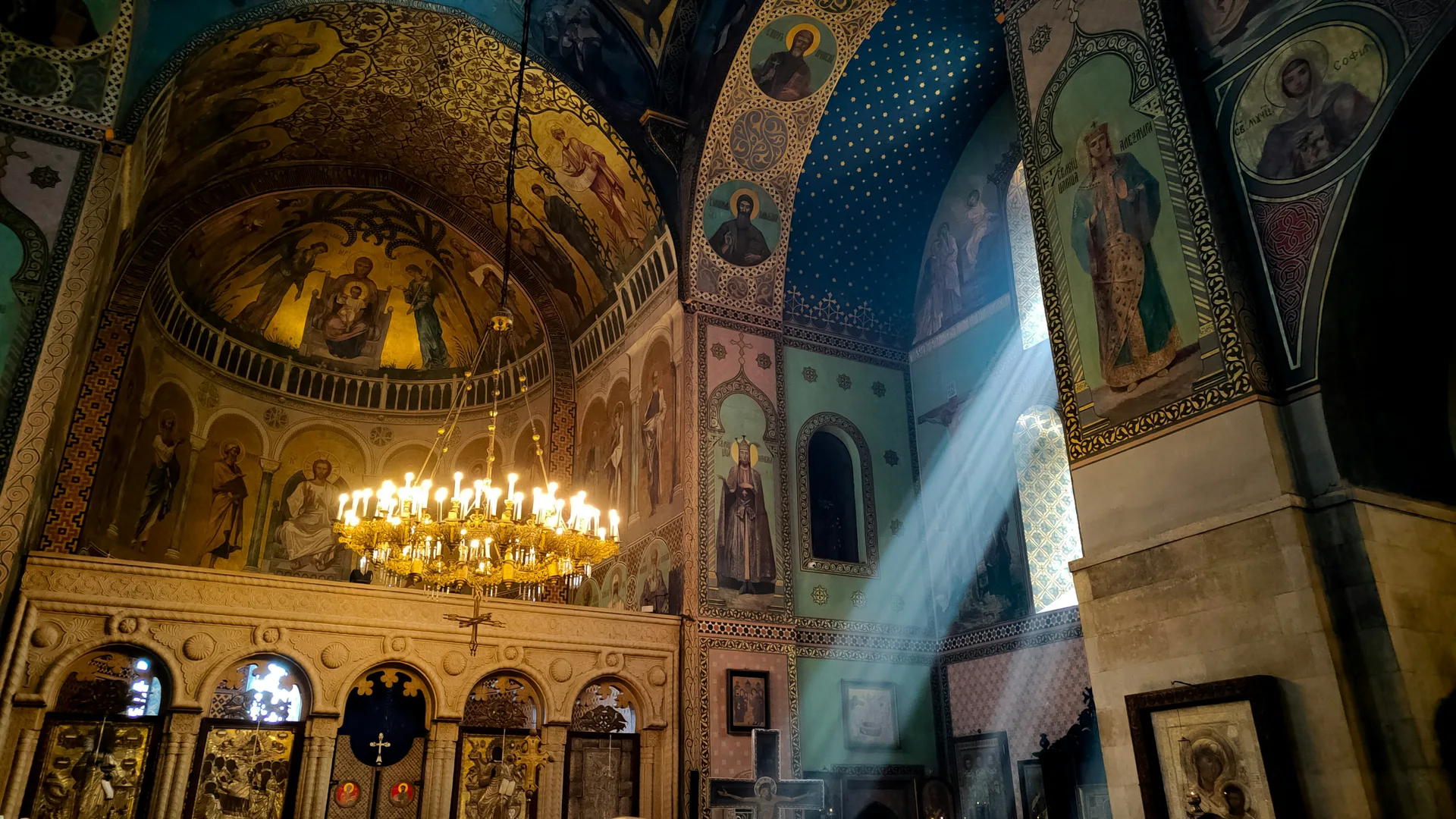
The cathedral is enormous by Georgian standards — one of the largest historical churches in the country. The interior is dim, covered in frescoes (some original, many repainted in the 19th century), with a zodiac wheel on the floor near the entrance that catches everyone's eye. Look for the carved bull's head on the eastern facade — legend says the architect's hand was cut off by his jealous master, who didn't want anyone to know a student had surpassed him.
Svetitskhoveli remains an active cathedral. The Catholicos-Patriarch still conducts major services here. If you visit on a Sunday or religious holiday, expect crowds.
Samtavro Monastery
Five minutes' walk from Svetitskhoveli, Samtavro is where Saint Nino lived and prayed during her time in Mtskheta. The complex includes a large church (11th century, rebuilt multiple times) and a small 4th-century chapel — one of the oldest surviving structures in Georgia. The tombs of King Mirian III and Queen Nana are inside. It's a working convent, much quieter than Svetitskhoveli, and you'll often have the courtyard to yourself. The blackberry bush in the churchyard is said to be descended from the one under which Saint Nino prayed.
Bebris Tsikhe (Fortress Ruins)
Walking north from Samtavro along the river, you'll reach the ruins of Bebris Tsikhe, a medieval fortress that once guarded the northern approach to Mtskheta. It's partially collapsed and there's no entry fee or signage. The walk is pleasant and the ruins give you an elevated view of the town, but don't expect a restored fortress — this is atmospheric rubble.
Antioch Bridge Ruins
Near the river confluence, look for the remains of an ancient stone bridge. These partially submerged pillars date back centuries and are visible from several viewpoints around town. Not a must-see, but a nice detail if you're walking along the river.
Things Most Guides Don't Tell You
Dress code is enforced
Both Svetitskhoveli and Jvari require covered shoulders and knees. Women need head coverings. Free wraps are available at entrances, but they're shared and not always clean. Bring your own scarf (see our packing guide).
The souvenir gauntlet
The street between Svetitskhoveli and the parking area is lined with stalls selling churchkhela, wine horns, fridge magnets, and honey. Prices are tourist-inflated. Churchkhela is fine to buy here — it's the same everywhere — but save wine and crafts for Tbilisi.
Photography restrictions
Photography is technically allowed inside the churches but flash is prohibited. During services, put your camera away — this is an active place of worship, not a museum. Be respectful and read the room.
It's hotter than Tbilisi
Mtskheta sits in a valley with little shade. In summer (June–August), temperatures easily hit 38°C+. The churches are cool inside, but walking between sites is brutal. Morning visits are strongly recommended.
No entrance fees
All churches and monasteries in Mtskheta are free to enter. No tickets, no reservations. This applies to Jvari, Svetitskhoveli, and Samtavro. The only cost is getting there.
Tour buses peak at 11am
Large groups from Tbilisi arrive between 10am and 1pm. If you come on your own, arrive by 9am or after 3pm. The difference in crowd levels is dramatic.
Getting to Mtskheta from Tbilisi
Mtskheta is close enough to Tbilisi that getting there is almost trivially easy. The tricky part is Jvari Monastery — it's up a separate hill with no public transport.
| Option | Duration | Cost | Notes |
|---|---|---|---|
| Marshrutka | 20–30 min | 1.50 GEL | From Didube station. Leaves when full. Frequent all day. Drops you at Mtskheta center. |
| Taxi (Bolt/Maxim) | 20–25 min | 15–25 GEL | Door to door. Can negotiate a round trip including Jvari for 40–60 GEL. |
| Day tour | Half day | 60–120 GEL | Usually combined with Jvari. Some include Gori/Uplistsikhe. A guide makes a real difference here. |
| Driving | 20 min | Fuel only | Easy highway drive. Free parking at Svetitskhoveli and at Jvari. |
The Jvari Problem
The marshrutka drops you in Mtskheta town, not at Jvari. If you want to see Jvari (you should), either take a taxi from Mtskheta center (10–15 GEL round trip), book a tour that includes both, or drive yourself. Walking to Jvari is technically possible but involves a 4 km uphill road with no sidewalk and fast-moving traffic. Don't do it.
Suggested Half-Day Itinerary
Most people visit Mtskheta as a half-day day trip from Tbilisi, and that's genuinely enough time. Here's an efficient route:
Jvari Monastery (9:00 AM)
Start here for the best light and smallest crowds. Spend 30–45 minutes. The view of the river confluence in morning light is the best you'll get all day.
Svetitskhoveli Cathedral (10:00 AM)
Drive or taxi down to the town center. Explore the cathedral interior — frescoes, zodiac wheel, the Life-Giving Pillar. Allow 45 minutes to an hour.
Samtavro Monastery (11:00 AM)
Walk five minutes from Svetitskhoveli. Quieter, more intimate. See Saint Nino's chapel and the royal tombs. 20–30 minutes.
Lunch + Stroll (11:30 AM)
Eat at one of the restaurants near Svetitskhoveli, wander the souvenir street, grab churchkhela. Back in Tbilisi by 1pm.
Combine with Gori and Uplistsikhe
Many tours combine Mtskheta with Gori (Stalin Museum) and Uplistsikhe (ancient cave city), making a full-day western Georgia trip. It's a lot of driving but covers three of Georgia's most important historical sites in one shot. If you're renting a car, this is a great road trip day.
When to Visit
| Season | Weather | Crowds | Notes |
|---|---|---|---|
| Spring (Apr–May) | 15–25°C, occasional rain | Moderate | Best overall. Green hills, comfortable walking. |
| Summer (Jun–Aug) | 30–40°C, dry | Heavy | Brutally hot. Go early morning. Peak tourism season. |
| Autumn (Sep–Nov) | 12–25°C, golden light | Moderate | Beautiful autumn colors. October 14 = Svetitskhovloba festival. |
| Winter (Dec–Mar) | 0–10°C, grey skies | Low | Quiet and atmospheric. Christmas (Jan 7) brings pilgrims. |
Where to Eat
Mtskheta has a handful of restaurants near Svetitskhoveli. None are exceptional by Tbilisi standards, but a couple are decent. The tourist-trap factor is real here — some restaurants bank on captive audiences. Stick to places where locals eat too.
| Restaurant | What to Order | Budget | Notes |
|---|---|---|---|
| Salobie | Lobio, mchadi, churchkhela | 10–20 GEL | Classic Georgian menu, garden seating. The original branch is a Tbilisi institution. |
| Old Tavern Mtskheta | Khinkali, mtsvadi, salads | 15–30 GEL | Garden restaurant near Samtavro. Good for a sit-down lunch. |
| Street vendors | Churchkhela, bread, honey | 2–5 GEL | Churchkhela here is fine. Skip the mass-produced souvenirs. |
Honest take on Mtskheta dining
You're 20 minutes from Tbilisi, which has some of the best restaurants in the Caucasus. If food is a priority, eat a quick bite in Mtskheta and save your appetite for dinner in the city. The restaurants here are fine, not special.
A Brief History
Mtskheta's history reads like a compression of the entire Caucasus timeline:
| Period | What Happened |
|---|---|
| ~1000 BC | Settlement established at the river confluence. Strategic location for trade and defense. |
| 3rd century BC | Becomes capital of the Kingdom of Iberia (Kartli) under King Parnavaz I. |
| 337 AD | Saint Nino converts King Mirian III. Christianity becomes state religion. Georgia is among the first nations to adopt it. |
| 5th century | King Dachi moves the capital to Tbilisi. Mtskheta retains religious importance. |
| 585–604 AD | Jvari Monastery built on the hilltop above the rivers. Becomes a masterpiece of early Georgian architecture. |
| 1010–1029 | Current Svetitskhoveli Cathedral built by architect Arsukidze, replacing earlier structures. |
| 1994 | UNESCO inscribes the Historical Monuments of Mtskheta as a World Heritage Site. |
Budget Breakdown
Half-Day Mtskheta Trip (per person)
One of the cheapest day trips in Georgia
Mtskheta is one of the most affordable outings you can do from Tbilisi. No entrance fees, cheap transport, and reasonable food prices make it accessible on any budget. Even a taxi for the full trip rarely exceeds 60 GEL.
Common Mistakes
Skipping Jvari
Some visitors only see Svetitskhoveli. Jvari is harder to reach without a car, but the view alone makes it the highlight. Don't skip it.
Going at midday in summer
The valley traps heat. By noon in July, you'll be miserable. Go early, leave by lunch.
Not bringing a head covering
Churches provide wraps, but they're well-used. A lightweight scarf in your bag saves the awkwardness.
Spending a full day
Unless you're deeply into church architecture, 3–4 hours is genuinely enough. Half a day is the sweet spot. Don't force it.
Overpaying for a taxi
Drivers at Svetitskhoveli parking lot quote 40+ GEL to Jvari. Use Bolt or negotiate before getting in. 10–15 GEL round trip is fair.
Expecting a big city
Mtskheta is a small town. The "old town" is a few streets. The value is historical and spiritual, not architectural variety. Calibrate expectations.
Frequently Asked Questions
How long do you need in Mtskheta?
3–4 hours covers all the major sites with time for lunch. A half-day trip from Tbilisi is the sweet spot.
Is Mtskheta worth visiting?
Absolutely. It's Georgia's most historically significant site, a UNESCO World Heritage location, and only 25 minutes from Tbilisi. Don't skip it.
How do you get from Tbilisi to Mtskheta?
Marshrutka from Didube station (1.50 GEL, 20–30 min), taxi via Bolt (15–25 GEL), or day tour (60–120 GEL including Jvari).
Can you walk to Jvari Monastery?
Not recommended. It's 4 km uphill on a road with no sidewalk and fast traffic. Take a taxi (10–15 GEL round trip).
Is there an entrance fee?
No. All churches and monasteries in Mtskheta are completely free. No tickets, no reservations.
Written by The Georgian Guide Team
We've visited Mtskheta across all seasons and can confirm: the river confluence view from Jvari in morning light is worth the early start. Based in Tbilisi, we write from repeated visits and lived experience in Georgia.
Last updated: February 2026.
Related Articles
Tbilisi First-Timer's Guide
Everything you need for your first visit to Georgia's capital.
Best Day Trips from Tbilisi
The best excursions within easy reach of the capital.
Kazbegi (Stepantsminda) Complete Guide
Georgia's most iconic mountain town and Gergeti Trinity Church.
Georgian Wine Culture
8,000 years of winemaking and the qvevri tradition.