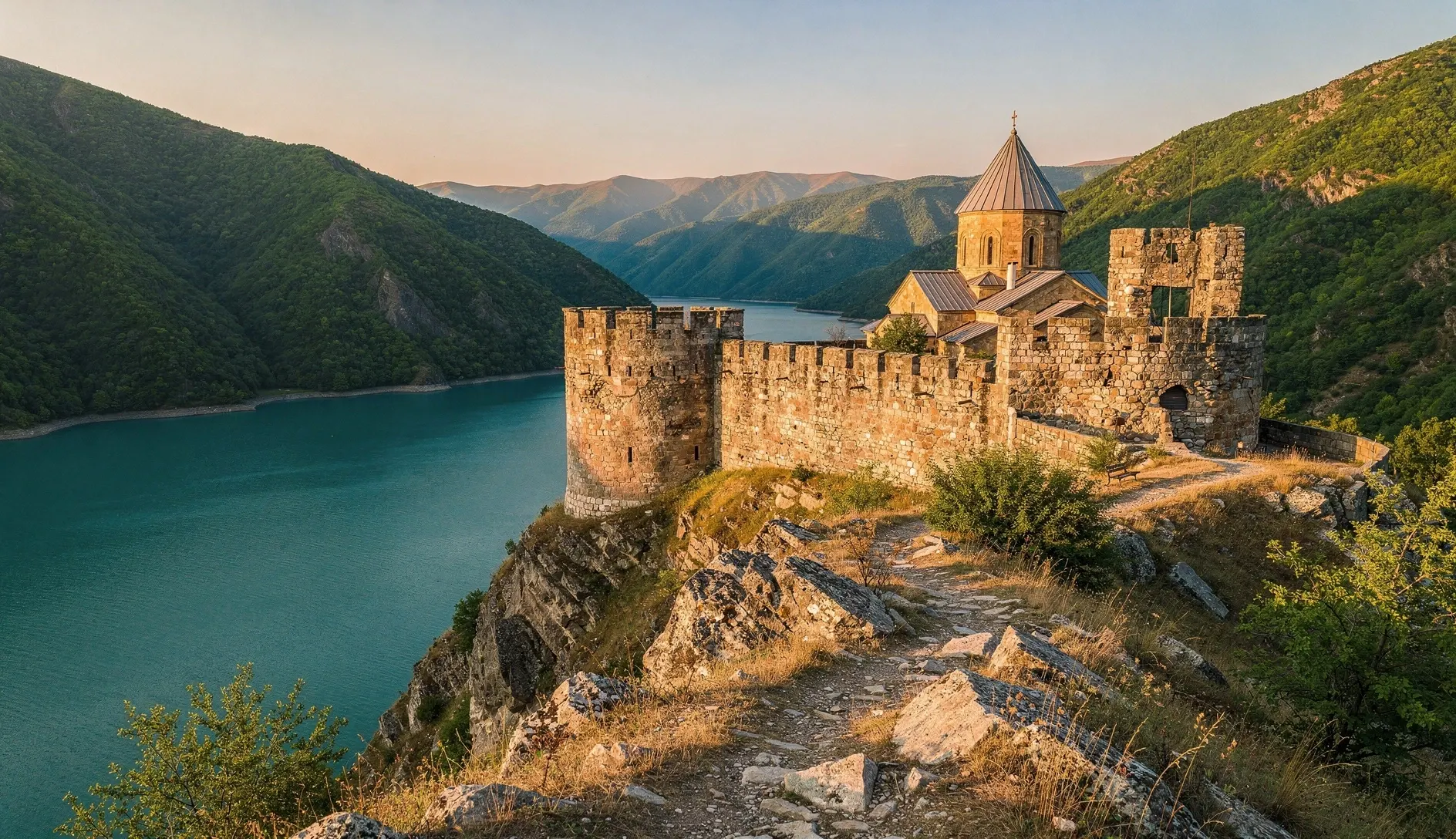
You'll stop at Ananuri whether you planned to or not. It sits right on the Georgian Military Highway about 70 kilometers north of Tbilisi, and every marshrutka driver, tour guide, and rental car GPS treats it as the mandatory first pull-over on the way to Kazbegi. The fortress appears on your right, the turquoise Jinvali Reservoir stretches out behind it, and suddenly everyone's out of the car taking photos. Fair enough — it's genuinely stunning.
But most visitors spend fifteen minutes here, snap some photos from the parking lot, and leave. Which is a shame, because Ananuri has a bloody, fascinating history involving massacres, secret tunnels, rival dukes, and a woman who chose death over betrayal. The fortress itself rewards a proper look — the carved facades are some of the finest medieval stonework in Georgia, and climbing the main tower gives you one of the best views on the entire highway.
This guide covers everything: what you're actually looking at, the history behind it, practical logistics, and why you should give it more than a quick photo stop.
Quick Facts
Why Ananuri Is Worth More Than a Photo Stop
There are two types of visitors at Ananuri: the ones who circle the parking lot, take a photo with the reservoir behind them, and get back in the car — and the ones who actually walk through the gate. Be the second type.
The fortress complex contains two churches, a defensive tower you can climb, carved facades that took decades to complete, and fragments of frescoes that somehow survived a fire that killed nearly everyone inside. It's compact enough to explore in 45 minutes to an hour, but rich enough that you'll keep noticing details — a carved angel here, an inscription there, a cannonball scar in the wall that makes the 1739 massacre suddenly feel very real.
And then there's the reservoir. The Jinvali (sometimes spelled Zhinvali) Reservoir was created in the 1980s when the Aragvi River was dammed for hydroelectric power. It drowned several villages in the process — a fact the Soviet authorities didn't lose much sleep over. What remains is an impossibly turquoise body of water that makes the fortress look like something from a fantasy novel. The color comes from glacial minerals washing down from the Greater Caucasus, and it's most vivid on sunny days between May and September.
The Bloody History of Ananuri
Ananuri was the seat of the Aragvi Eristavis — feudal dukes who controlled this stretch of the Aragvi Valley from roughly the 13th century. Think of them as medieval Georgian warlords: powerful enough to build fortresses, pious enough to build churches, and violent enough to need both.
The fortress you see today was constructed over the 16th and 17th centuries, though the site was fortified earlier. It consists of an upper and lower castle connected by a curtain wall. The upper castle — the part that survives — was the last line of defense. The lower castle is mostly rubble now, though you can still trace its outline.
The 1739 Massacre
The defining event in Ananuri's history is its fall in 1739. A rival dynasty — the Eristavis of Ksani, led by a duke named Shanshe — besieged the fortress. The Aragvi clan held out for a while, but eventually the attackers broke through. What followed was a massacre. The Aragvi Eristavis were wiped out almost entirely, and the fortress was set on fire. Those frescoes you'll see inside the Church of the Mother of God? Most of them were destroyed in that blaze. The fragments that survive are haunting precisely because of what's missing.
The Legend of Ana from Nuri
One of the more compelling legends about Ananuri involves how the fortress got its name. The story goes that during a siege, the defenders survived because a secret tunnel led to a water source — allowing them to resupply while the attackers waited outside the walls. Eventually, the besiegers captured a woman named Ana, who came from the village of Nuri. They tortured her to reveal the tunnel's location. She refused and was killed. Ana-Nuri became Ananuri.
Whether this is historically accurate or folk etymology, it's the story every Georgian knows. And standing inside the fortress walls, looking at the thickness of the stone, you can believe that secret passages existed. These places were built by people who expected to be attacked.
After the Fall
Four years after the massacre, local peasants revolted against the new rulers from Ksani and invited King Teimuraz II to take direct control. Another peasant uprising in 1746 required King Erekle II of Kakheti to help suppress it. The fortress saw action until the early 19th century, when the Russian Empire absorbed Georgia and rendered most medieval fortifications obsolete.
What to See Inside the Fortress
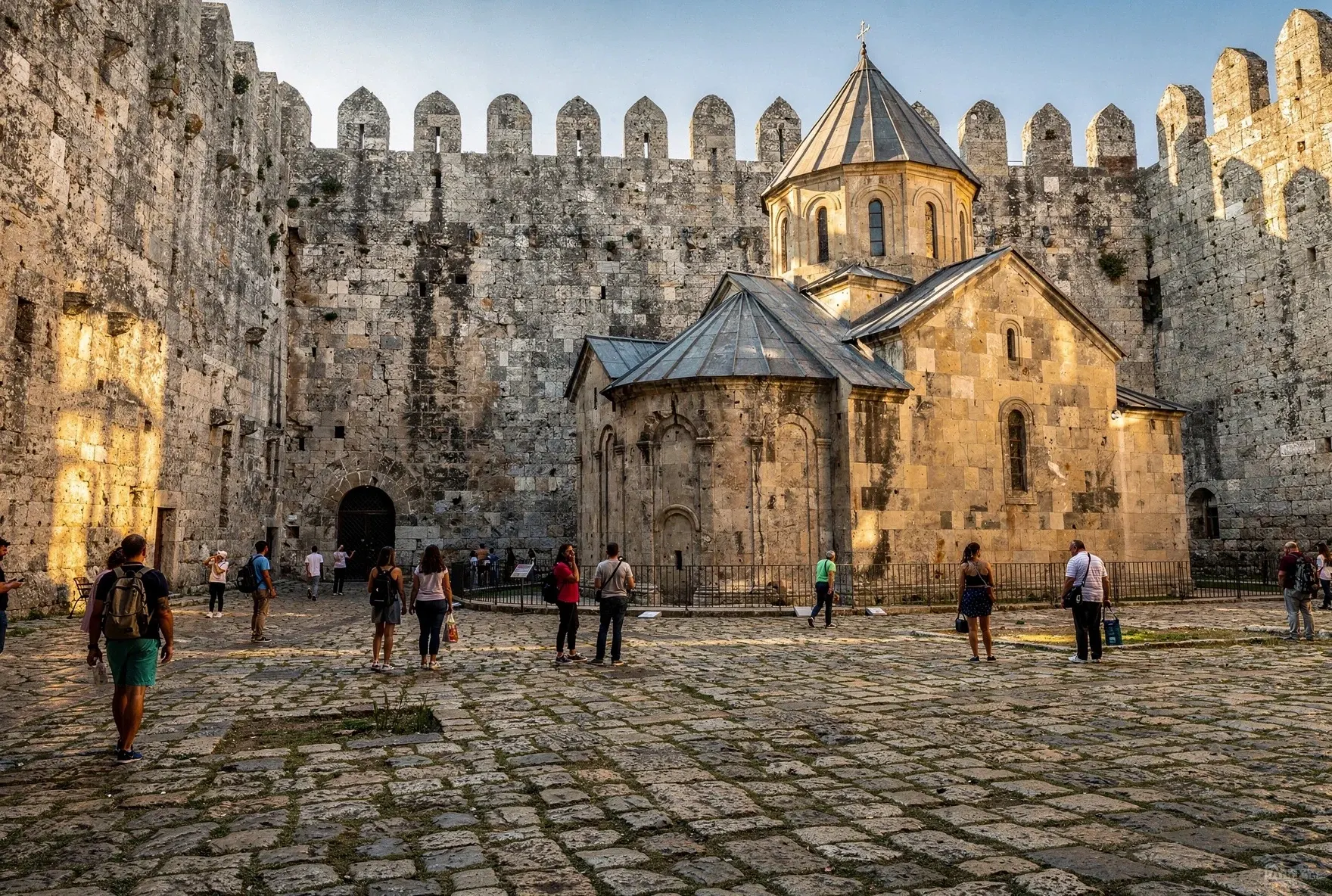
The complex is compact but dense. Here's what you're looking at as you walk through the gate.
Church of the Mother of God (Ghvtismshobeli)
This is the larger and more impressive of the two churches, built in 1689 by the son of Duke Bardzim. It's a classic Georgian central-dome design — look up inside and you'll see the drum and cupola rising above. The exterior is where the real artistry lives: the north entrance has elaborate carved stonework, and the south facade features a beautiful grapevine cross that's become one of the most recognizable motifs in Georgian architecture.
Inside, look for the surviving frescoes. They're fragmentary — most were destroyed in the 1739 fire — but what remains shows remarkable skill. You'll see traces of saints, biblical scenes, and decorative patterns, all rendered in muted colors that have somehow survived three centuries of smoke damage and neglect.
The Older Church of the Virgin
This smaller church, built in the first half of the 17th century, sits adjacent to the large square tower. It's less ornate than the Church of the Mother of God but arguably more atmospheric. Inside, you'll find the graves of several Aragvi Eristavis — the dukes who built this place and eventually died defending it. There's also a stone baldaquin (a canopy structure) erected by the widow of Duke Edishera, who died in 1674. It's a surprisingly personal touch in what's otherwise a military complex.
Sheupovari Tower
The large square tower — called Sheupovari, which translates roughly to "the unshakeable" — is the architectural centerpiece of the fortress. You can climb it. Do it. The narrow stone stairway is dark and slightly claustrophobic, but the view from the top is spectacular: the reservoir stretching north, the highway winding south toward Tbilisi, and the Caucasus foothills rolling in every direction. This is the money shot that most parking-lot photographers miss entirely.
Photography Tip
The best photos come from the top of Sheupovari Tower — you get the church domes in the foreground with the reservoir behind them. Late afternoon light (around 4–5 PM in summer) is ideal, as the sun hits the stone walls at a warm angle and the reservoir glows its deepest turquoise.
The Curtain Wall
The crenellated defensive wall connecting the two castles is worth walking along if you can access it. The battlement openings (the notches in the top of the wall) were designed for archers, and looking through them gives you a visceral sense of what defending this place must have been like. The wall also shows the different construction periods — newer stonework patching older sections, each layer representing a different generation of Aragvi dukes adding to the defenses.
The Jinvali Reservoir
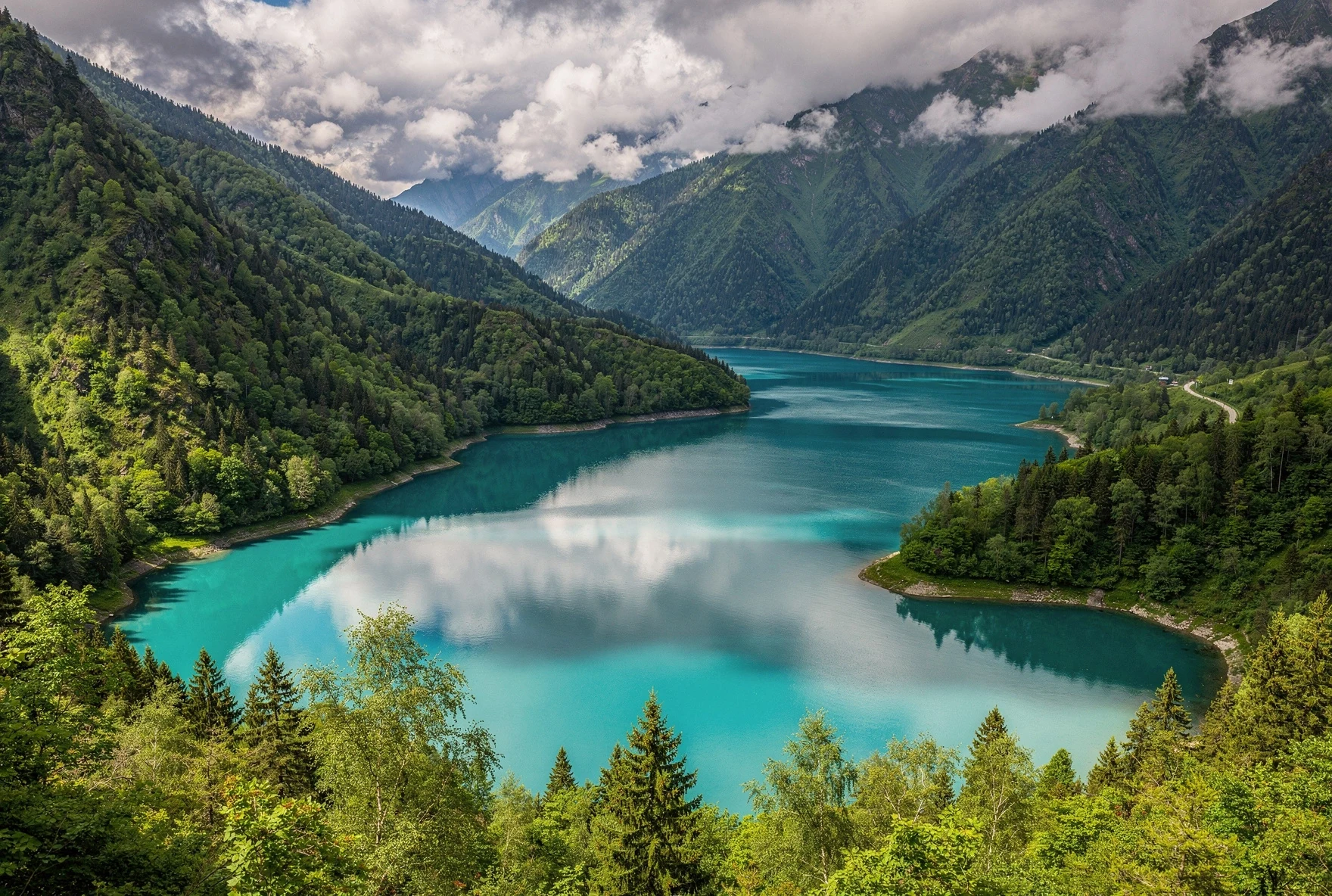
The reservoir that makes Ananuri's backdrop so spectacular didn't exist until the 1980s. The Jinvali Dam was built on the Aragvi River to generate hydroelectric power and supply water to Tbilisi. When the valley flooded, several villages disappeared beneath the water. On very dry years, you can sometimes see the remains of old structures emerging from the receding waterline — a ghostly reminder of what was sacrificed.
The water's striking turquoise color comes from suspended glacial sediments washed down from the high Caucasus. It's most vivid between May and September, especially on sunny days. In winter, it takes on a darker, moodier blue-gray that's beautiful in a completely different way.
Swimming in the Reservoir
Technically possible, and locals do it on hot summer days, but it's not an official swimming spot. The water is cold even in August (it's glacier-fed), and there are no lifeguards or facilities. If you do swim, stay close to shore — the reservoir is deep and the bottom drops off fast.
For kayaking or boat trips, a few informal operators have started offering tours on the reservoir in recent years. Ask around at the parking lot — pricing is negotiable and usually runs 30–50 GEL per person for a half-hour ride.
How to Get to Ananuri
Ananuri sits directly on the Georgian Military Highway (E60), making it one of the easiest fortress sites in Georgia to reach. It's 72 kilometers north of Tbilisi, just past the town of Zhinvali.
| Option | Duration | Cost | Notes |
|---|---|---|---|
| Rental car | ~1 hour | From 80 GEL/day | Best option. Free parking at the fortress. Combine with Kazbegi. |
| Private taxi | ~1 hour | 80–120 GEL round trip | Negotiate at Didube or via Bolt. Driver waits while you explore. |
| Kazbegi marshrutka | ~45 min | 5 GEL | Ask driver to drop you at Ananuri. Getting back requires flagging another marshrutka. |
| Guided day tour | Full day | 60–100 GEL | Usually combined with Kazbegi. Book via GetYourGuide or hotels. |
Marshrutka Strategy
If you take the marshrutka, your biggest challenge is getting back. These minibuses don't stop at Ananuri on a schedule — you'll need to stand by the highway and wave one down. They pass fairly frequently (every 30–60 minutes in peak season), but it's not guaranteed. A better plan: take a marshrutka toward Kazbegi, stop at Ananuri, explore, then flag a return marshrutka or share a taxi with other travelers in the parking lot.
Practical Tips
⏱️ Time Needed
30 minutes for a quick look, 45–60 minutes to explore properly, including the tower climb and both churches. Most tours allow 30–40 minutes, which is tight.
🕐 Best Time to Visit
Early morning (before 10 AM) or late afternoon (after 4 PM) to avoid tour bus crowds. The parking lot gets packed between 11 AM and 3 PM in summer.
👗 Dress Code
Both churches are active religious sites. Women should cover their heads (scarves available at the entrance), and shoulders/knees should be covered for both men and women.
🍽️ Food & Drink
A few stalls in the parking lot sell churchkhela, fruit, and drinks. The restaurant across the highway is basic but decent. For a proper meal, wait until Pasanauri (20 min north) — it's famous for khinkali.
| Season | Weather | Reservoir Color | Crowds |
|---|---|---|---|
| Spring (Apr–May) | Mild, occasional rain | Emerald green | Moderate |
| Summer (Jun–Aug) | Hot, sunny | Vivid turquoise | Heavy |
| Autumn (Sep–Nov) | Cool, golden foliage | Deep teal | Light |
| Winter (Dec–Mar) | Cold, possible snow | Blue-gray | Very light |
What to Combine Ananuri With
Nobody drives to Ananuri and back as a standalone trip. It's always part of a bigger day. Here are the most logical combinations:
Ananuri + Kazbegi
The classic. Continue 85 km north on the Georgian Military Highway to Kazbegi for Gergeti Trinity Church. Full day trip or overnight.
Ananuri + Gudauri
Stop at Ananuri on the way to Gudauri ski resort (winter) or for summer paragliding. 50 km further north.
Ananuri + Pasanauri
Continue 20 minutes north to Pasanauri, the khinkali capital of Georgia. Several roadside restaurants serve some of the best dumplings in the country.
Georgian Military Highway
Drive the full highway from Tbilisi to Kazbegi. Ananuri is the first major stop — followed by Pasanauri, the Cross Pass, and the Friendship Arch.
UNESCO Status
Ananuri has been on UNESCO's tentative list for World Heritage Site inclusion since 2007. That means Georgia has nominated it, but it hasn't yet been formally evaluated or inscribed. The fortress meets several criteria — it's a significant example of medieval Georgian fortress architecture, it has rich carved decoration, and the setting is exceptional.
Why hasn't it been inscribed yet? The process is slow, and Georgia has other sites in the pipeline. The Colchis Rainforests and Wetlands were inscribed in 2021, and Tbilisi's historic district is also being considered. Ananuri's tentative listing does provide some international recognition and helps justify conservation funding, but don't expect the UNESCO plaque anytime soon.
Common Mistakes
❌ Only Seeing It from the Parking Lot
The parking lot view is nice, but the fortress interior — the carved churches, the tower climb, the frescoes — is what makes Ananuri special. Walk through the gate.
❌ Visiting at Peak Hours
Between 11 AM and 3 PM in summer, the parking lot fills with tour buses. The fortress feels cramped. Come early or late for a completely different experience.
❌ Skipping the Tower
Sheupovari Tower is the best viewpoint at Ananuri. The stairway is narrow and dark, but the panorama from the top — reservoir, mountains, highway — is worth it.
❌ Not Bringing a Head Covering
The churches are active religious sites. Women need head coverings, and shoulders/knees should be covered. Scarves are usually available at the entrance, but don't count on it.
Frequently Asked Questions
Is there an entrance fee?
No. Ananuri is completely free to visit. There's no ticket booth, no gates — just walk in. Parking is also free.
What are the opening hours?
The fortress grounds are open from dawn to dusk year-round. The churches keep roughly the same hours but may close earlier in winter. There's no official schedule — it's an open site.
Can I visit Ananuri as a day trip from Tbilisi?
Yes, but it's overkill to go just for Ananuri. Combine it with the Georgian Military Highway drive, Pasanauri for khinkali, or continue to Kazbegi.
Is Ananuri safe to visit?
Yes. It's one of the most visited tourist sites in Georgia. The only hazard is the tower stairway — it's steep and unlit, so watch your step. The parking lot can get busy with vendors but nobody's pushy.
Are there toilets at Ananuri?
There are basic public toilets near the parking lot. They're not luxurious, but they exist and are free.
Can I swim in the reservoir?
People do, but it's not an official swimming area. The water is cold (glacier-fed) and deep. There are no lifeguards. Use caution and common sense.
Written by The Georgian Guide Team
Based in Tbilisi, we've driven past Ananuri more times than we can count — on the way to Kazbegi, Gudauri, and every other excuse to take the Military Highway. This guide reflects years of visits across all four seasons.
Last updated: March 2026.
Related Articles
Kazbegi (Stepantsminda): Complete Guide
Georgia's most iconic mountain town and Gergeti Trinity Church.
Georgian Military Highway: Complete Driving Guide
One of the world's great road trips, from Tbilisi to Kazbegi.
Mtskheta: Georgia's Ancient Capital
Another essential day trip from Tbilisi — UNESCO-listed churches and history.
Best Day Trips from Tbilisi
The best excursions within easy reach of the capital.