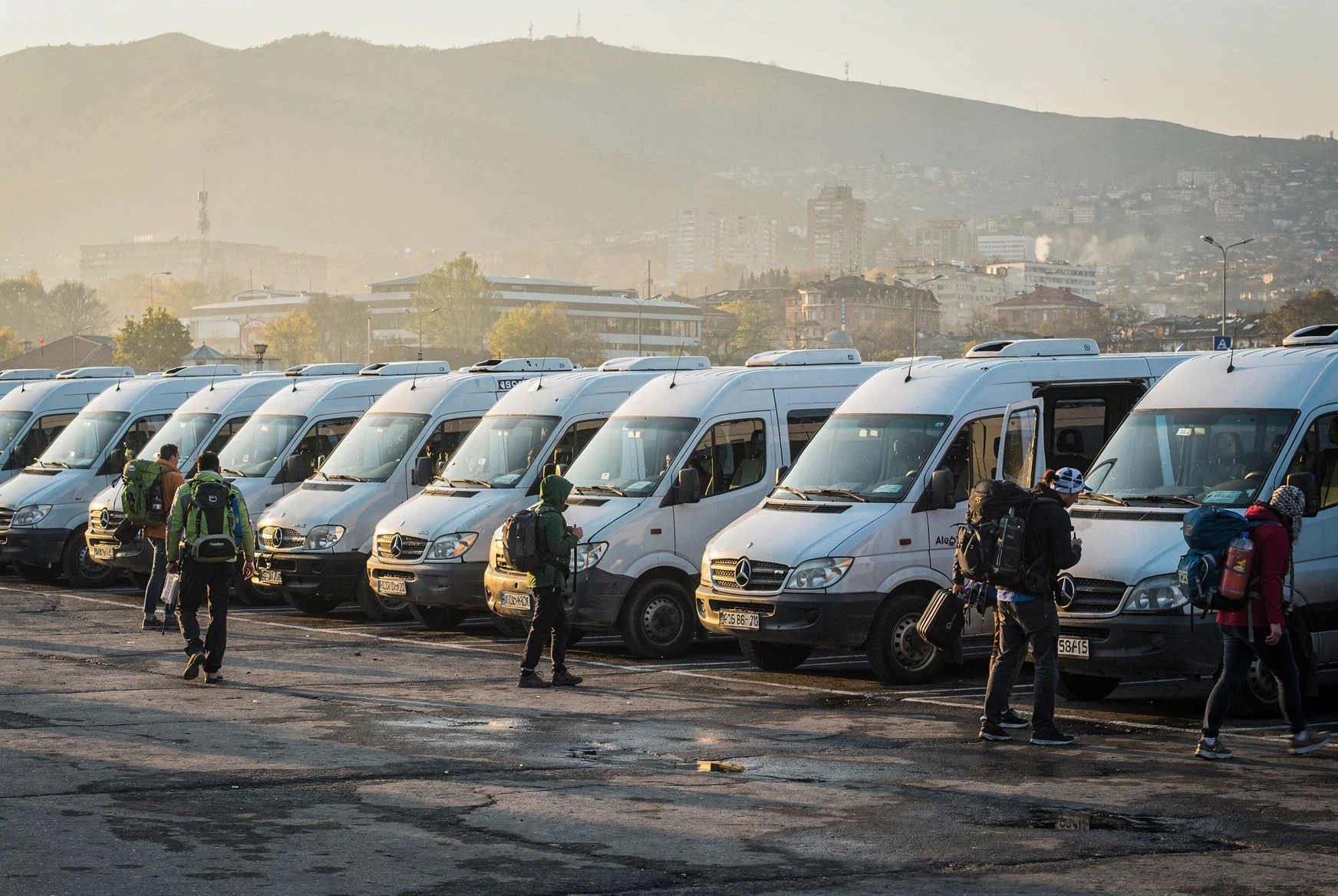
Tbilisi does not have one elegant, obvious central bus station where all intercity transport behaves sensibly. It has several hubs, each with its own geography, habits, and level of chaos. If you know which one you need, the system is manageable. If you guess, the city will happily waste your morning.
This is the part many generic Georgia transport guides skip. They tell you to “take a marshrutka from Tbilisi” as if that is one simple instruction. It is not. Tbilisi has Didube, Ortachala, Samgori, the Station Square area, plus scattered odds and ends that only make sense after someone points at the right van. For first-time visitors, the real challenge is not the ride itself. It is getting to the correct departure point before the ride leaves without you.
If you sort that one thing out, Georgia gets much easier. Suddenly the road to Kazbegi, the Kakheti wine-country hop, the Rustavi errand, or the Kutaisi transfer stops feeling like improvised field research and starts feeling like transport.
The quick answer: which Tbilisi station do you need?
If you only want the blunt version, here it is: Didube handles a big chunk of the tourist routes people care about — Kazbegi, Gudauri, Mtskheta, Gori, Borjomi, Kutaisi, and plenty of western-bound departures. Ortachala is the more common play for Kakheti and some southern or cross-border services. Samgori is mostly useful for Rustavi and a few eastern or suburban runs. Station Square matters more for trains than for bus strategy, though it occasionally appears in intercity transport conversations because Georgia enjoys ambiguity more than travelers do.
| Station | Usually best for | Access |
|---|---|---|
| Didube | Kazbegi, Gudauri, Mtskheta, Gori, Borjomi, Kutaisi, Batumi, western and northern Georgia | Directly by Didube metro |
| Ortachala | Sighnaghi, Telavi, parts of Kakheti, some southern routes, some international departures | Usually Bolt, taxi, or city bus from central Tbilisi |
| Samgori | Rustavi and some eastern / suburban traffic | Samgori metro |
| Station Square area | Overflow randomness, a few regional departures, and people confusing train travel with bus travel | Station Square metro and railway complex |
Do not trust vague internet shorthand
When a blog says “take the minibus from Tbilisi,” that is not enough information. You still need the actual station. Without that, you are one Bolt ride away from beginning the day in the wrong corner of the city.
Why Tbilisi bus stations confuse people so much
Because the system grew by habit, not by traveler logic. Tbilisi is a capital city where metro, rail, city buses, ride-hailing apps, marshrutkas, informal terminal culture, and assorted roadside departures all coexist in one large practical shrug. Locals manage because locals learn the patterns. Visitors get tripped up because they expect one central terminal with neat signs, a single departures board, and route logic that behaves like an airport. That is not the mood here.
There are recognizable patterns. North and west usually pull toward Didube. Kakheti often pulls toward Ortachala. Rustavi points you toward Samgori. But there are enough exceptions, seasonal quirks, and driver-level improvisations that it is smart to treat every big intercity move as something to verify, not something to assume.
The other reason this feels harder than it is: Tbilisi traffic can turn a wrong guess into a 30- to 45-minute penalty. In a city where many departures are morning-weighted and some marshrutkas leave once full, that is not a minor mistake. That is the difference between leaving today and eating a sad station khachapuri while you reconsider your life choices.
Didube station: the one most travelers will use
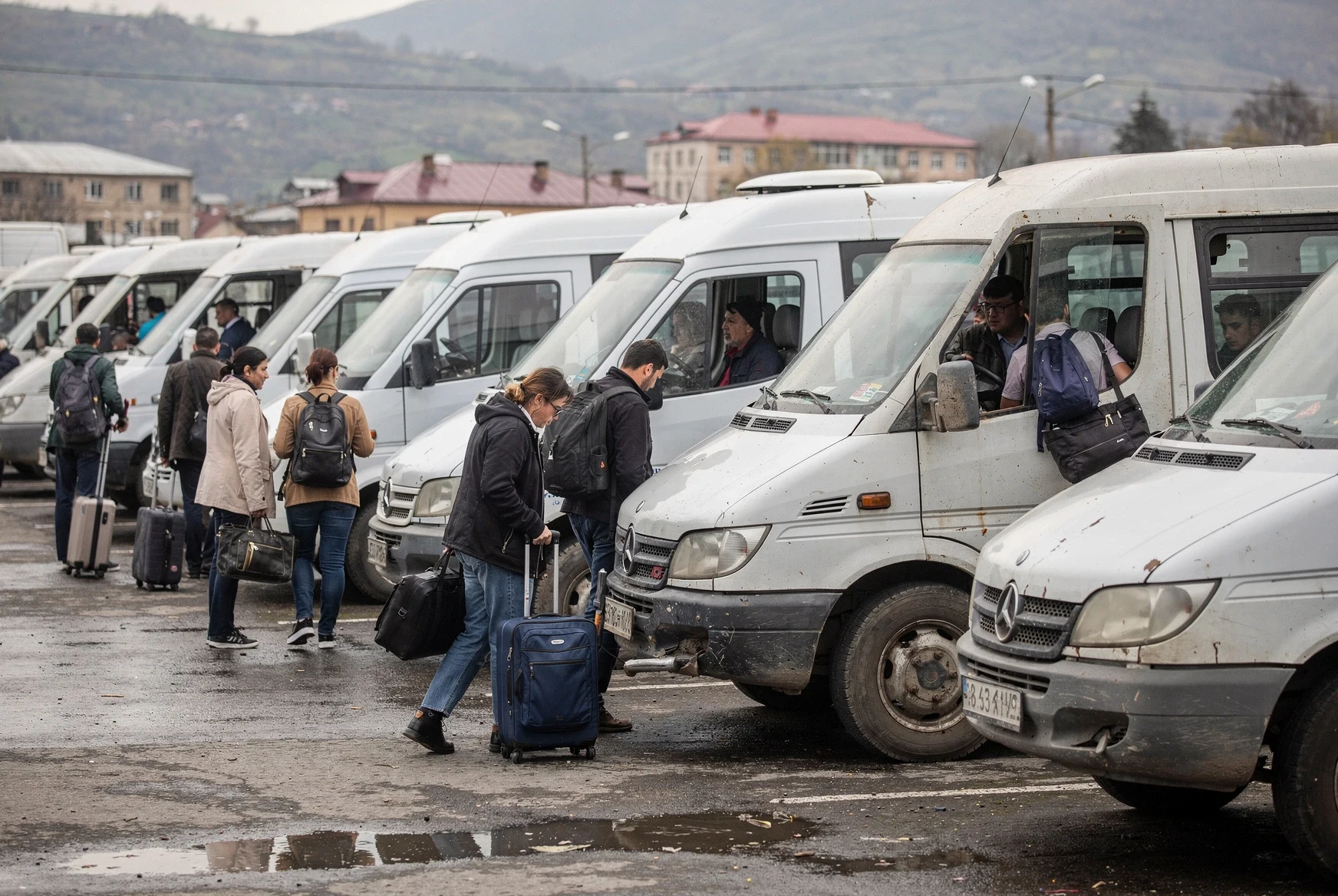
If you are doing classic tourist Georgia by road, Didube is the station that matters most. It is ugly in a functional way, sprawling in a mildly chaotic way, and genuinely useful. It serves a huge share of the routes first-time visitors end up needing: Kazbegi, Mtskheta, Gori, Borjomi, Kutaisi, and a lot more besides.
The biggest advantage is access. You can take the metro straight to Didube, surface into the surrounding transport ecosystem, and start asking questions immediately. For a traveler who is already navigating a foreign city, that matters. A station being messy is easier to forgive when at least the metro drops you on top of it.
Best reason to use Didube
Excellent coverage for northbound and westbound routes, plus easy metro access and enough passenger traffic that departures on big routes are frequent.
Main downside
It can feel visually chaotic, and the first five minutes there are often less “organized transport hub” and more “good luck, detective.”
Didube makes the most sense when your destination is part of the standard overland tourist circuit or when you want a high chance of finding departures without advanced coordination. It is also where many people accidentally discover that Georgia's long-distance road system runs more on pattern recognition than on glossy terminal design.
Routes where Didube is often the right answer
- Kazbegi / Stepantsminda and Gudauri
- Mtskheta and Gori
- Borjomi and Akhaltsikhe-area directions
- Kutaisi and many western Georgia departures
- Batumi by road, if you insist on doing the long version instead of taking the train
If your route sits on the railway network, read the Georgia Train Travel Guide before defaulting to Didube. This is especially true for Batumi and some western routes where the train is simply a more civilized use of your day.
Ortachala station: the Kakheti and southern-route workhorse
Ortachala is the station that many travelers discover only after going to Didube first and being told, with admirable Georgian brevity, that they are in the wrong place. For Sighnaghi, Telavi, and several Kakheti-bound or southern-facing routes, Ortachala is often the more useful hub.
It usually feels a bit more terminal-like and a bit less transport-bazaar-like than Didube, though that should not be mistaken for some Scandinavian bus-station fantasy. It is still Georgia. Things still depend on asking, confirming, and turning up early enough not to tempt fate.
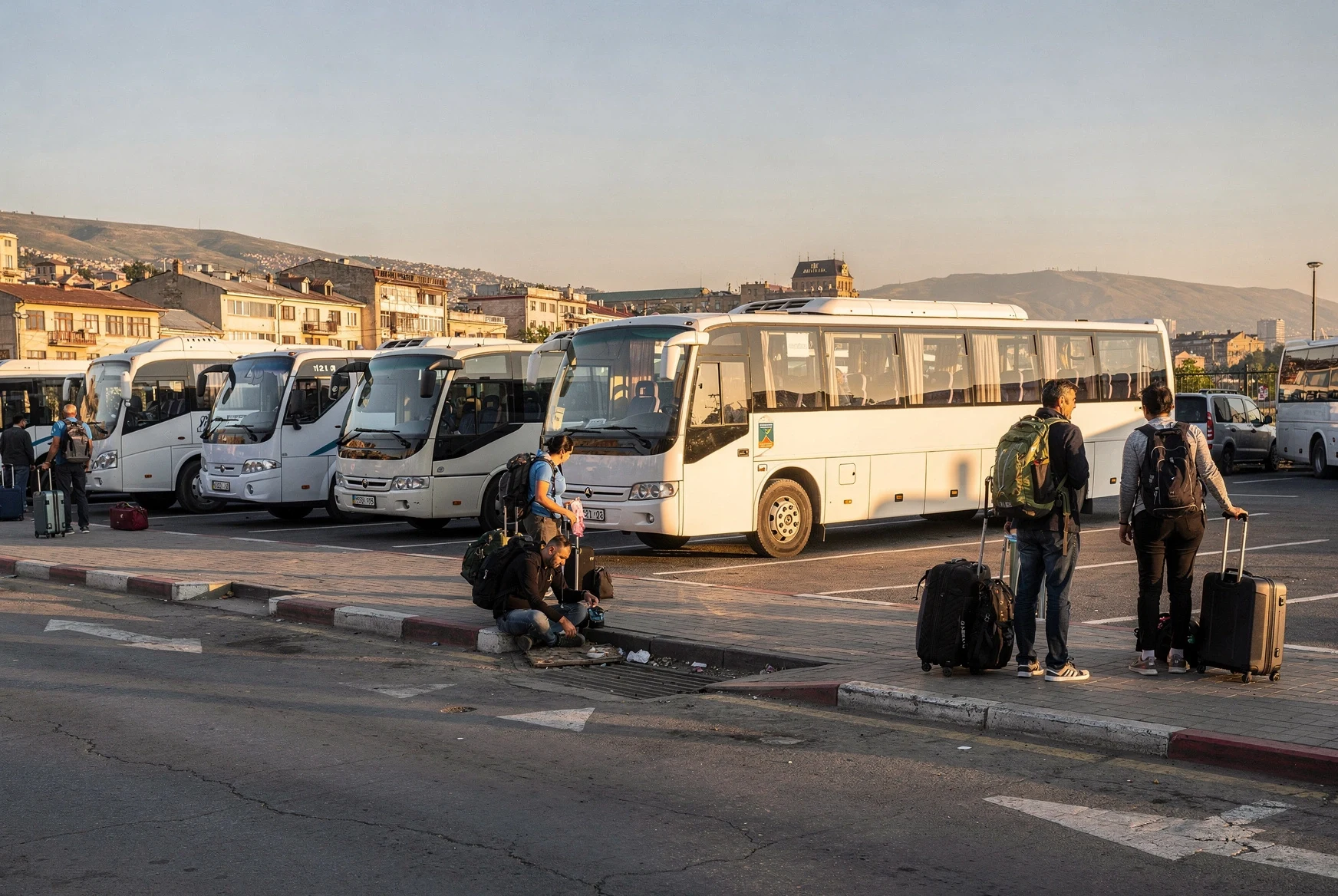
The catch is access. Ortachala is not as beautifully plug-and-play as Didube for most tourists. Unless you are staying nearby, you will probably reach it by Bolt, taxi, or a city bus connection. That extra logistics layer is exactly why confirming the right station beforehand matters. Ortachala is perfectly workable when you mean to go there. It is annoying when you get sent there after already burning time elsewhere.
Kakheti rule of thumb
If your plan involves Sighnaghi, Telavi, or a wine-country base and someone tells you to start from Ortachala, believe them. Kakheti is the route cluster where optimistic guessing causes the most unnecessary backtracking.
Routes where Ortachala is commonly useful
- Sighnaghi
- Telavi
- Some Kakheti town and village routes
- Some southern and international coach departures
If you are pairing Kakheti with a broader wine trip, it is worth comparing public transport against a driver or rental car. Wine-country travel in Georgia gets better the moment you stop pretending every vineyard day should be built around terminal logistics.
Samgori: useful, but not usually central to a tourist itinerary
Samgori matters more than most visitors realize, but less than Didube and Ortachala if your trip is built around the classic Georgia circuit. The most practical tourist-facing use case is Rustavi, plus some eastern or suburban traffic that locals rely on more than foreign travelers do.
The helpful thing about Samgori is that it is metro-connected, which immediately makes it less annoying than any bus station that requires an extra taxi layer. The less helpful thing is that many tourists do not need it often enough to build intuition around it. So when it does become relevant, it can feel oddly obscure despite being easy enough to reach.
Most common traveler use
Rustavi visits, practical errands, or region-adjacent routes that do not sit on the more obvious tourist stations.
What it is not
It is not the universal answer for intercity travel, and it is usually not where your Kazbegi, Kutaisi, or Kakheti trip starts.
If you are reading this because some forum comment vaguely mentioned Samgori for your route, verify it. This is exactly the kind of half-true transport advice that mutates online over time.
What about Station Square?
Station Square is important in Tbilisi transport, but mostly because of rail, metro interchange, and the general gravitational pull of the central station complex. It appears in bus-station conversations because there are always a few regional oddities, overflow departures, and semi-formal transport solutions orbiting the area. That does not make it the answer to every intercity question.
For most visitors, Station Square should trigger one question first: am I actually supposed to be taking the train? If the answer is yes, great. Go there. If the answer is no, do not let the fact that it feels central seduce you into assuming your marshrutka must also leave from there.
Central does not mean universal
Station Square is the place many travelers assume everything must leave from because it looks like transport. Unfortunately, Georgia did not organize the system around your instinct.
How departures actually work at these stations
This is the part where people want a clean timetable answer and Georgia offers a philosophical one instead. Some services have posted schedules. Some leave roughly on time. Some leave once enough passengers show up. Some appear to have a fixed departure and then stretch reality a little if two more fares are within reach. None of this means the system is impossible. It just means you should plan for flexibility.
Busy routes are easiest. Kazbegi, Mtskheta, Kutaisi, and the big standard corridors usually have enough turnover that missing one departure does not destroy the day. Quieter routes are less forgiving. Morning is generally better, especially if your onward plan involves mountains, small towns, or a second connection.
| Departure reality | What to do |
|---|---|
| Popular route, morning departure | Arrive 20–30 minutes early and expect a decent chance of leaving quickly |
| Quiet route or small town | Confirm the day before and arrive early enough that “almost full” works in your favour |
| Afternoon mountain plan | Avoid it if possible; late improvisation in Georgia tends to get worse, not better |
| Fixed schedule mentioned online | Treat it as useful but not sacred; verify locally if the trip matters |
If you like systems, think of Georgian bus-station timing as “structured elasticity.” There is usually a pattern. There is also room for the pattern to behave like Georgia.
How to find the right vehicle without losing your mind
At the bigger hubs, especially Didube, the process is often less “read the giant departures screen” and more “ask three people and triangulate.” That sounds worse than it is. Once someone understands your destination, they usually point you in the right direction. The tricky part is that destination signs may be in Georgian only, route logic is sometimes informal, and the difference between “this goes there” and “this goes near there” can matter.
The simplest move is to have the destination saved on your phone in English and, ideally, in Georgian script. Show it. Ask directly. Repeat the destination name back. If the route is important — say you are trying to make a hotel check-in, a church visit before closing, or a second onward connection — confirm whether the vehicle goes direct or only to the larger town where you then need another ride.
- Show the destination written down, not just pronounced from memory
- Ask what time it leaves
- Ask whether it goes direct
- Keep small cash handy
- Take a screenshot of your map and route before leaving central Tbilisi
Georgian station problem-solving gets dramatically easier once you stop trying to look self-sufficient and just ask clearly.
Common routes and the station you will most likely need
This is the part most travelers actually want, so here is the practical cheat sheet. These are common patterns, not divine commandments, and you should still verify close to travel day. But if you need a working default, this is the right place to start.
| Destination | Most likely station | Notes |
|---|---|---|
| Kazbegi / Stepantsminda | Didube | Classic northbound tourist route; morning is best |
| Gudauri | Didube | Often part of the same northbound corridor |
| Mtskheta | Didube | Cheap, frequent, straightforward |
| Gori | Didube | Good for Uplistsikhe connections too |
| Borjomi | Didube | Compare against train if comfort matters more than speed |
| Kutaisi | Didube | Common route with frequent demand |
| Batumi | Didube by road / Station Square by train | Train usually wins on sanity |
| Sighnaghi | Ortachala | Common Kakheti mistake is going to Didube first |
| Telavi | Ortachala | Verify the exact departure point the day before |
| Rustavi | Samgori | Metro-linked and relatively easy once you know it |
Which station feels easiest for a first-time visitor?
Oddly enough, the answer is still Didube, even though it is visually the least polished of the bunch. Why? Because utility beats beauty. Metro access is simple. Popular routes are popular for a reason. There are enough departures that the system forgives mistakes. Once you accept the atmosphere, it works.
Ortachala is easier if your route specifically belongs there and you have already decided to take a taxi or Bolt. Samgori is easier if you actually need Samgori. The hard part is not that any of these places are impossible. It is that only one of them usually makes sense for the trip you are trying to take.
Best for broad tourist usefulness
Didube
Best if you're specifically going to Kakheti
Ortachala
When not to use a Tbilisi bus station at all
This is an underrated travel skill in Georgia: recognizing when the “local transport” answer is not the smart answer. If you are carrying large luggage, traveling with kids, nursing a hangover, trying to hit multiple wineries, or attempting a long route that the train covers well, the heroic bus-station approach may be false economy.
Take Tbilisi to Batumi. Yes, you can do it by road from Didube. But unless your schedule makes the train impossible, the rail option is cleaner, calmer, and less punishing. Take Kakheti wine touring. Yes, you can piece things together from Ortachala. But if the point of the day is enjoying wineries, not proving you can solve transport puzzles, a driver is often the better call.
Georgia rewards pragmatism. Do the local thing when it is the right thing, not when it merely sounds adventurous on paper.
Practical survival tips for using Tbilisi bus stations
Arrive with buffer
For common routes, 20–30 minutes early is sensible. For quiet routes, go earlier and verify more.
Bring small cash
Drivers and terminal setups are not ideal places to test the national supply of change.
Save the destination in Georgian
Showing the place name works better than pronunciation roulette.
Do not overpack
Marshrutka luggage logic is generous only if your bag is modest.
The other useful habit is emotional, not logistical: do not let the atmosphere spook you. Georgian stations can look rougher than they function. Once you ask the right question to the right person, the whole thing usually becomes much simpler.
Final verdict
Tbilisi's bus stations are not elegant, but they are not some impossible local secret either. The key is knowing that the city works through multiple hubs with different route logic, not one central terminal that serves everything. If you remember that, most of the confusion disappears.
For a lot of trips, the answer is straightforward: Didube for north and west, Ortachala for a lot of Kakheti and some southern routes, Samgori for Rustavi-type needs, Station Square mainly for trains. Confirm before you go, keep your expectations realistic, and accept that in Georgia the route can be perfectly normal even when the station choreography feels improvised.
That is really the whole country in one transport lesson.
Written by The Georgian Guide Team
We live in Tbilisi and use the city's transport system year-round, including the glamorous bits where “bus station strategy” matters more than any scenic fantasy about the Caucasus.
Last updated: March 2026.
Related Articles
Marshrutkas in Georgia
The deeper guide to fares, luggage, departure logic, and when the minibus is worth it.
Getting Around Georgia
The bigger transport picture across trains, marshrutkas, Bolt, rental cars, and city transit.
Georgia Train Travel Guide
Use this before doing a long road transfer that the railway already solves better.
Tbilisi Public Transport
Metro, buses, cable cars, and how to reach these stations without turning arrival day into nonsense.