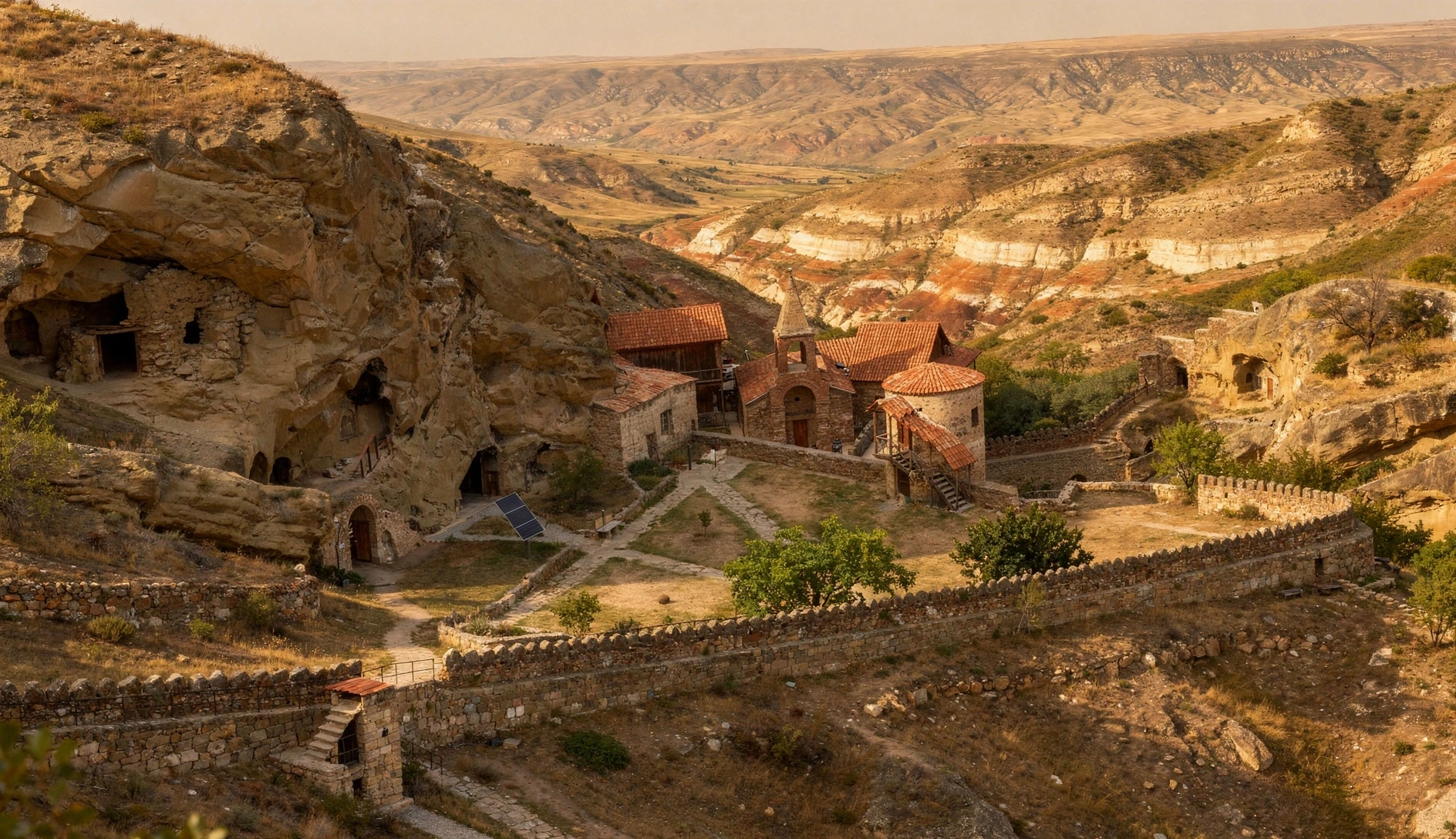
David Gareja is the kind of place that makes you question why it isn't more famous. A sprawling 6th-century cave monastery complex carved into the hills of a semi-desert landscape that genuinely looks like another planet. It's one of Georgia's most extraordinary sites — and also one of its most complicated to visit.
The complication? The monastery complex sits right on the disputed Georgia-Azerbaijan border. Since 2019, part of it has been off-limits. But here's what most guides won't tell you straight: what remains open is still genuinely worth the trip, and the surrounding landscape — the so-called Rainbow Hills — is arguably the real star of the show.
This guide covers everything: what's open, what's closed, how to get there, what to expect, and whether it's still worth the journey in 2026. Short answer: yes. With caveats.
Quick Facts
A Brief History (That's Actually Interesting)
In the 6th century, thirteen monks arrived in Georgia from Mesopotamia with a single mission: spread Christianity. They were the Thirteen Assyrian Fathers, and their leader's name — David Garejeli — would become permanently etched into the landscape of eastern Georgia.
David chose one of the most inhospitable spots imaginable. The Gareja plateau is a semi-arid steppe near the Azerbaijan border, baking in summer, freezing in winter, with no natural water source worth mentioning. That was the point. He wanted isolation from the world, and he found it.
What happened next was extraordinary. Over the following centuries, monks carved more than 5,000 cells into the soft sandstone rock. These weren't crude holes — they built sprawling complexes with chapels, refectories, libraries, watchtowers, and entire villages. At its peak, the complex housed hundreds of monks and became one of Georgia's most important centers of theology, art, and learning.
The frescoes are what scholars get excited about. The cave churches at Udabno Monastery contain paintings of Orthodox saints, biblical scenes, and a rare portrait of Queen Tamar — Georgia's greatest medieval ruler. Some date to the 10th–13th centuries and represent some of the finest examples of Georgian medieval art.
Then, as with much of Georgian history, the destruction came. Persian Shah Abbas I's army massacred an estimated 6,000 monks in 1615. The Soviet military used the caves for target practice, putting bullet holes through irreplaceable frescoes. And now, a border dispute threatens what remains.
The Border Dispute — What You Need to Know
This is where visiting David Gareja gets complicated, and where most travel blogs get vague. Here's the situation clearly.
The monastery complex straddles the Georgia-Azerbaijan border — a border that is largely undelimited, meaning the two countries have never formally agreed where the line runs. The Lavra Monastery (lower complex) sits on the Georgian side. The Udabno Monastery (upper complex) sits on or very near the disputed line. Bertubani Monastery is on the Azerbaijani side entirely.
For decades, this wasn't really a problem. An informal agreement let tourists and pilgrims access everything freely. Then in June 2019, tensions escalated. Activists gathered at the site, Azerbaijan deployed additional border guards, and access to the upper monastery was restricted.
Current Status (February 2026)
Lavra Monastery (lower complex) is fully open to visitors. Udabno Monastery (upper complex) and the ridge hike remain closed. Georgian border guards will turn you back if you attempt the trail. The situation has not changed materially since 2019, and no resolution appears imminent.
What's Open vs. What's Closed
| Site | Status | What You'll See |
|---|---|---|
| Lavra Monastery | ✅ Open | Cave church, St. David's tomb, courtyard, balconies, tunnels, monks' cells |
| Udabno Monastery | ❌ Closed | Medieval frescoes, Queen Tamar portrait (inaccessible since 2019) |
| Ridge Hike | ❌ Closed | 3 km trail connecting Lavra to Udabno (border zone) |
| Rainbow Hills | ✅ Open | Colorful sedimentary rock formations, hiking trails near Udabno village |
| Natlismtsemeli Monastery | ✅ Open | John the Baptist Monastery, 7 km east of Lavra (requires 4WD or hiking) |
| Bertubani Monastery | ❌ Inaccessible | On Azerbaijani territory |
Is It Still Worth Visiting?
Yes — but temper your expectations. If you came specifically for the Udabno frescoes and the ridge hike (which, honestly, were the highlights pre-2019), you'll be disappointed. The Lavra Monastery alone, while impressive, might not justify a 3-hour round trip for everyone.
But here's the thing: David Gareja was never just about the monasteries. The landscape is genuinely surreal — rolling semi-desert hills with mineral-striped rock formations that look lifted from Arizona or Central Asia. The drive through empty steppe, passing through the industrial ghost town of Rustavi, is an experience in itself. And the nearby Rainbow Hills have become the secondary attraction that arguably saves the trip.
My honest take: combine David Gareja with the Rainbow Hills and Natlismtsemeli Monastery for a full day. That combination is absolutely worth it. Lavra alone? It depends on how much you value the journey over the destination.
Lavra Monastery — What to Expect
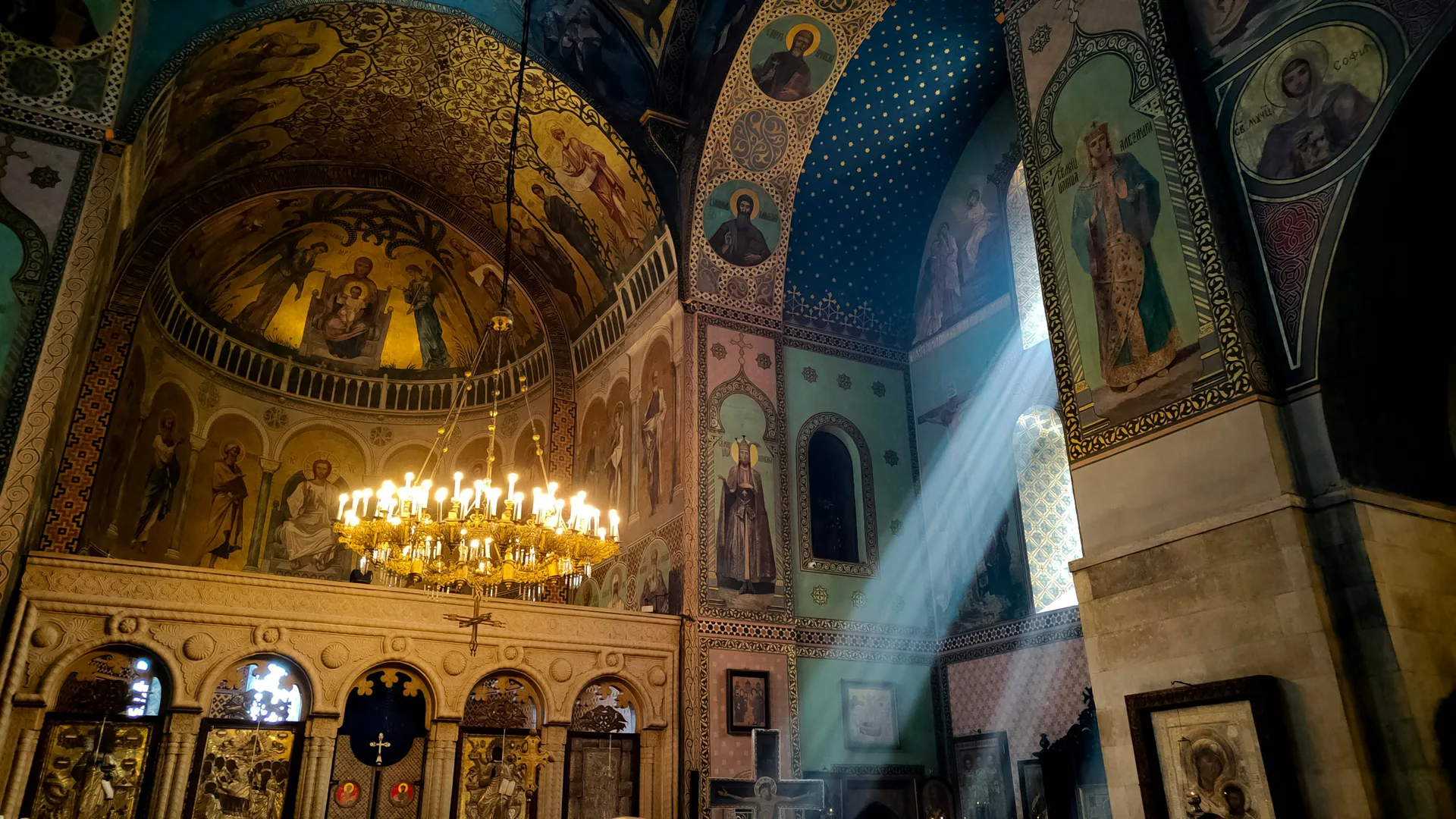
Lavra is the main monastery — the one you'll see immediately upon arrival. Monks still live here, which gives it a quietly powerful atmosphere that museum-ified sites lack.
The highlight is the 6th-century cave church containing St. David Garejeli's tomb. It's small, dark, and deeply atmospheric — a genuine holy site, not a tourist attraction pretending to be one. The carved stone is worn smooth by centuries of pilgrims touching the walls.
From the church, you can explore multiple levels of the complex via wooden balconies and stone passages. The cells are carved directly into the cliff face, some barely large enough for one person, others opening into surprisingly spacious rooms. The courtyard below has beautifully engraved tombstones and views up at the honeycomb of caves above you.
Rehabilitation work has been ongoing for years, so expect some scaffolding. But the areas that are accessible give you a real sense of scale — you're walking through a 1,500-year-old vertical city carved into rock.
Dress Code
This is an active monastery. Women should cover their heads and shoulders (scarves usually available at the entrance). Men should wear long trousers. Both sexes should dress modestly — no tank tops or short shorts. You may be asked to leave if you're dressed inappropriately.
Budget about 1–1.5 hours for Lavra Monastery. You can walk 100–200 meters up the hill behind the complex for an elevated view of the caves and the surrounding landscape, but you won't get far before border guards redirect you.
The Rainbow Hills
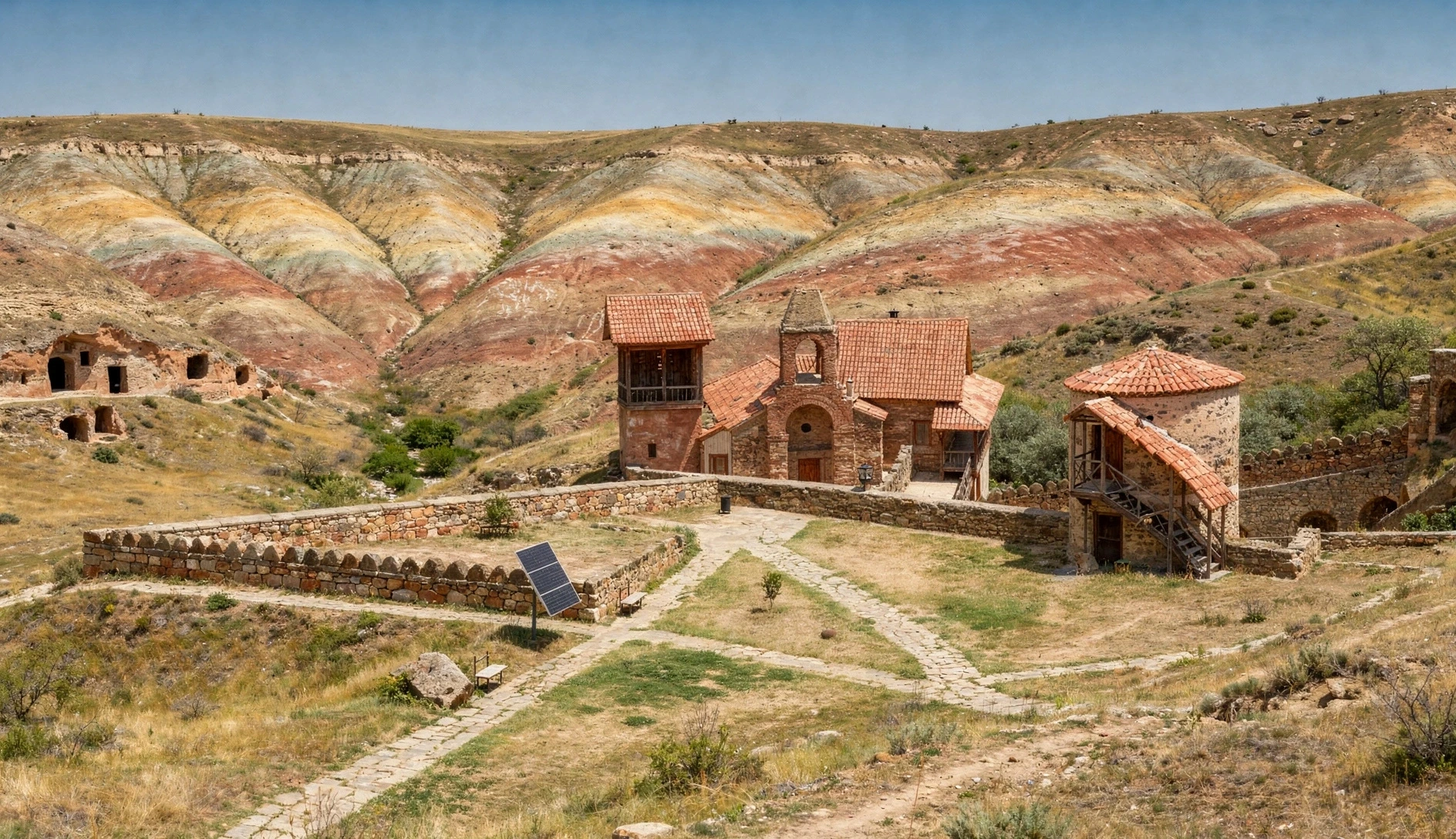
If David Gareja itself is the history lesson, the Rainbow Hills are the visual payoff. These are sedimentary rock formations with vivid horizontal stripes — reds, oranges, yellows, creams, and grays — created by different mineral deposits laid down over millions of years. The Eurasian and Afro-Arabian tectonic plates literally collide here, which is responsible for the unusual geology.
The hills are located near Udabno village (not to be confused with Udabno Monastery), about 15 km from the Lavra parking lot. There's no formal trail system, but the terrain is open and walkable. Most people hike for 1–3 hours through the formations, depending on how far they want to go.
🌅 Best Time of Day
Late afternoon (4–6 PM) when the low sun makes the colors most vivid. Morning works too, but midday sun washes everything out.
🥾 Difficulty
Easy to moderate. No technical hiking, just open terrain with some uneven ground. Sturdy shoes recommended — it's rocky and the clay can be slippery after rain.
📷 Photography
Bring a wide-angle lens. The scale of the formations is hard to capture otherwise. Drone flying is discouraged near the border zone (military sensitivity).
🧴 Essentials
Sunscreen, hat, 2+ liters of water. There is zero shade and zero water out there. This is a semi-desert — take it seriously.
Natlismtsemeli Monastery
If you have a 4WD (or strong legs), Natlismtsemeli (John the Baptist) Monastery is about 7 km east of Lavra along a rough dirt track. It's far less visited than David Gareja proper and feels genuinely remote — you'll likely have the place to yourself.
The monastery dates to the same era as Lavra and contains well-preserved frescoes that you can actually see up close, unlike the now-inaccessible ones at Udabno. The caves here are smaller and more intimate, and the surrounding landscape of eroded badlands is spectacular.
Getting there requires either a high-clearance vehicle or a 2–3 hour round-trip hike across open steppe. The track is unmarked and can be confusing — download maps.me offline maps before you go.
How to Get There
David Gareja is about 110 km southeast of Tbilisi. There's no public transport — you're either driving, joining a tour, or hitchhiking (possible but unreliable).
| Option | Cost | Time | Notes |
|---|---|---|---|
| Private tour | $60–100 per person | Full day | Most popular option. Usually includes Rainbow Hills. Book via hotel or Viator/GetYourGuide. |
| Group tour | $25–45 per person | Full day | Budget option. Less flexibility, fixed schedule. Check guesthouses in Tbilisi for daily departures. |
| Rental car (2WD) | $30–50/day | 1.5–2 hrs each way | Main road is paved all the way to the parking lot. 2WD is fine for Lavra. 4WD needed for Natlismtsemeli or off-road routes. |
| Rental 4WD | $60–100/day | 1.5–2 hrs each way | Recommended if you want to explore Rainbow Hills by car and visit Natlismtsemeli. Worth the premium. |
| Taxi from Tbilisi | 100–150 GEL round trip | Full day | Negotiate with a Bolt/Yandex driver for a day rate. Make sure they wait — there are no taxis at David Gareja. |
The Self-Drive Route
From Tbilisi, take the S4 highway south toward Rustavi. After Rustavi, follow signs for Udabno/David Gareja. The road is paved but narrow in places. The last stretch through open steppe is dramatic — rolling hills, no trees, zero buildings. You'll pass through a brief stretch where you technically cross the Azerbaijani border on the highway (don't worry, there's no checkpoint). The parking lot at David Gareja has basic facilities: toilets, a small café, and a souvenir stand.
The Drive — Don't Sleep Through It
Most guides focus exclusively on the monastery and forget that the drive is half the experience. The route takes you through three distinct landscapes in under two hours.
First: the urban sprawl south of Tbilisi, unremarkable. Second: Rustavi — a Soviet industrial city that feels like a set from a dystopian film. Rows of identical concrete apartment blocks, rusting factories, peeling paint. If you have time, it's worth a brief stop. Rustavi is one of the most visually fascinating cities in Georgia, though "fascinating" and "beautiful" are different things.
Third: the open steppe. Once you leave Rustavi behind, the landscape transforms abruptly. Flat, treeless grassland stretches to every horizon. The road narrows. You pass through Udabno village — a handful of buildings that make "sleepy" sound overly energetic — and then it's just you, the road, and geological time.
The semi-desert landscape around David Gareja sits where the Eurasian and Afro-Arabian tectonic plates meet. The mineral-rich sedimentary rock creates those distinctive colored stripes. In spring, the steppe erupts in wildflowers — briefly, violently green before summer bakes everything back to brown.
Best Time to Visit
| Season | Temperature | Verdict |
|---|---|---|
| Spring (Apr–May) | 15–25°C | 🏆 Best time. Green steppe, wildflowers, comfortable hiking. Late April is peak. |
| Summer (Jun–Aug) | 30–40°C | Brutal. Zero shade, scorching rock. If you must go, leave Tbilisi at 6 AM. Bring 3+ liters of water. |
| Autumn (Sep–Oct) | 15–25°C | Good alternative. Dry, warm, fewer tourists. October can get cold at elevation. |
| Winter (Nov–Mar) | -5 to 10°C | Possible but miserable. Wind chill on the exposed plateau is real. Road may be icy. Few or no other visitors. |
What to Bring
| Item | Why |
|---|---|
| Water (2–3 liters) | No water sources on site. The small café may not be open. |
| Sunscreen + hat | Zero shade. Semi-desert sun burns fast. |
| Sturdy shoes | Rocky terrain, loose gravel. Sandals won't cut it. |
| Head covering (women) | Required inside the active monastery. Bring your own or borrow at the entrance. |
| Packed lunch | The café at the parking lot is unreliable. Pack food from Tbilisi. |
| Offline maps | Mobile signal is patchy. Download maps.me or Google Maps offline before leaving. |
| Cash (GEL) | No ATMs, no card readers. Small amounts for the café, souvenir stand, or tipping a driver. |
Suggested Day Trip Itinerary
| Time | Activity | Duration |
|---|---|---|
| 7:00 AM | Leave Tbilisi (beat the heat and tour buses) | — |
| 8:30 AM | Quick stop in Rustavi for coffee and Soviet architecture | 20 min |
| 9:30 AM | Arrive at David Gareja. Explore Lavra Monastery. | 1–1.5 hrs |
| 11:00 AM | Drive to Rainbow Hills near Udabno village | 20 min |
| 11:30 AM | Hike the Rainbow Hills | 1.5–2 hrs |
| 1:30 PM | Picnic lunch (bring your own) | 30 min |
| 2:00 PM | Optional: drive to Natlismtsemeli (4WD only) | 1.5 hrs |
| 3:30 PM | Drive back to Tbilisi | 2 hrs |
The Round Trip Option
If you have a 4WD, consider driving out via the main road and returning via the unpaved track through the steppe (or vice versa). The off-road route through open grassland with no marked roads — just following tire tracks — is an unforgettable experience. Use maps.me for navigation and don't attempt it alone after rain.
Common Mistakes
🌞 Going at Midday in Summer
The semi-desert hits 40°C with zero shade. Leave Tbilisi at sunrise or go in spring/autumn. Heatstroke is a real risk.
💧 Not Bringing Enough Water
The café may be closed. There are no shops anywhere nearby. 2 liters minimum per person, 3 in summer.
🚶 Trying to Hike to Udabno
Border guards will turn you back, and some travelers have reported unpleasant encounters. Don't test it — the situation is sensitive.
🚕 No Return Transport
There are zero taxis at David Gareja. If you came by taxi, negotiate a wait-and-return deal. Getting stranded here is not fun.
📱 Relying on Mobile Data
Signal drops out once you leave Rustavi. Download offline maps before you go. Google Maps and maps.me both work well.
🐍 Ignoring Snake Warnings
The area has Levantine vipers and other species. Stick to trails, watch where you step, don't reach into caves blindly. This isn't a joke — be aware.
What to Combine It With
David Gareja is remote enough that combining it with other major destinations in a single day is difficult. However, there are a few options:
| Combination | Detour | Verdict |
|---|---|---|
| Rainbow Hills | 15 km from Lavra | Essential. This should be part of every David Gareja trip. |
| Natlismtsemeli | 7 km from Lavra (rough road) | Highly recommended with 4WD. Adds 1.5–2 hours. |
| Kakheti wine region | 60 km north | Possible as a 2-day trip. Visit David Gareja in the morning, then head to Sighnaghi or Telavi for the night. |
| Rustavi | On the way | Quick 30-minute stop for Soviet architecture photography. Not a destination, but a worthwhile pause. |
Frequently Asked Questions
Is David Gareja open to tourists in 2026?
Lavra Monastery (lower complex) is fully open with no restrictions. Udabno Monastery (upper complex) and the ridge hike have been closed since 2019 due to the Georgia-Azerbaijan border dispute. The Rainbow Hills and Natlismtsemeli Monastery are also accessible.
Do I need a 4WD to visit David Gareja?
No — a regular car can reach the main parking lot at Lavra Monastery via paved road. A 4WD is only needed if you want to visit Natlismtsemeli Monastery or take the off-road route through the steppe.
Is there an entrance fee?
No. David Gareja is free to visit. There is no ticket office or entrance fee for either the monastery or the Rainbow Hills.
Can I visit David Gareja by public transport?
Not practically. There is no regular bus or marshrutka service to David Gareja. Your options are a tour, a rental car, or a negotiated taxi. Some budget travelers hitchhike from Udabno village, but this is unreliable.
How much time do I need?
Budget a full day from Tbilisi. Lavra Monastery alone takes 1–1.5 hours. Add the Rainbow Hills (2 hours) and Natlismtsemeli (1.5 hours) for the complete experience. Including driving, plan for 8–10 hours round trip.
Written by The Georgian Guide Team
We've been exploring Georgia for years, from Tbilisi's winding streets to the remotest monasteries. Our guides are based on firsthand experience and honest reporting — no affiliate-driven recommendations, no sugarcoating.
Last updated: February 2026.
Related Articles
Day Trips from Tbilisi
The best trips you can do in a single day from the capital.
Vardzia Cave City
Georgia's other great cave monastery — on a much larger scale.
Kakheti Wine Region
Combine David Gareja with wine tasting on a 2-day trip.
Getting Around Georgia
Transport options including car rental, marshrutkas, and taxis.