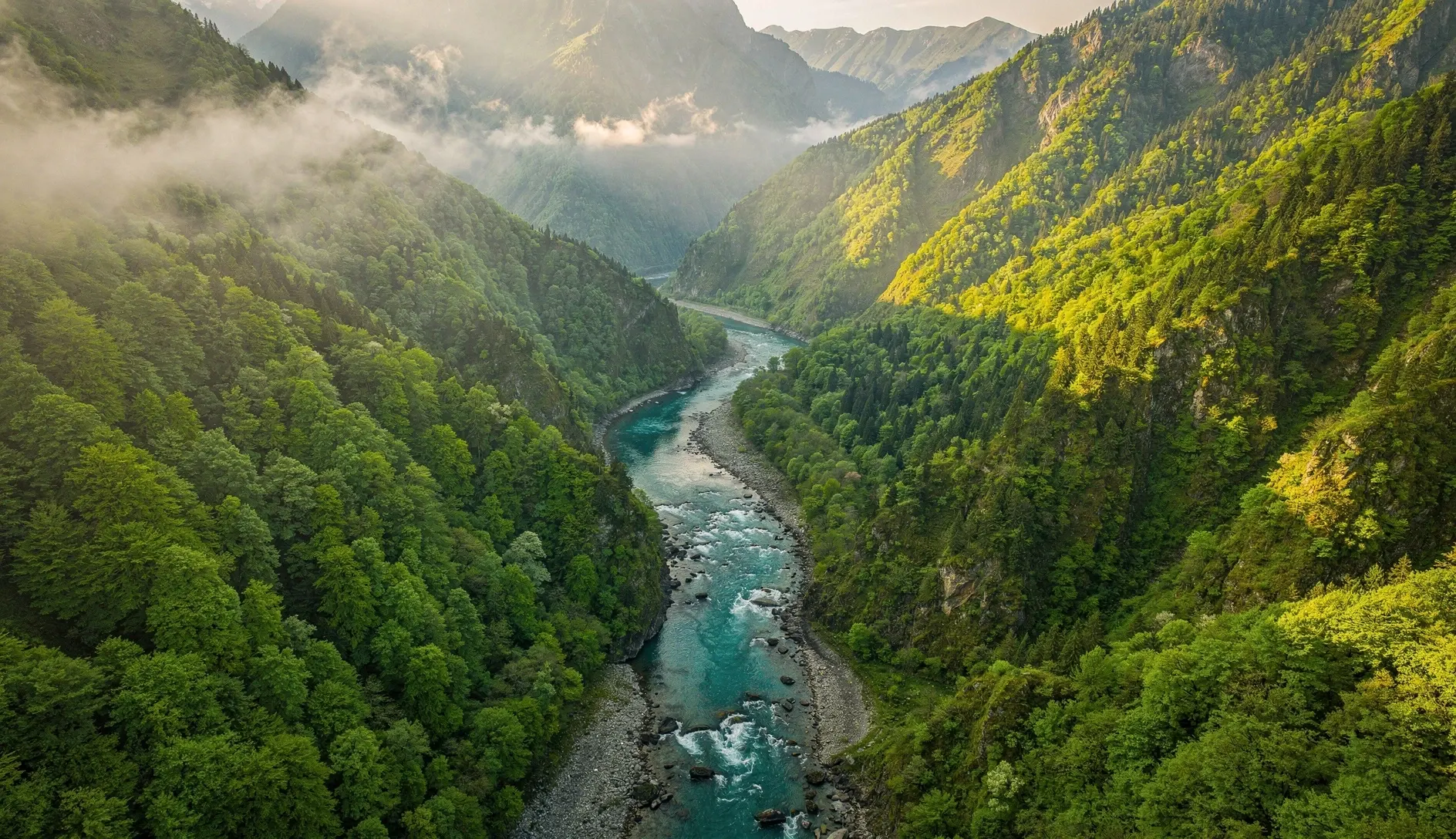
Lagodekhi doesn't get the attention that Svaneti or Kazbegi do — and that's exactly why you should go. Georgia's first nature reserve (protected since 1912, before most of Europe thought conservation was worth the trouble) sits in the far northeast corner of Kakheti, pressed against the borders of Azerbaijan and Dagestan. It's 24,000 hectares of beech forest, glacial lakes, and wildlife that hasn't been disturbed by Instagram crowds. Yet.
Why Lagodekhi Deserves Your Attention
Most visitors to Georgia never make it to the northeast. The gravitational pull of Kazbegi and Svaneti is strong, and Lagodekhi sits a solid 2.5-hour drive east of Tbilisi with no famous church perched on a cliff to lure people in. That's its superpower.
What you get instead: pristine Colchic forest (the kind that existed across Europe before humans cleared it all), a glacial lake at 2,780 meters that literally straddles the Russian border, waterfalls hidden in gorges so deep the sunlight barely reaches the bottom, and a 9th-century fortress crumbling quietly in the woods. The park holds nearly two-thirds of all plant species found in Georgia. The wildlife list reads like a nature documentary script — East Caucasian tur, chamois, red deer, brown bears, lynx, golden eagles, bearded vultures.
And you'll share it with almost nobody.
The Five Trails at a Glance
Lagodekhi has five official trails, and that's it. No unmarked side routes to stumble onto, no freestyle scrambling allowed. This is a strictly managed reserve — you register at the visitor center, pick your trail, and stick to it. The upside: trails are well-marked and maintained. The downside: no spontaneous detours.
| Trail | Distance | Difficulty | Duration | Highlight |
|---|---|---|---|---|
| Black Rock Lake | ~26 km (return) | Hard | 2–3 days | Glacial lake at 2,780m on Russian border |
| Ninoskhevi Waterfall | ~17 km (return) | Moderate–Hard | 1 day (6–8 hrs) | 40m waterfall in a deep gorge |
| Rocho (Grouse) Waterfall | ~19 km (return) | Moderate | 1 day (6–8 hrs) | Rare hornbeam forest, UNESCO heritage site |
| Machi Fortress | ~21 km (return) | Moderate | 1 day (7–9 hrs) | 9th-century Kakhetian royal fortress |
| Nature Interpretation Path | ~3 km | Easy | 1–2 hrs | Educational walk, good for families |
Registration Is Mandatory
You must register at the Lagodekhi Visitor Center before starting any trail. This isn't optional — it's a strict nature reserve. Bring your passport. Registration is free for day hikes; overnight stays in shelters have a small fee. The center is open daily, typically 9:00–18:00.
Black Rock Lake — The Main Event
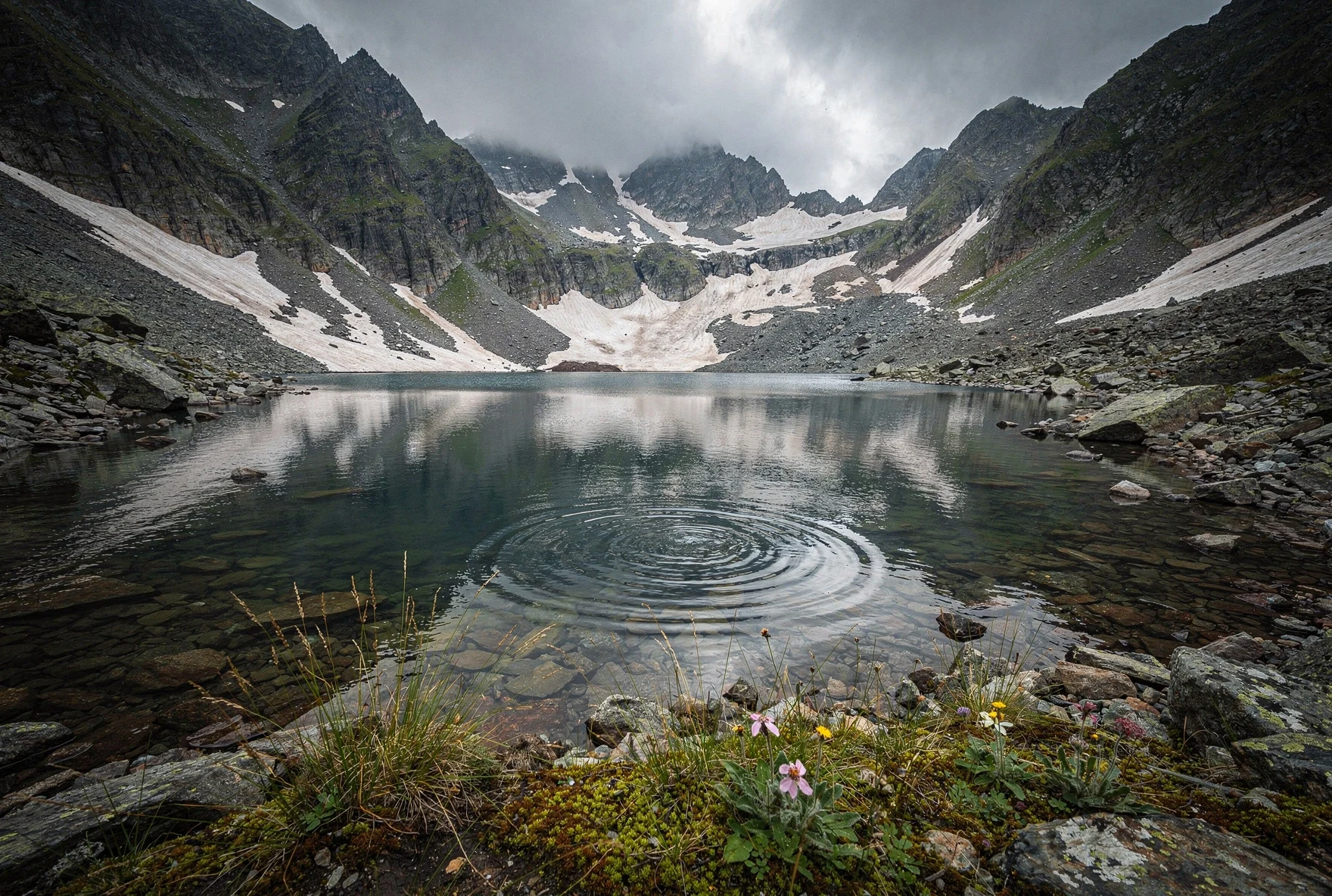
This is the trail most people come to Lagodekhi for, and it's genuinely one of the best multi-day hikes in Georgia. The destination — Lake Grdzeli (locally called Black Rock Lake or Shavi Klde) — sits at 2,780 meters in a dramatic cirque right on the border with Dagestan. It's 14 meters deep, surrounded by dark volcanic rock, and on a clear day, reflects the peaks so perfectly it looks doctored.
The catch: you earn every meter of it. The trail gains roughly 2,000 meters of elevation from the visitor center, almost all of it on the way up. It's a relentless forest climb on day one, followed by alpine meadows and scree on day two. Your legs will have opinions about this.
Day-by-Day Breakdown
Day 1: Visitor Center → Meteo Shelter
~11.5 km, 6–8 hours. Relentless uphill through dense beech forest. The path is clear but steep. The Meteo Shelter (basic, sleeps ~16 people) is your stop for the night. There's a spring nearby for water. Bring a sleeping bag — the shelter is walls and a roof, not a hotel.
Day 2: Meteo Shelter → Black Rock Lake → Demidov Shelter
~5–6 km. You break out of the treeline into alpine meadows. The views open up dramatically — the Alazani Valley stretches below, and on clear days you can see across to Azerbaijan. You'll pass a border guard post (bring your passport). The lake is about 30 minutes past the guards. Camp at the newer Demidov Shelter near the lake, or return to Meteo.
Day 3: Descent
The full descent is 2,000+ meters of vertical drop back to the visitor center. Allow 5–6 hours. Start early — your knees will thank you for finishing before the afternoon heat. The descent from Demidov to the trailhead is brutal on the joints; trekking poles aren't optional here.
Alternative: 2-Day Speed Version
Strong hikers do it in 2 days: push to the lake on Day 1 (extremely long, 10+ hours), descend on Day 2. Only recommended if you're fit and start at dawn. Most people prefer the 3-day pace — there's no shame in it.
Wildlife Spotting
The alpine zone above the treeline is where you're most likely to see East Caucasian tur (wild mountain goats), chamois, and birds of prey. Keep quiet in the early morning. The park has designated observation spots along the trail — the rangers at the visitor center can tell you where.
What to Bring for Black Rock Lake
| Item | Why |
|---|---|
| Sleeping bag (comfort to 0°C) | Shelters are unheated; nights at 2,500m+ are cold even in summer |
| Trekking poles | Non-negotiable for the descent — 2,000m of vertical drop |
| 3L water + purification | Springs exist but aren't everywhere; carry enough between refills |
| Food for 3 days | No shops, no restaurants, no guesthouses on the trail |
| Rain gear | Afternoon thunderstorms are common in the mountains, even in summer |
| Passport/ID | Border guards near the lake will check your documents |
| Headlamp | Shelters have no electricity |
Ninoskhevi Waterfall — The Best Day Hike
If you only have one day in Lagodekhi, this is the trail to pick. The Ninoskhevi Waterfall (also called the Great Waterfall or Gurgeniani Waterfall) drops 40 meters into a gorge on the Ninoskhevi River, and the approach through old-growth forest is half the reason to go.
The trail starts from the Gurgeniani information center (not the main visitor center — it's a separate entrance point). At roughly 8.5 km one way, it's a solid full-day hike rated moderate to hard. The difficulty comes from river crossings — you'll wade through the river multiple times on slippery rocks. Waterproof boots or sandals with good grip are essential. Bring a change of socks.
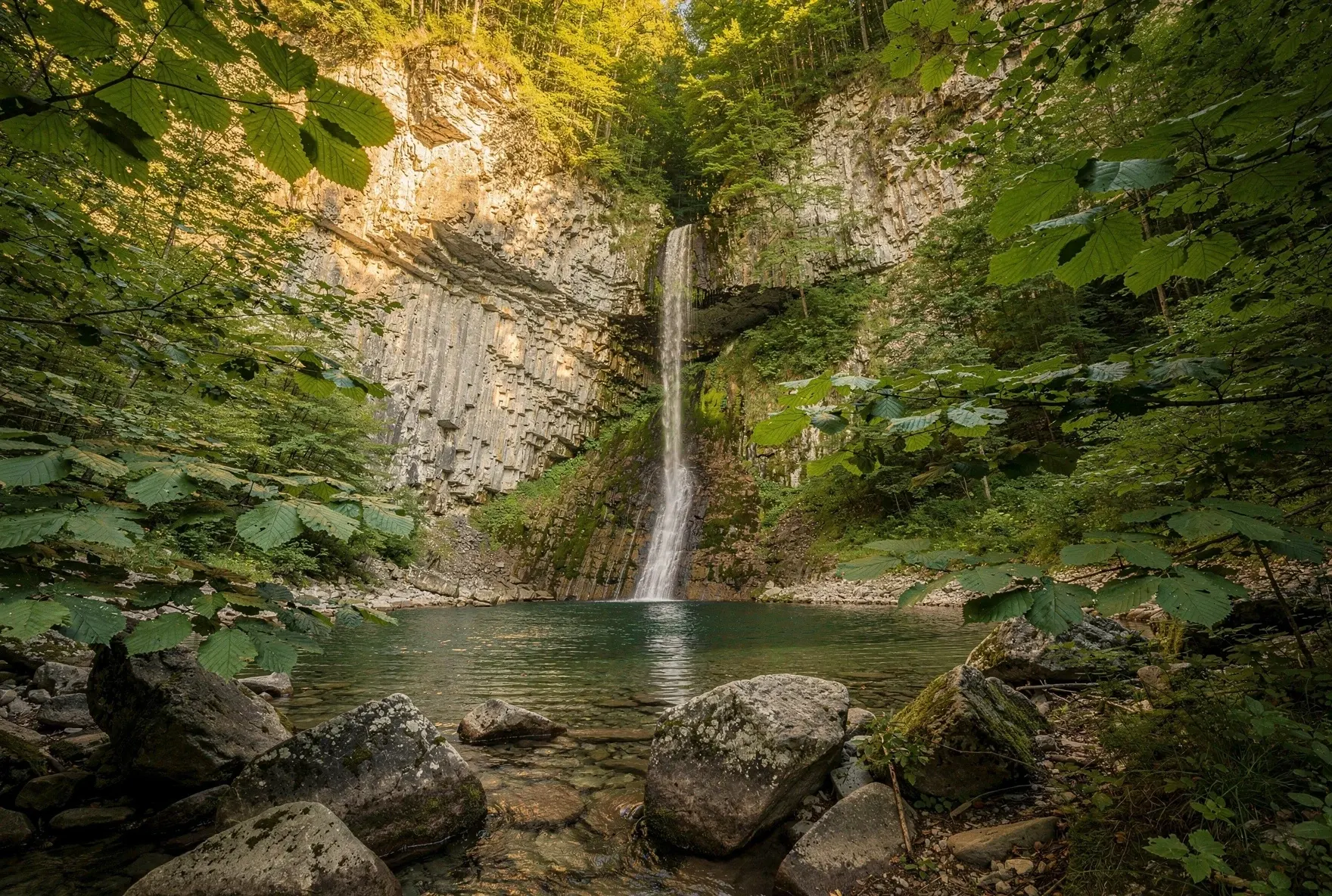
The forest along this trail is spectacular — ancient Oriental beech trees, hornbeam groves, carpets of ferns and moss. It's the kind of forest that barely exists in Europe anymore. The gorge narrows as you approach the waterfall, and the final stretch feels almost cave-like, with cliffs rising on both sides and the roar of water echoing off the walls.
River Crossing Warning
The Ninoskhevi trail involves several river crossings on wet rocks. After heavy rain, the river level rises significantly and crossings can become dangerous. Check conditions at the visitor center before setting out. Don't attempt this trail in or after heavy rainfall.
Rocho (Black Grouse) Waterfall
The Rocho Waterfall trail is the most accessible longer hike in Lagodekhi. At 9.5 km from the main Lagodekhi visitor center, it's rated moderate — no river crossings, no scrambling, just a long walk through forest. The waterfall itself is only about 6 meters tall, which is a bit anticlimactic if you're coming from Ninoskhevi. The real draw is the forest.
The trail passes through a Colchic Rainforest section — part of a UNESCO World Natural Heritage Site — with hornbeam groves that are genuinely rare in the Caucasus. The trees are old, the canopy is thick, and the whole thing feels properly ancient. If you care more about forest ecology than dramatic waterfalls, this is your trail.
The path follows the Shroma River through a narrow gorge with walls 50–70 meters high. It's shaded almost the entire way, which makes it the best option on hot days.
Machi Fortress — History in the Wilderness
For something different: the Machi Fortress trail leads 10.5 km into the forest to the ruins of a 9th-century stronghold that served as a summer residence for the kings of Kakheti. There's also a small old church on the site. The fortress itself is atmospheric rather than grand — crumbling stone walls being slowly consumed by the forest. But the combination of history and wilderness is unique in Georgia's national parks.
The trail has a bridle path, meaning you can do it on horseback if your legs need a day off. Arrange horses through the visitor center — they work with local guides who know the route. Expect to pay around 80–150 GEL for the day depending on the season and your negotiation skills.
Horseback Option
The Machi Fortress and Black Rock Lake trails both have bridle paths suitable for horses. This is a legitimate way to do the trails if you're less fit or want to cover more ground. Arrange through the visitor center at least a day in advance — horses aren't always available on short notice.
Nature Interpretation Path
This short 3 km loop is designed for families, school groups, and anyone who wants a taste of the forest without committing to a full-day hike. It's easy, flat, and has informational signs about local flora and fauna. Not thrilling, but useful if you're visiting with kids or just want to stretch your legs after the drive from Tbilisi.
When to Go
| Season | Conditions | Best For |
|---|---|---|
| June | Snow melting on high passes, wildflowers blooming, streams running high | Waterfall trails (maximum water flow) |
| July–August | Warm, alpine meadows in full bloom, afternoon thunderstorms common | Black Rock Lake (snow-free access) |
| September | Drier, cooling temperatures, autumn colors beginning, fewer visitors | All trails — arguably the best month overall |
| October | Full autumn colors, cooler, first snow possible at high elevations | Forest trails (spectacular foliage), combine with Kakheti grape harvest |
| November–May | Many trails closed, snow at higher elevations, limited infrastructure | Not recommended for most visitors |
Combine with Kakheti Wine Country
Lagodekhi is in the Kakheti region — Georgia's wine heartland. A smart itinerary: hike Lagodekhi for 1–3 days, then drive to Kakheti wine country for cellar visits and tastings. September–October is ideal for both (hiking weather + grape harvest).
Getting There
| Method | Details | Cost |
|---|---|---|
| Marshrutka from Tbilisi | From Isani bus station, runs roughly hourly. ~2.5–3 hours. Tell the driver you need the national park entrance. | ~15 GEL |
| Shared taxi from Tbilisi | From Isani metro area. Faster, more comfortable, leaves when full. | ~20–25 GEL per person |
| Private transfer | Door-to-door from Tbilisi. Arrange through your accommodation or Bolt. | ~160–200 GEL one way |
| Rental car | ~170 km from Tbilisi, good paved road the entire way. Parking at the visitor center. | Car rental from ~80 GEL/day |
| From Sighnaghi/Telavi | If you're already in Kakheti. Marshrutkas connect the towns; 1–2 hours depending on route. | ~8–12 GEL |
The visitor center is at the main entrance to the park, right in Lagodekhi town. If you're taking a marshrutka, make sure the driver knows you want the national park — the town of Lagodekhi itself is small and easy to overshoot.
Where to Stay
Inside the park, your options are the Meteo Shelter and Demidov Shelter (Black Rock Lake trail only) — both basic, both requiring you to bring everything. Outside the park, Lagodekhi town has guesthouses, a couple of hotels, and some genuinely creative accommodation options.
| Option | Type | Price Range | Notes |
|---|---|---|---|
| Park shelters | Mountain hut | ~10–20 GEL/night | Walls and roof only. Bring sleeping bag, food, everything. |
| Guesthouses in Lagodekhi | Family-run | 40–80 GEL/night | Homemade dinner usually included. Best local experience. |
| Hotels in Lagodekhi | Hotel | 80–200 GEL/night | Royal Palace Hotel is the fanciest option in town. |
| Treehouses / eco-cabins | Eco-lodge | 60–150 GEL/night | Search Booking.com for "Eco Village in the Forest" and similar. |
Budget Guide
Budget (per person/day)
Comfortable (per person/day)
Practical Tips
🥾 Footwear Matters
Waterproof hiking boots with ankle support for the multi-day trails. For Ninoskhevi, consider bringing sandals for the river crossings — you'll be walking through knee-deep water on rocks.
📱 No Signal
Mobile coverage disappears almost immediately on most trails. Download offline maps (Maps.me or OsmAnd) before you start. Tell someone your planned route and return date.
💧 Water Sources
Springs and streams along most trails, but not continuously. Carry at least 2–3 liters and bring purification tablets or a filter. Don't rely on finding water everywhere — ask at the visitor center about current conditions.
🐻 Bears Exist
Brown bears live in Lagodekhi. Encounters are extremely rare on marked trails, but they happen. Store food properly, don't cook near your sleeping area, and make noise on the trail. The rangers can brief you on current activity.
🛒 Stock Up Before
Lagodekhi town has small shops but limited selection. Buy trail food (nuts, dried fruit, bread, cheese, canned goods) in Tbilisi or Telavi before you arrive. The guesthouses can sometimes prepare packed lunches if you ask.
🗑️ Pack It Out
This is a strict nature reserve. Carry out everything you bring in. No fires except at designated spots. The park staff take conservation seriously — respect it.
Common Mistakes
Underestimating Black Rock Lake
The elevation gain is relentless. People who "hike sometimes" assume they'll be fine with 2,000m of climb carrying a full pack. Train your legs or take the 3-day option.
Arriving Without Registration
You cannot enter the park without registering. The visitor center closes in the evening. If you arrive late, you're hiking the next morning. Plan accordingly.
Forgetting Your Passport
The Black Rock Lake trail takes you to the Russian border. Border guards will check your documents. No passport = you turn around before reaching the lake.
Starting Too Late
Afternoon thunderstorms in the mountains are common in summer. Start early — especially for the alpine sections. Getting caught above the treeline in a thunderstorm is genuinely dangerous.
No Backup Plan
Weather can shut down trails. If your whole trip is built around Black Rock Lake and the mountains are socked in, have a Plan B. The waterfall trails work in most weather.
Skipping the Kakheti Connection
Don't drive 2.5 hours from Tbilisi, hike, and drive right back. Lagodekhi is in Kakheti — add a day or two for Sighnaghi, wine tastings, or Kakheti wine country.
Suggested Itineraries
Weekend Escape (2 Days)
Full Lagodekhi Experience (5 Days)
Kakheti + Lagodekhi Combo (1 Week)
Wildlife You Might See
Lagodekhi is one of the best wildlife habitats in the Caucasus, though seeing large animals requires patience and luck. The park hosts 150 bird species, 53 mammals, and over 40 species on Georgia's Red List of endangered animals.
| Animal | Where | Likelihood |
|---|---|---|
| East Caucasian Tur | Alpine zone above treeline (Black Rock Lake trail) | Moderate — scan the ridgelines at dawn |
| Chamois | Rocky slopes, alpine meadows | Moderate — often seen near the lake |
| Red Deer | Forest edges, meadows at dawn/dusk | Low to moderate — they hear you first |
| Brown Bear | Throughout, mostly deep forest | Very low — they avoid humans |
| Golden Eagle | Alpine zone, soaring above ridgelines | Moderate — look up during the lake trek |
| Bearded Vulture | High altitude, cliff faces | Low — but unmistakable 3m wingspan |
| Caucasian Snowcock | Alpine scree above 2,500m | Low — hear them more often than see them |
Frequently Asked Questions
Do I need a guide?
Not required for any trail — they're all well-marked. But a local guide adds context (wildlife knowledge, history) and is recommended for the Black Rock Lake trek if you're not an experienced mountain hiker. Arrange through the visitor center.
Is it free to enter?
Day hiking registration is free. Overnight stays in park shelters cost a small fee (around 10–20 GEL). Horse rental and guided services have separate fees. Check current prices at the visitor center or the Agency of Protected Areas website.
Can I camp anywhere in the park?
No. You can only stay at designated camping zones and shelters. This is a strict nature reserve with real enforcement. Wild camping will get you a fine and a stern lecture from rangers.
Is it safe to hike alone?
The day hikes are fine solo. For Black Rock Lake, going with a partner or group is strongly recommended — you're in alpine wilderness with no cell signal for 2–3 days. If something goes wrong, you need someone who can go for help.
How does it compare to Svaneti or Kazbegi?
Different vibe entirely. Svaneti and Kazbegi are about dramatic alpine scenery with medieval towers and monasteries. Lagodekhi is about forest, solitude, and wildlife. It's wilder, quieter, and more focused on nature than cultural landmarks. If you want to feel genuinely alone in the mountains, Lagodekhi delivers.
Written by The Georgian Guide Team
Based in Georgia and spending more time on mountain trails than is probably reasonable. We've hiked every trail in Lagodekhi and have a complicated relationship with the descent from Black Rock Lake.
Last updated: February 2026.
Related Articles
12 Best Hikes in Georgia
From easy day walks to epic multi-day treks across the Caucasus.
Mestia to Ushguli Trek
Day-by-day guide to Georgia's most famous multi-day hike through Svaneti.
Kakheti Wine Region Guide
Georgia's wine heartland — the perfect pairing with a Lagodekhi trek.
Sighnaghi: The City of Love
A charming hilltop town just a short drive from Lagodekhi.