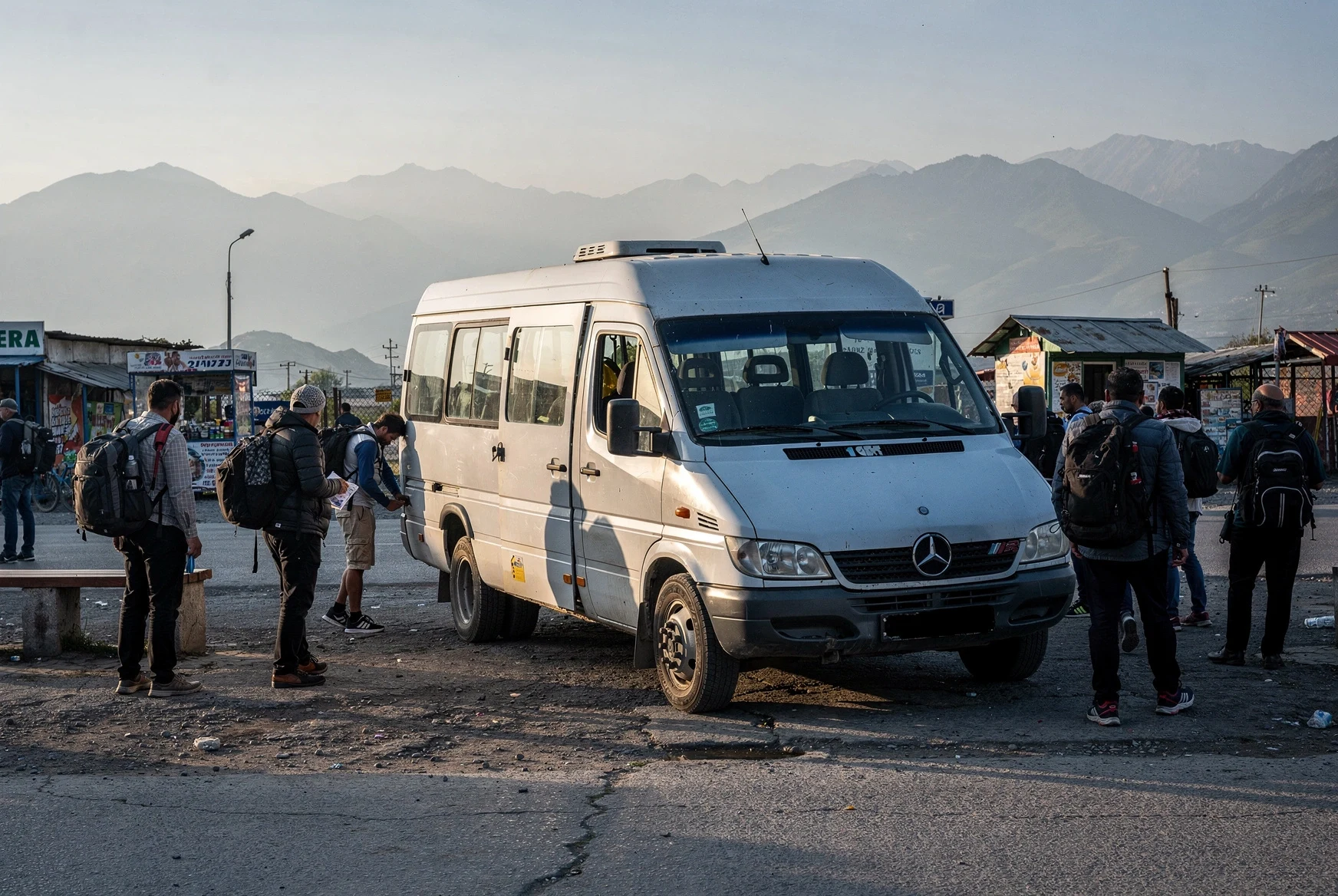
Marshrutkas are one of those Georgian travel experiences that sound charming until you are standing in a chaotic station yard with a backpack, three conflicting directions, and a driver smoking beside a van that may or may not be going where you need. Then they become less folklore, more logistics.
Still, if you are traveling around Georgia, you will probably use one. They remain the backbone of intercity transport for routes trains do not cover well, for mountain destinations, for smaller towns, and for the many trips where a private driver feels excessive and a rental car feels like work. The trick is understanding what marshrutkas are good at — and what they are absolutely not good at.
This guide is the practical version. Not the romantic backpacker version where every cramped minibus becomes a cultural awakening. Sometimes it is just a cheap ride to Kazbegi. Sometimes it is a sweaty wait in Didube. Both things can be true.
What is a marshrutka?
A marshrutka is a minibus running a fixed route, usually between cities, towns, or villages. Think of it as a hybrid between a bus and a shared taxi: the route is set, the departure style is loose, the luggage system is creative, and the entire experience depends more on local habit than formal signage.
In Georgia, marshrutkas are still the default transport for a huge amount of domestic travel. Yes, trains are better for some major routes. Yes, private drivers are better if you value comfort or want scenic stops. But for many trips — especially mountains, regional towns, or budget-friendly one-way travel — the marshrutka is still the practical answer.
The short version
Marshrutkas are cheap, useful, and sometimes mildly ridiculous. Use them when they fit the route well. Do not confuse “common” with “comfortable,” and do not assume there is an elegant central booking system hiding somewhere.
When marshrutkas are a good idea — and when they are not
The sweet spot is simple: use marshrutkas when you need a straightforward point-to-point ride and the alternative would be either an expensive driver or a transport chain involving three separate moves and a small prayer. They work well for places like Kazbegi, Mtskheta, Borjomi, Sighnaghi, Telavi, Kutaisi, Batumi, Akhaltsikhe, and plenty of smaller regional hops.
They are less appealing when comfort matters, when you have a lot of luggage, when you are traveling with kids, when road safety is already making you tense, or when the route is so long that the train clearly makes more sense. Tbilisi to Batumi is the obvious example: yes, there are marshrutkas, but the train is a more civilized way to spend half your day.
Use a marshrutka when
You want the cheapest direct ride, your route does not have a useful train, and you can tolerate a bit of chaos without taking it personally.
Skip it when
You want comfort, fixed schedules you can trust, lots of luggage space, or the freedom to stop for viewpoints, lunch, and monasteries on the way.
If you are still deciding between transport types, read Getting Around Georgia for the wider picture and our train guide if your route sits on the rail network.
Which Tbilisi station to use
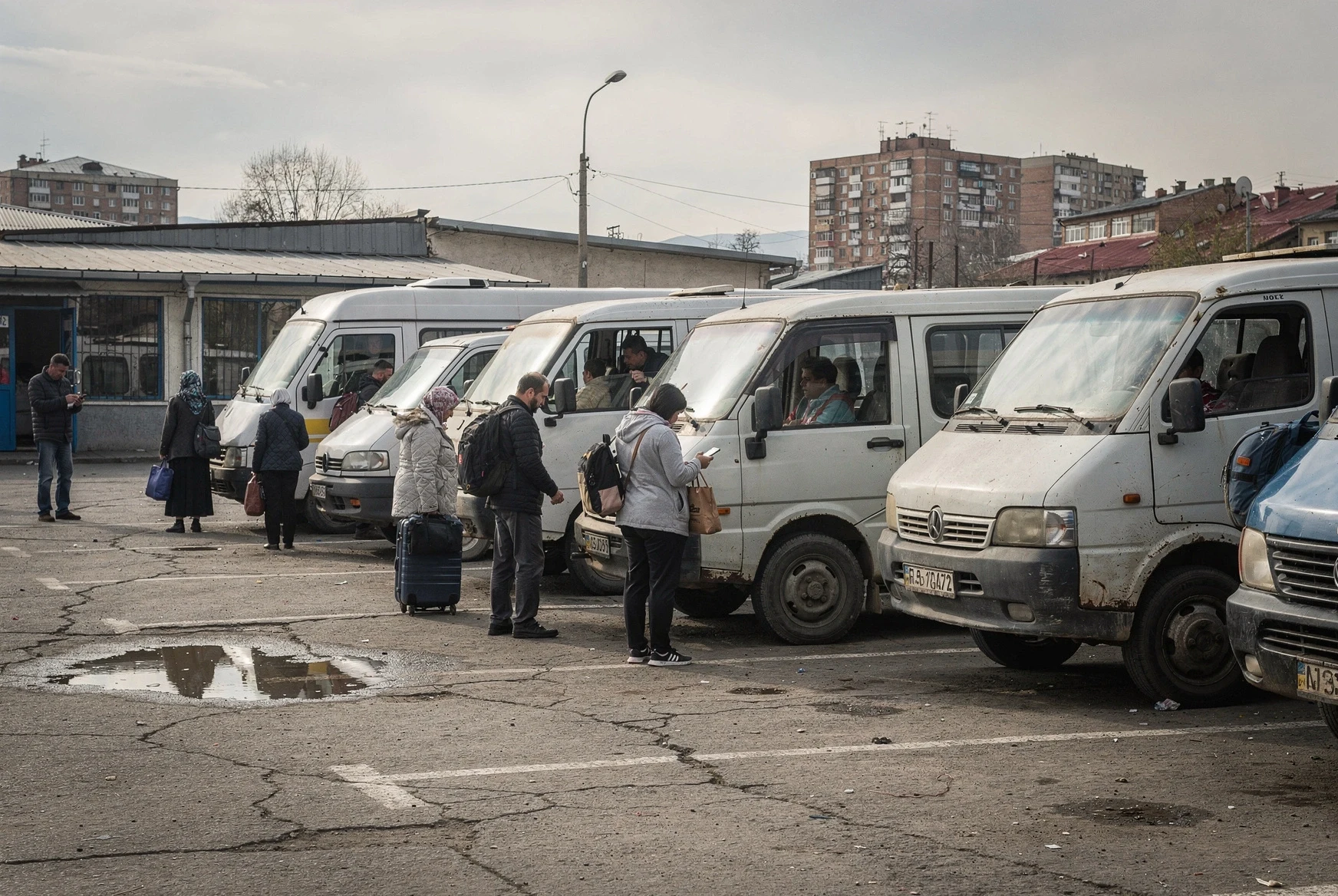
This is where most first-timers mess up. Tbilisi does not have one neat intercity bus terminal serving the whole country. It has several transport hubs, and if you go to the wrong one, you do not get a gold star for effort. You get an annoying detour.
| Station / hub | Best for | Nearest metro / access |
|---|---|---|
| Didube | Kazbegi, Gudauri, Mtskheta, Gori, Borjomi, Kutaisi, Batumi, much of western and northern Georgia | Didube metro |
| Ortachala | Kakheti routes such as Sighnaghi and Telavi, plus some southern and cross-border services | Usually reached by taxi or bus from 300 Aragveli / Isani area |
| Samgori | Rustavi and some eastern or suburban routes | Samgori metro |
| Station Square area | A few regional departures and overflow randomness, but not the clean answer for most tourists | Station Square metro |
The rule is brutally simple: Didube for north and west, Ortachala for Kakheti and many eastern routes. If you are unsure, check with your guesthouse or hotel the night before. Georgian hosts are often better at transport intel than the internet.
Need the station-by-station version?
Read the dedicated Tbilisi Bus Stations Guide for Didube, Ortachala, Samgori, Station Square logic, and the route patterns that trip up first-timers.
Do not improvise your station choice
If your destination is in Kakheti and you head to Didube because “it looked like the main bus station,” you have not discovered a clever shortcut. You have just created an extra problem for yourself.
How departures actually work
Here is the annoying but important nuance: marshrutkas often do have a rough timetable, but that does not mean they behave like proper long-distance coaches. Some routes leave at fixed times. Some leave when full. Some pretend to be fixed-time routes and then wait for a few more passengers anyway. Georgia contains multitudes.
On busy routes, this is not a big problem. Tbilisi to Mtskheta, Kutaisi, Kazbegi, or Batumi usually has enough demand that vans move frequently. On quieter routes, especially outside peak hours, your departure may depend on passenger numbers, local habit, and how optimistic the driver feels about filling the last few seats.
Morning is your friend. Early and mid-morning departures are the most common, especially for mountain routes and smaller towns. If you show up late in the afternoon hoping to improvise transport deep into the regions, sometimes it works and sometimes you discover why locals sorted this before lunch.
My rule of thumb
- For popular routes: arrive 20–30 minutes early.
- For quieter routes or mountain destinations: arrive 30–45 minutes early.
- For remote places: confirm the latest departure the day before with your accommodation.
That small bit of planning saves a disproportionate amount of stress.
How to find the right van
There is no elegant central departures board covering every marshrutka in Georgia. Sometimes there is a timetable posted. Sometimes there are handwritten notes. Sometimes there is only a yard, a few parked minibuses, and a chain of pointing fingers that eventually leads you to the correct vehicle.
The windshield normally shows the destination. The catch is that it may be written only in Georgian. If you know a few Georgian letters, great. If not, say the place name out loud, show it on your phone, and ask directly. Drivers, station workers, and random bystanders are usually pretty helpful once they understand what you are trying to do.
What to show
Have the destination written in English and, ideally, in Georgian on your phone. This works better than trying to pronounce “Stepantsminda” confidently and being sent somewhere else.
What to ask
Ask where the van is, what time it leaves, and whether it goes directly to your stop or only to the final destination on the sign.
Typical fares and route expectations
Prices are usually reasonable enough that the bigger decision is comfort, not money. Below are the kinds of fares travelers commonly encounter on major routes. These can move over time, but the ballpark matters more than pretending every driver in Georgia runs from a sacred identical tariff sheet.
| Route | Typical fare | Typical duration |
|---|---|---|
| Tbilisi → Mtskheta | About 1.50 GEL | About 25 minutes |
| Tbilisi → Kazbegi | About 10 GEL | About 3–3.5 hours |
| Tbilisi → Borjomi | About 10 GEL | About 3 hours |
| Tbilisi → Sighnaghi | About 8 GEL | About 2 hours |
| Tbilisi → Kutaisi | About 15 GEL | About 3.5–4 hours |
| Tbilisi → Batumi | About 25 GEL | About 5–6 hours |
For longer runs like Batumi or Kutaisi, the fare may still look good, but do not let “cheap” bully you into a worse transport choice if the train is available and clearly better for your day.
Luggage, seating, and comfort reality
Marshrutkas are not designed around modern luggage optimism. If you are traveling with a neat backpack or one carry-on-size suitcase, fine. If you have two giant roller bags and shopping from half of Tbilisi, you are becoming the problem.
Some vans have room in the back for bags. Some use every scrap of space creatively. Some will make you keep smaller bags on your lap or under your feet. This is another reason to arrive a bit early: early boarding gives you better seat choice and less argument over where your stuff goes.
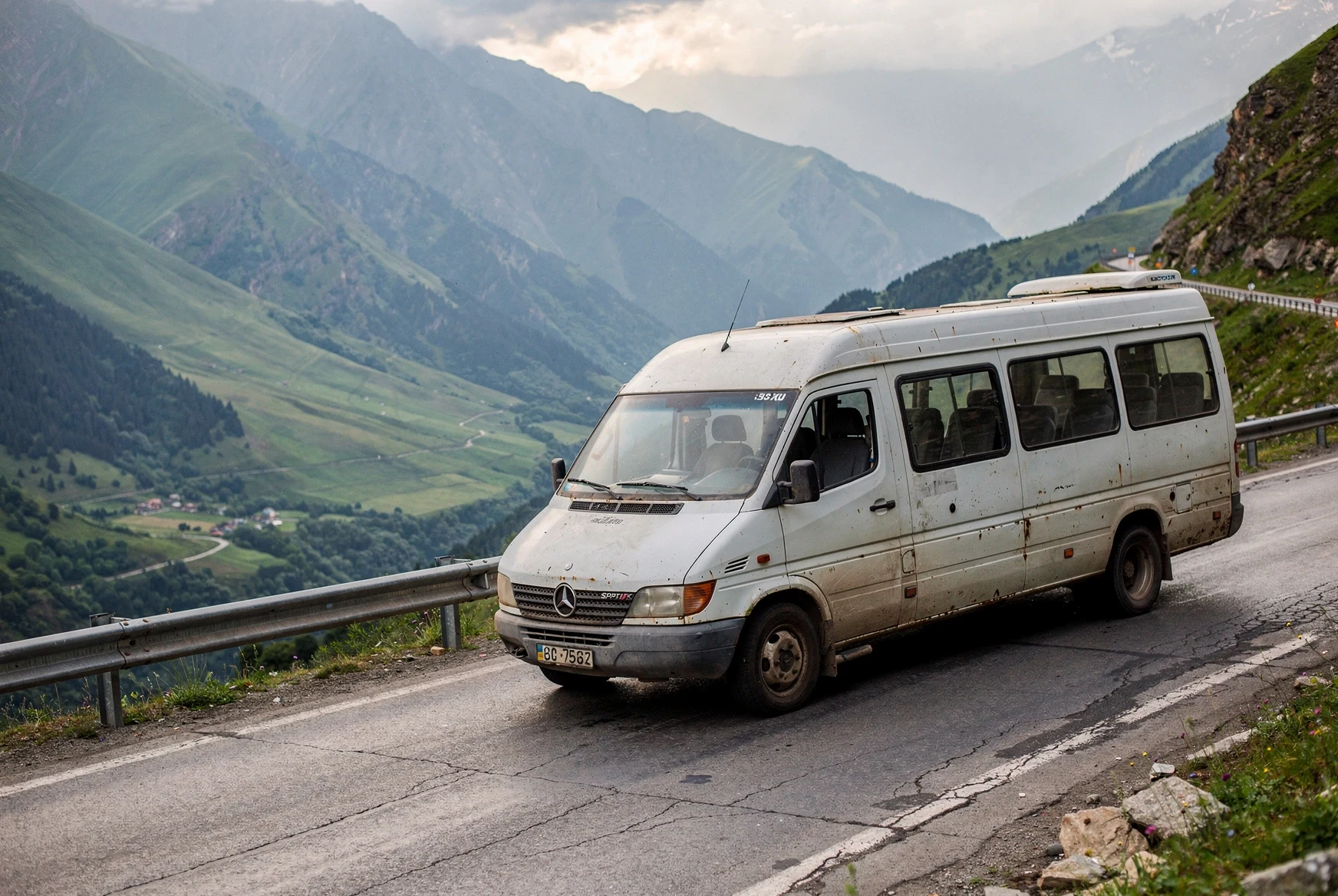
If you get motion sickness, sit toward the front. The rear seats can be rough, especially on mountain roads where suspension feels like an optional extra. Also, if you are tall, accept in advance that marshrutkas were not built around your needs. This is one of those times where the budget option reminds you it is the budget option.
Pack for the transport you are using
Georgia rewards light packing more than many people expect. Marshrutkas, mountain guesthouses, station yards, and random stairs all become easier when you are not dragging an apartment behind you.
How payment works and how to get off
Payment is usually cash. Sometimes you pay when boarding, sometimes once you are moving, sometimes near the end. This is not a crisp international coach system with printed tickets and barcodes. Bring small notes and do not expect the driver to be delighted by your 100-GEL bill for a 10-GEL ride.
If you are not going to the final destination, make sure the driver knows where you need to get off. On many routes, intermediate drop-offs are normal. If you need the van to stop, say გააჩერეთ / gaacheret — “stop” — or make it otherwise very clear. Georgia is not shy. You do not need to whisper your intentions into the seat fabric.
Safety and driving style
This is the part where glossy travel copy gets evasive. Georgian road culture can be aggressive. Marshrutka drivers are not all maniacs, but neither are they known for meditative Scandinavian restraint. Fast overtakes, heavy braking, rough lane discipline, and a general faith-based relationship with space are all things you may encounter.
Most rides are fine. That is also true. But if you are already anxious on roads, it is worth knowing that marshrutkas are not the calmest transport product in the country. On mountain routes, road quality, weather, and driver temperament matter. If that sounds like a bad mix for you, spend the extra money on a private driver or choose a better-timed alternative.
Safer habits
Choose daytime departures, sit near the front, avoid mountain rides in bad weather when possible, and do not force a same-day late transfer into a remote area.
When to spend more
For long mountain journeys, family travel, or if you want scenic stops and sanity, a hired driver is usually money well spent.
Marshrutka vs train vs hired driver
This is the comparison that actually matters. People obsess over whether marshrutkas are “authentic,” which is not a useful transport metric. Better questions: Is it efficient? Is it comfortable enough? Is it the smartest use of your day?
| Option | Best for | Main downside |
|---|---|---|
| Marshrutka | Budget travel, direct regional routes, mountain gateways, flexible one-way trips | Less comfort, less schedule certainty, rougher ride quality |
| Train | Batumi, Zugdidi, Borjomi, major westbound routes where comfort matters | Limited network, fewer routes, some schedules sell out |
| Hired driver / shared taxi | Scenic stops, groups, families, Kakheti loops, mountain roads, maximum ease | Costs more, especially solo |
For routes like Tbilisi to Batumi, the train usually wins. For routes like Tbilisi to Kazbegi, the marshrutka is fine if you want cheap and direct. For Kakheti winery days, a driver is usually smarter than turning transport into a puzzle between wine tastings.
The practical tips that save the most hassle
- Confirm the station the day before. This prevents the dumbest and most common mistake.
- Bring cash and small notes. Do not depend on cards.
- Start early. Late-day improvisation works worse the farther you go from Tbilisi.
- Carry offline maps. Signal and signage are not always enough.
- Pack lightly. Your future self in a cramped van will thank you.
- Know your stop. Especially if you are getting off before the final destination.
- Do not over-romanticize suffering. If a train or driver is obviously better, choose the better option.
Final verdict
Marshrutkas in Georgia are neither the disaster some travelers describe nor the charming folk institution others try too hard to mythologize. They are a useful, imperfect transport tool. On the right route, they are cheap, direct, and completely fine. On the wrong route, they are a cramped reminder that spending a bit more would have bought you a much better day.
Use them strategically. Learn the station logic. Bring cash. Arrive early. And if your transport plan begins to feel like an endurance test rather than a smart decision, that is usually your cue to switch to a train or hire a driver.
Written by The Georgian Guide Team
We live in Tbilisi and have done the glamorous parts of Georgia travel along with the unglamorous ones — including wrong-platform confusion, Didube chaos, and enough marshrutka rides to know when the cheap option is smart and when it is just stubborn.
Last updated: March 2026.