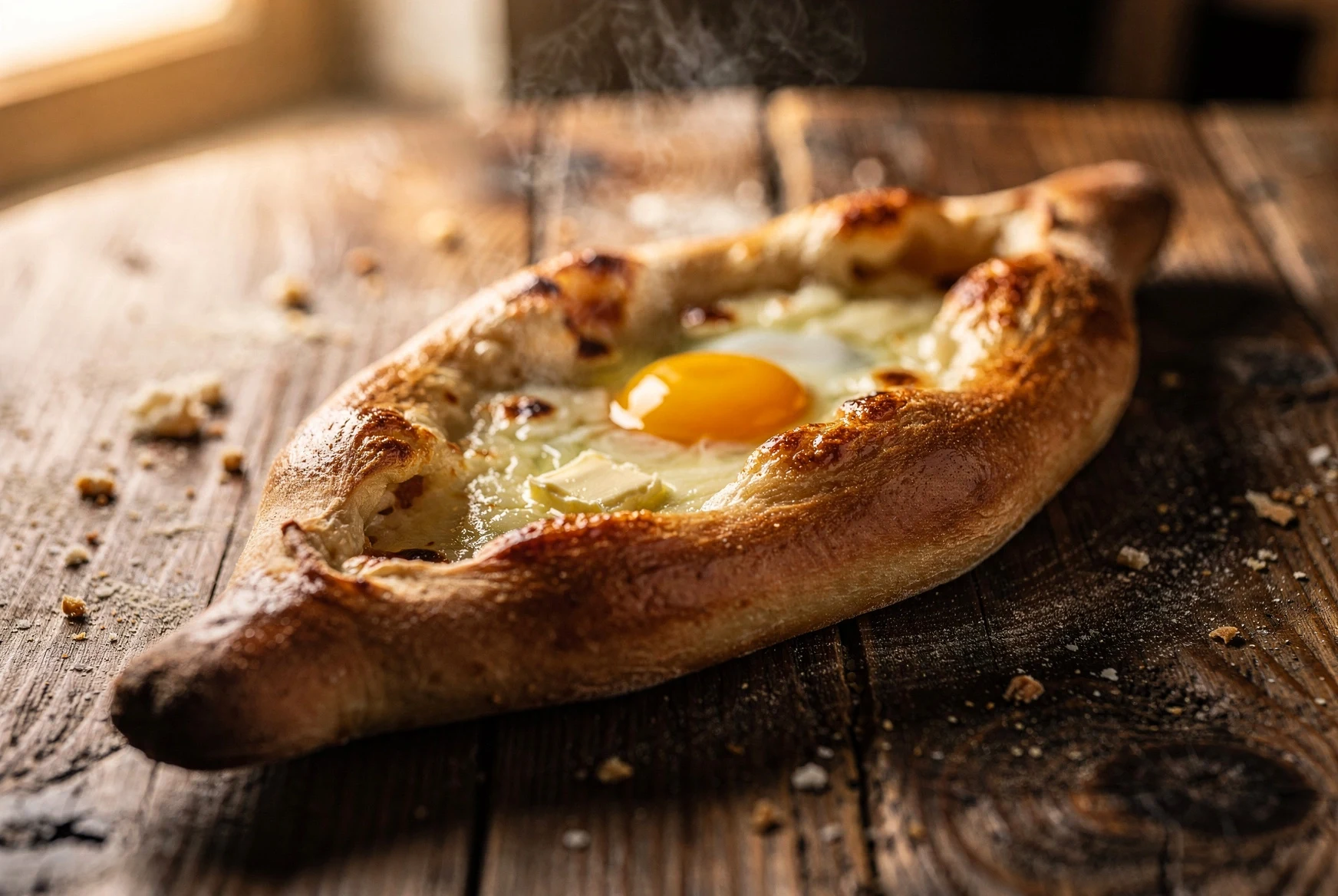
If khinkali is the dish foreigners learn to perform, khachapuri is the one they fall in love with by accident. You order one because it sounds harmless. Bread and cheese. Cute. Then a boat the size of a small aircraft lands on the table with molten sulguni, a raw egg, and enough butter to make your afternoon legally unavailable.
Khachapuri is Georgia's national comfort food, but that description is still too tidy. It is breakfast in some homes, road food in some regions, hangover repair in others, and an absolutely reckless lunch if you also planned to keep moving afterwards. Every part of the country has opinions about what counts as the real version. Those opinions are not polite.
This guide is for travelers who want the proper explanation: what khachapuri actually is, which regional styles matter, how to eat Adjarian khachapuri without looking confused, where to buy the bakery version versus the sit-down restaurant version, and when to stop ordering like your stomach is a political statement.
What is khachapuri, exactly?
At its simplest, khachapuri is Georgian cheese bread. But that is like calling wine "grape liquid" and expecting the job to be done. The word combines khacho and puri, usually understood as cheese and bread, and the dish comes in several regional forms with different doughs, fillings, shapes, and social uses.
Some versions are filled and sealed. Some are open-faced. Some are soft and almost custardy in the middle. Some are crisp and portable enough to eat in a car park outside a roadside bakery. Most use Georgian cheeses like sulguni or imeruli cheese, but the exact mix varies and every cook will tell you the texture depends on balance, not just ingredients.
The quick reality check
Not all khachapuri is heavy, and not all of it is the Instagram boat from Batumi. If you only try the Adjarian version, you have tried the loudest style, not the whole category.
Khachapuri is everywhere because it works in almost every context. It is cheap enough to be everyday food, indulgent enough to be comfort food, and easy enough to standardize that bakeries, cafes, canteens, and serious restaurants can all serve it. Which also means the quality range is wide. A good khachapuri is glorious. A bad one is just oily sadness in bread form.
Why khachapuri matters so much in Georgia
Because it sits right in the middle of Georgian daily life. Tourists often meet it as a novelty dish. Locals do not. For a lot of Georgians, khachapuri is ordinary in the best way. It is what appears on family tables, at roadside stops, in school-adjacent bakeries, during long drives, at supra overflow moments, and in those low-key meals when nobody is trying to impress anyone.
It also maps regional identity unusually clearly. Ask people about wine and the conversation gets philosophical. Ask about khachapuri and it gets territorial fast. Adjara has its boat. Imereti has its round classic. Mingrelia adds more cheese because apparently moderation is a foreign idea. Guria puts boiled egg inside at New Year. Achma goes full layered chaos. Every version tells you something about the region it came from.
And unlike some national dishes that become more symbolic than delicious, khachapuri survives contact with reality. It is not "important" in a museum sense. It is important because it is genuinely good when done right, and because Georgia never made the mistake of treating comfort food with too much restraint.
The main khachapuri styles travelers should actually know
| Style | Region | What it is | Best for |
|---|---|---|---|
| Adjaruli | Adjara | Boat-shaped bread with molten cheese, butter, and egg | First-time spectacle and full-contact indulgence |
| Imeruli | Imereti | Round filled cheese bread, the everyday classic | Road trips, bakeries, and sane lunch decisions |
| Megruli | Samegrelo | Like Imeruli, but with extra cheese baked on top | People who looked at Imeruli and said "more" |
| Achma | Adjara / broader west | Layered sheets of dough and cheese, closer to pie or lasagna | Bakery trays, family meals, and strategic overeating |
| Guruli | Guria | Crescent-shaped bread with cheese and chopped boiled egg | Seasonal curiosity with real regional character |
Those are the versions worth understanding first. There are more, including Penovani khachapuri made with flaky pastry and bakery variants that blur into snack food. But if you know these five, you can read a menu without guessing and order like a person with a plan instead of a person dazzled by melted cheese.
Adjarian khachapuri: the one everyone photographs
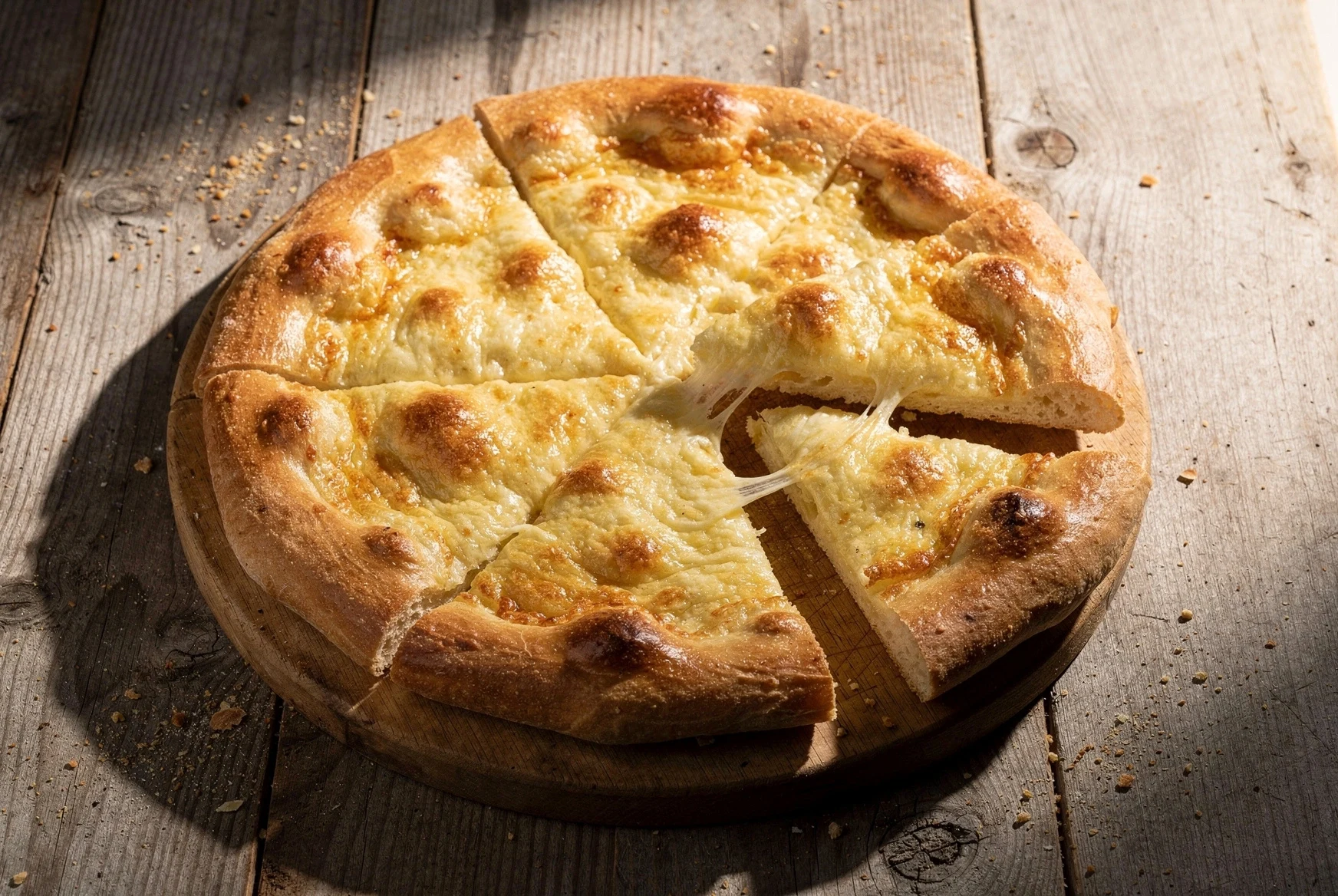
This is the famous one from Batumi and the wider Adjara region: an open boat-shaped bread filled with hot cheese, topped with egg and a chunk of butter that starts melting the second it lands. It deserves the hype, mostly. The problem is that it also attracts a lot of mediocre versions built for photos rather than flavor.
A proper Adjarian khachapuri should arrive blistered and slightly charred at the edges, with bread strong enough to hold the filling but soft enough to tear. The center should be rich but not gluey. The butter is not decorative. The egg is not decorative. You stir them into the cheese, tear off the pointed ends, and use those pieces to scoop the middle until the structure starts losing the argument.
How to eat Adjarian khachapuri
Mix the egg and butter into the hot cheese first. Then tear off the crust from the sides and dip it into the center. Do not attack it with knife-and-fork seriousness unless you enjoy looking like you lost a small domestic battle.
The tourist mistake is ordering Adjarian khachapuri as a side dish. It is not a side dish. It is the event. Order one for the table if other food is coming, or one as your main if you are prepared for a very committed lunch. Also, don't pair it with a second heavy bread dish unless your itinerary for the next two hours is "sit quietly and reconsider."
Imeruli and Megruli: the styles you will probably eat more often
Imeruli khachapuri is the sensible classic. Round, filled, usually less theatrical, often better for everyday eating. If Adjarian is the one that gets posted, Imeruli is the one that actually gets bought on normal days. Bakeries sell it by the slice or whole, road stops keep it warm behind glass, and families put it on the table without making a speech.
Megruli khachapuri takes that model and adds another layer of cheese on top. It is richer, saltier, and slightly more indulgent without the egg-and-butter drama of Adjarian. Samegrelo in general does not have a reputation for cooking timidly, and Megruli is a good example of why.
For travelers, these are often the smarter orders when you want something delicious, portable enough, and less likely to derail the rest of your day. They also show how Georgian food works outside the postcard version. Not everything is designed to become content. Some of it is just meant to be eaten while getting on with your life.
Other versions worth trying if you see them
Achma
Layered, soft, buttery, and held together by cheese. Closer to a Georgian answer to cheese pie than to standard bread. Brilliant when fresh. Heavy enough to qualify as weather.
Guruli
Usually crescent-shaped with chopped boiled egg inside the cheese filling. Strong New Year association in Guria, but you may see it outside the holiday season in bakeries that know what they are doing.
Penovani
Flaky pastry khachapuri sold in bakeries and quick snack spots. Less romantic, more practical. A strong move when you need fuel and have zero interest in a formal meal.
Lobiani's Cheese Cousin
Not khachapuri, but worth mentioning because travelers mix them up constantly. Lobiani is bean-filled, not cheese-filled. If you want the cheaper, less aggressive lunch, lobiani is often the smarter call.
Where to eat khachapuri properly
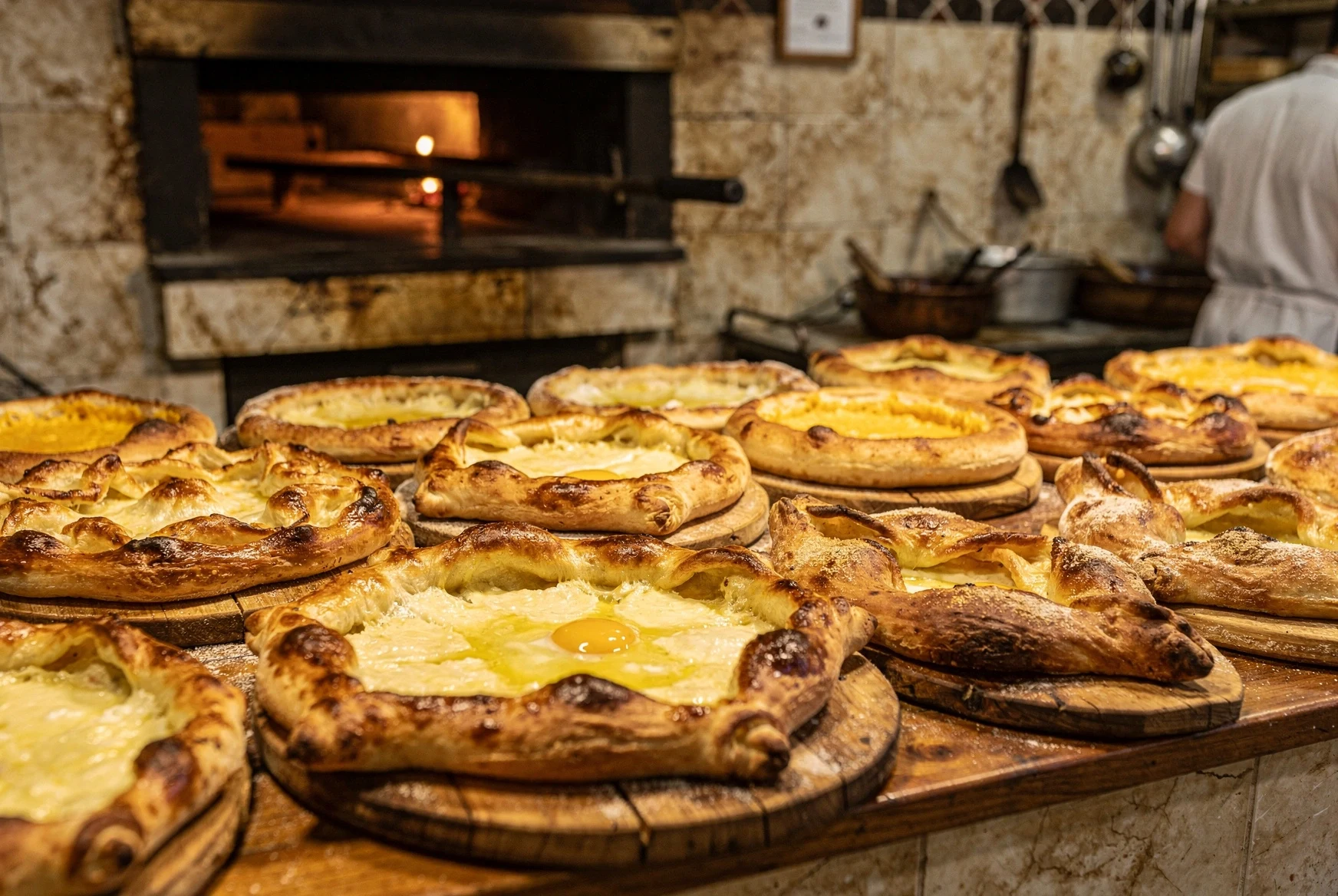
There is no single perfect venue type. The right place depends on which style you want and how seriously you take bread. The short version: bakeries are best for everyday round khachapuri, restaurants are better for full Adjarian service, and roadside stops are often underrated because nobody bothered to decorate them for foreigners.
| Place type | Best order | Why it works |
|---|---|---|
| Neighborhood bakery | Imeruli, Megruli, Penovani | Fast turnover, fresher bread, lower prices, fewer theatrics |
| Sit-down Georgian restaurant | Adjarian or table-sharing orders | Better service, proper plating, easier if you are ordering several dishes |
| Roadside stop | Imeruli or regional house style | Often shockingly good because they cook for locals who would complain loudly |
| Market or food hall | Slices, snacks, quick lunch | Good for sampling without committing to a whole cheese strategy |
In Tbilisi, bakery counters are where you learn what locals actually buy. Not every memorable food experience needs mood lighting. If you want the wider map of where to eat, use our best restaurants in Tbilisi guide and our Tbilisi markets guide. If you are headed west, Batumi and the Adjara coast are where Adjarian khachapuri makes the most contextual sense.
What khachapuri costs in 2026
Prices depend heavily on where you are and whether the place is cooking for locals, tourists, or both. But khachapuri is still one of the more accessible pleasures in Georgia. You can eat a strong bakery version cheaply. You can also overpay for a mediocre one in a polished old-town dining room with a nice playlist.
Typical price range
Cheap does not mean bad here
With khachapuri, the price-quality curve is not elegant. Some of the most satisfying versions come from plain bakeries with fluorescent lighting and zero interest in your travel aesthetic.
Common tourist mistakes with khachapuri
Ordering too much bread at once
Khachapuri plus khinkali plus bread basket plus fries is how you end up walking around Tbilisi like a stunned python. Pick one major carb event.
Only trying Adjarian
It is great, but it is not the whole story. Try Imeruli or Megruli if you want to understand what people actually eat regularly.
Treating it like a side
A whole khachapuri is usually a real meal or at least a serious shared dish. Respect the mass before you commit.
Buying the first sad old slice you see
Freshness matters. If it has been sitting under tired lights for hours, move on. Georgia has enough bakeries that you usually can.
Where travelers should try each style
If your trip is Tbilisi-heavy, you can still try several versions well. The city gets enough regional food traffic that good bakeries and restaurants cover most of the basics. But if you are going to Batumi, that is when Adjarian khachapuri stops being just a dish and starts feeling geographically right. It belongs to the coast the way some foods really do.
If you're in Kutaisi or broader Imereti, order Imeruli. If you're heading to Samegrelo, try Megruli with no apologies. If you spot Achma in western Georgia and it looks fresh, say yes. And if a roadside place on a western route is full of Georgian drivers eating silently and efficiently, that is usually a better signal than a menu translated into six languages.
| If you're going to... | Order this | Why |
|---|---|---|
| Batumi / Adjara | Adjarian khachapuri | The regional original, and usually the version people care most about getting right |
| Kutaisi / Imereti | Imeruli khachapuri | The everyday classic in its home region |
| Samegrelo | Megruli khachapuri | Extra-cheese excess done with regional conviction |
| Tbilisi | A comparative tasting approach | You can sample several styles without changing cities |
Khachapuri vs khinkali: if you only have room for one
The honest answer is that khinkali is the more distinct ritual, but khachapuri is the safer crowd-pleaser. If you are traveling with picky eaters, children, or people who do not want to learn dumpling etiquette under pressure, khachapuri wins easily. Cheese bread travels better across cultural borders than broth-filled dumplings.
If you want the more obviously Georgian social performance, go khinkali. If you want the dish you are most likely to crave again later, go khachapuri. Ideally you do both, just not at the same meal unless your decision-making style is built on regret. Our dedicated khinkali guide is the place to continue that particular argument.
So which khachapuri should you order first?
If it is your first time in Georgia and you want the full dramatic experience, order Adjarian khachapuri once and do it properly. Mix the center. Tear the crust. Accept that your afternoon is now a dairy-based event. Then, on another day, order Imeruli from a good bakery and notice how much more quietly useful it is. That is when the category starts making sense.
The broad rule is simple. Adjarian for spectacle. Imeruli for everyday pleasure. Megruli when you want to lean into excess. Achma when you are in the mood for layers and consequences. And any time you find a bakery that smells right and has fast turnover, trust your nose more than your apps.
For a wider food overview, start with our what to eat in Georgia guide. For quick snack culture, go to the street food guide. But if all you needed was permission to prioritize cheese bread on this trip, here it is.
Written by The Georgian Guide Team
We have eaten far more khachapuri than is medically inspiring, in Tbilisi bakeries, Batumi restaurants, western Georgia road stops, and family tables where saying no was not really on the table.
Last updated: March 2026.
Related Articles
What to Eat in Georgia
The big-picture guide to Georgian dishes, regional specialties, and restaurant reality.
Khinkali in Georgia
How to eat them properly, what fillings matter, and where the best versions actually are.
Georgian Street Food
Bakery snacks, market bites, and the fast cheap stuff worth eating between proper meals.
Batumi Guide
For the city most associated with Adjarian khachapuri and Georgia's Black Sea coast.