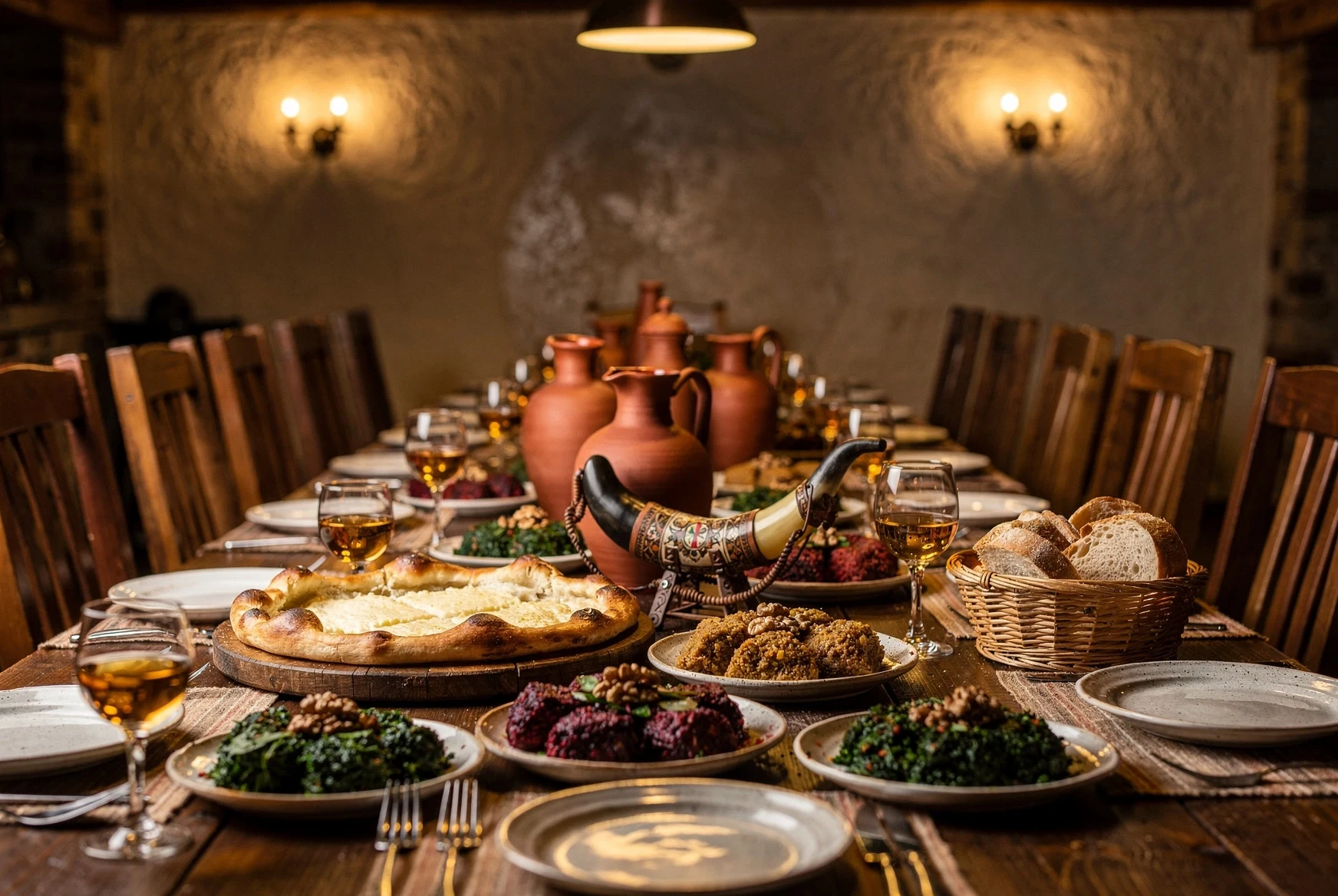
A lot of Georgia gets flattened into one lazy sentence: they're very hospitable. True, but also useless. Plenty of countries are hospitable. Georgia built an operating system around it.
The clearest expression of that system is not just the food-heavy supra itself. It is the way the table is governed: the toasts, the order, the pauses, the emotional gear shifts, the little speeches that start with peace and end with somebody talking sincerely about their dead grandfather while everyone else nods into a glass of amber wine.
At the center of that sits the tamada — the toastmaster. Not a cute local flourish. Not a gimmick for tourists. The person steering the whole thing.
This guide is about that ritual specifically: what the tamada actually does, how Georgian toasts work in real life, what alaverdi means, when you are supposed to drink, what foreigners usually get wrong, and how to participate without either performing fake expertise or sitting there like a frightened exchange student.
What is a tamada, exactly?
The tamada is the person who leads the toasts at a Georgian table. If that sounds small, it isn't. In practice the tamada sets the rhythm of the evening, decides what themes get honored, chooses when others may speak, and keeps the table from collapsing into random drinking with side dishes.
At a serious supra, the tamada is not just the loudest uncle. Ideally, he is someone with presence, timing, memory, and enough emotional intelligence to move the room without turning it into theatre-school nonsense. A good tamada can be funny without becoming a clown, sincere without becoming unbearable, and drunk without visibly becoming useless. That last part matters more than you might expect.
The role is still usually male, especially at traditional family events, village feasts, and weddings. In Tbilisi and among younger circles, the rules are looser and women absolutely can take the role. But if you are visiting Georgia and end up at a classic supra, odds are still high the tamada will be a middle-aged or older man with a surprisingly good memory and a dangerous tolerance for wine.
He is not there to dominate the conversation for vanity reasons. He is there because Georgia does not treat communal drinking as a casual free-for-all. The tamada gives it structure, and the structure is the point.
The short version
If there is a tamada, do not freelance the evening. Wait for the toast, raise your glass with everyone else, and do not start your own speech unless invited or clearly welcomed into the flow.
Why Georgian toasts are different from normal toasts
In much of Europe, a toast is a trigger: somebody says cheers, glasses click, everyone drinks, conversation resumes. In Georgia, a toast is content. It is a miniature speech with a moral center, and people are expected to listen.
That does not mean every toast is grand or mystical. Some are funny. Some are blunt. Some go on too long because the tamada has mistaken himself for Tolstoy. But even the shorter ones tend to have intention behind them. A toast is supposed to name something worth honoring: peace, guests, parents, children, the dead, friendship, love, Georgia itself, the reason everyone gathered, or the future they hope for.
This is why Georgian tables can feel emotionally denser than visitors expect. You are not just eating khachapuri and drinking wine. You are participating in a social ritual where people repeatedly declare what matters to them, in public, often with startling sincerity. It is part dinner, part ceremony, part group therapy with walnuts.
| Normal toast elsewhere | Georgian toast |
|---|---|
| Quick trigger to drink | Short speech with an explicit theme |
| Anyone can throw one in casually | Usually governed by the tamada or host |
| Conversation keeps going through it | People are expected to shut up and listen |
| Mostly about mood | About mood, hierarchy, memory, and meaning |
| One or two per meal | Repeated throughout the entire feast |
How the toast order usually works
There is no single universal script recited identically in every region and every household. Anyone claiming there is has either had too much wine or not enough experience. But there is a recognizable logic, especially at more traditional tables.
Most serious supras move from the large and formal toward the personal and specific. Early toasts establish moral order. Later toasts loosen, deepen, and become more intimate. Somewhere in the middle the whole thing can shift from ceremonial to hilarious and back again.
| Typical point in the meal | Common toast theme | What it does |
|---|---|---|
| Opening | God, peace, or the occasion | Sets seriousness and gives the table a moral center |
| Early | Georgia, guests, parents, elders | Honors the people and values that outrank individual ego |
| Middle | Friendship, love, children, absent friends | Shifts the room into something warmer and more personal |
| Memorial moment | The dead | A quieter, heavier toast; usually not clinked |
| Late | The future, luck, health, spontaneous themes | Lets the table breathe, improvise, and drift into stories |
The order can vary regionally. Some families always begin with peace. Some prioritize God. Some tables move quickly to guests because hospitality is the practical religion of the evening. The main thing to understand is that the sequence is supposed to feel earned. You do not jump straight into horny banter and random jokes when the table is still establishing itself.
And yes, there is usually a toast to the dead at some point. That is not a mood-killer. In Georgia, remembrance sits naturally at the same table as celebration. That combination can surprise visitors from cultures that keep grief and joy more neatly separated.
What is alaverdi?
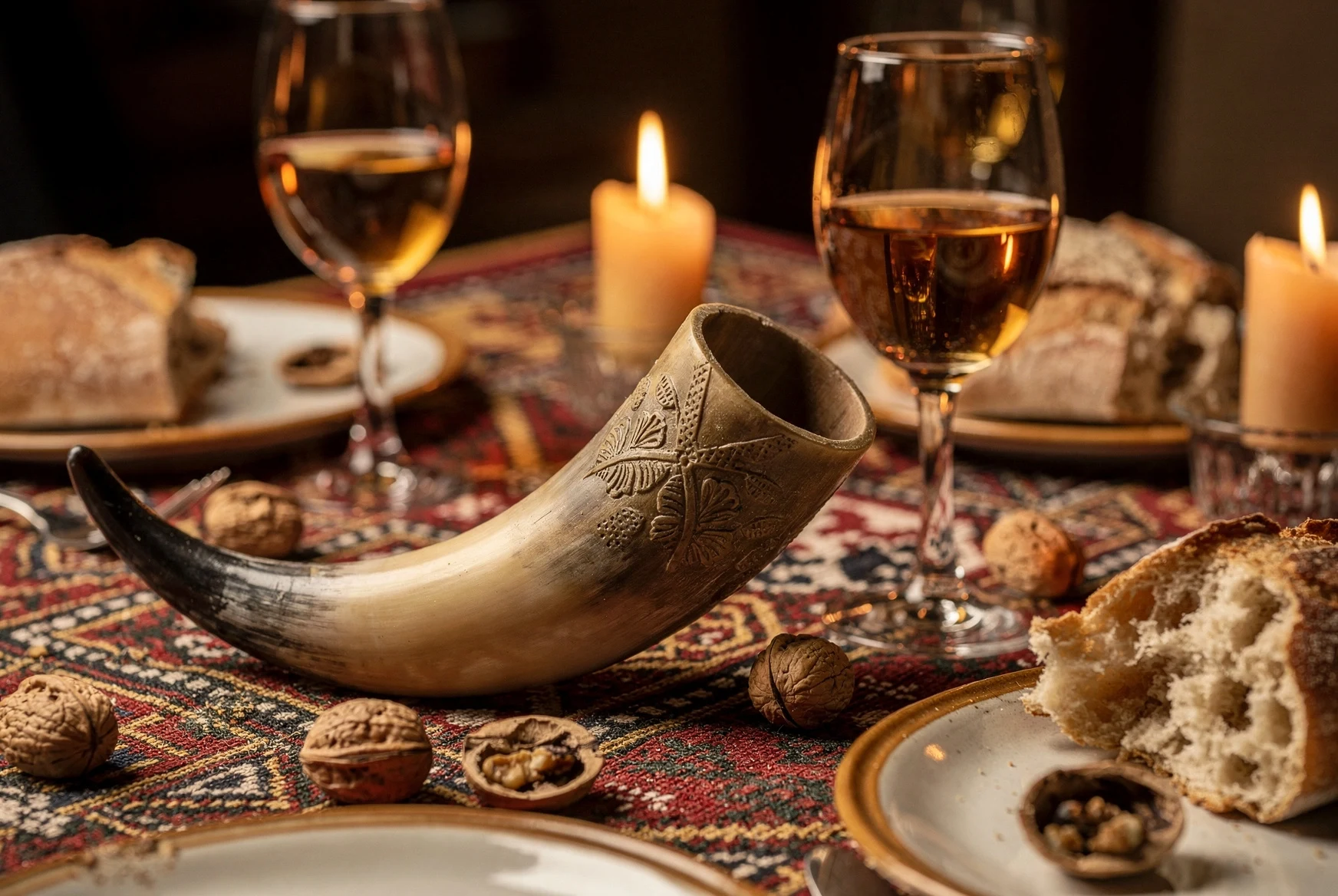
Alaverdi is one of those Georgian words that gets thrown at foreigners because it sounds poetic and faintly mystical. In simple terms, it means the floor is being passed to someone else to continue the same toast theme.
The tamada gives the main toast. Then he may invite another person to add their own words — an extension, not a new topic. That is alaverdi. It can be formal, generous, strategic, affectionate, or slightly dangerous if the chosen speaker has the self-awareness of a lawn chair.
If someone gives you alaverdi, you do not need to deliver a doctoral thesis in comparative sorrow. You just need to stay on theme and say something sincere. If the toast is to parents, talk about parents. If it is to friendship, do not suddenly pivot into crypto, mountain roads, or the superiority of your homeland's beer. This should not need saying. It does.
The safest formula for a foreign guest is simple: thank the table, honor the theme, keep it short, and finish cleanly. Georgia respects sincerity much more than rhetorical gymnastics. Nobody needs you cosplaying a Caucasian philosopher after two glasses of homemade wine.
Good alaverdi
Short, on-theme, specific, and human. One memory or one genuine point is enough.
Bad alaverdi
Long, self-centered, drunk, or totally unrelated to the toast that was just made.
When you actually drink
This is where visitors often panic because they imagine Georgian tables as mandatory full-glass death matches. Reality is more nuanced. The old ideal is indeed that important toasts are honored properly and the glass is emptied. In some traditional circles, especially outside Tbilisi, that expectation still has teeth. In many urban settings, there is more flexibility than the folklore suggests.
What matters most is not theatrical volume of alcohol. It is participation in the ritual. You wait for the toast. You raise your glass with the table. You drink after the speaker finishes. You do not start sipping halfway through because your mouth is dry and you have confused the tamada with background audio.
If you are a foreign guest, you usually get some grace. Georgians know they grew up in this system and you did not. But grace is not the same as invisibility. If everyone is standing for a serious toast and you are fiddling with your fork or checking WhatsApp, yes, you will look stupid.
Do not self-pour like a bar regular
At a proper supra, free-sipping between toasts makes you look like you missed the point. A little casual drinking happens at looser tables, but the formal signal is still: wine follows the toast, not your boredom.
What foreigners usually get wrong
The most common mistake is treating Georgian toasts like entertainment rather than social duty. Visitors often listen with amused anthropologist energy, as if the tamada is performing a quaint custom for them personally. He isn't. He is holding the room together according to a logic everyone else at the table already understands.
The second mistake is trying too hard. Some foreigners learn one or two Georgian words, get invited to say something, and immediately attempt a booming semi-ironic speech they cannot control. This usually lands somewhere between charming and catastrophic. Simpler is better.
The third mistake is assuming more alcohol equals more authenticity. Wrong. A good tamada is respected for control. A guest who gets sloppy, repetitive, loud, or sentimental in the boring way is not becoming Georgian. He is becoming a problem.
Other repeat offenders include:
| Mistake | Why it lands badly |
|---|---|
| Interrupting a toast | It breaks the hierarchy and looks disrespectful immediately |
| Clinking during a toast to the dead | That moment is usually quieter and more restrained |
| Starting a new toast without permission | It cuts across the tamada's role and can feel socially tone-deaf |
| Turning the whole thing into a joke | Humor is welcome; mocking the ritual is not |
| Trying to match locals drink for drink | You are probably outclassed, and bravado ends badly |
How to handle your first serious supra
If this is your first proper Georgian feast, your job is not to impress anybody. Your job is to be a good guest.
Arrive with enough bandwidth for a long evening. Do not book something important two hours later. Eat steadily rather than heroically. Watch the older Georgians for cues. If the room stands, stand. If nobody is talking, do not start. If the tamada nods toward you, say something decent and concise. If you are drinking wine, pace yourself ruthlessly. Georgia is full of people who can out-toast you before dessert without slurring a syllable. This is not the arena for ego.
If you do not drink alcohol, say so clearly and early. That is better than weird half-participation. Many Georgian tables will work around it if you are straightforward and respectful. Water or juice can still be used for the toast itself, especially in mixed or more modern company. The social act matters more than the exact liquid, even if older purists may privately disagree.
And if you genuinely do not understand what was just said? That is normal. Much of the texture of a Georgian toast lives in language, rhythm, and cultural shortcuts that do not transfer perfectly. You can still follow the emotional shape of the room. Usually that is enough.
Before the meal
Do not show up rushed, hungry enough to panic, or with an early escape excuse you expect people to admire.
During the toasts
Listen, watch, raise your glass when everyone else does, and let the table show you the rules before you improvise.
If asked to speak
Thank the host, stay on the theme, keep it short, and finish before you become your own worst enemy.
What a good tamada feels like from the table
The easiest way to understand the role is to think about its absence. Without a tamada, a big table becomes random: side conversations splinter, louder people dominate, drinking loses structure, and the evening drifts into generic noise. With a good tamada, the meal has narrative. It gathers itself repeatedly.
You feel it in the timing. The toast comes just as chatter starts to fragment. A joke lands right before the room gets too solemn. Someone specific gets invited to speak because the tamada knows their story matters to the theme. The dead are remembered without the whole dinner collapsing into gloom. A hard-edged patriotic toast gets followed by something warmer and more human. None of this is accidental.
That is why Georgians still take the role seriously even in much more modern settings. The tamada is not just a relic. He is a social technology. Slightly theatrical, yes. Occasionally exhausting, also yes. But when it works, it produces a table that feels more alive than the average dinner party has any right to be.
Should you try to be a tamada as a visitor?
Almost never.
If a small group of Georgian friends jokingly appoints you tamada for a relaxed dinner and everyone clearly wants the bit, fine. Go ahead and enjoy your brief, doomed reign. But at a real supra, especially a family table, wedding, village gathering, or anything with elders present, the answer is no. That role carries cultural weight you have not earned in a long weekend.
What you can do is participate well. That is enough. Georgia generally rewards good-faith effort more than perfect performance. You do not need to become local in order to be welcomed. You just need to understand which part of the evening belongs to you and which part does not.
Final verdict: what the toasts reveal about Georgia
The tamada and the toasts make visible what Georgia values when nobody is pretending to be modern and frictionless: hierarchy, hospitality, memory, emotional directness, national feeling, family, guests, and the idea that a shared table should mean more than calorie intake.
Sometimes that ritual is moving. Sometimes it is funny. Sometimes it runs too long and you begin negotiating privately with your liver. But even then, it tells you something real about the country. Georgia does not separate eating, drinking, speaking, remembering, and belonging as neatly as many places do. It insists those things happen together.
Which is why the tamada matters. He is not just leading a toast. He is making sure the table stays a table, not just a pile of plates and ethanol.
Written by The Georgian Guide Team
We live in Georgia and have sat through enough supras to know the difference between a warm family toast, a gifted tamada, and a man who should have switched to water three speeches ago.
Last updated: March 2026.
Related Articles
The Georgian Supra
The bigger feast guide: food, wine, music, ritual, and how the whole evening works.
Chacha in Georgia
Because somebody at the table may eventually produce it, and you should know what you are dealing with.
Georgian Wine Culture
The wider story behind qvevri, amber wine, homemade pours, and why the table runs on wine in the first place.
Georgian Culture & Etiquette
The broader unwritten rules around homes, gifts, body language, and social behavior in Georgia.