Gori has a problem that most cities would kill for: everyone knows it. Unfortunately, they know it for one thing — Joseph Stalin was born here in 1878. That single biographical fact has turned a quiet city in central Georgia into one of the country's most visited destinations, which is both its blessing and its curse.
The Stalin Museum is genuinely fascinating — not because it glorifies the man (though it somewhat does), but because it's a bizarre Soviet time capsule that raises uncomfortable questions about how Georgia processes its own history. But if Stalin is all you see, you're missing the point. Fifteen minutes outside town, the ancient cave city of Uplistsikhe predates Stalin by about three thousand years and is one of the most impressive archaeological sites in the Caucasus. The hilltop Gori Fortress has watched over the valley since the Middle Ages. And the city itself — scarred by the 2008 Russian bombing and slowly rebuilding — tells a story about modern Georgia that no museum could capture.
Most visitors treat Gori as a quick day trip box to tick. This guide argues you should give it more attention than that.
Quick Facts
Why Visit Gori
Let's be honest: most people come to Gori because of Stalin. And that's fine — the museum is genuinely worth seeing. But reducing Gori to "Stalin's hometown" is like reducing Stratford-upon-Avon to "Shakespeare's hometown." It's technically true and completely insufficient.
Gori sits in the Shida Kartli region, the geographic heart of Georgia. The Liakhvi River cuts through town, the Greater Caucasus rise to the north, and the broad Kartli Plain stretches in every direction. This has been strategically important land for millennia — which is exactly why Uplistsikhe was built here, why the fortress stands on that hill, and why Russia chose to bomb it in 2008.
🏛️ History in Layers
From Bronze Age cave cities to medieval fortresses to Soviet-era museums to 2008 war scars. Few places pack this much history into such a small area.
🚗 Easy Access
On the main E60 highway between Tbilisi and Kutaisi. Perfect as a day trip or a stop between the two cities.
🏔️ Off the Tourist Trail
Despite the museum's fame, Gori sees far fewer tourists than Mtskheta or Kazbegi. The town itself feels authentically Georgian.
🍷 Kartli Wine Country
Shida Kartli produces excellent wines that get overshadowed by Kakheti. The local reds from Chinuri and Goruli Mtsvane grapes are worth seeking out.
The Stalin Museum
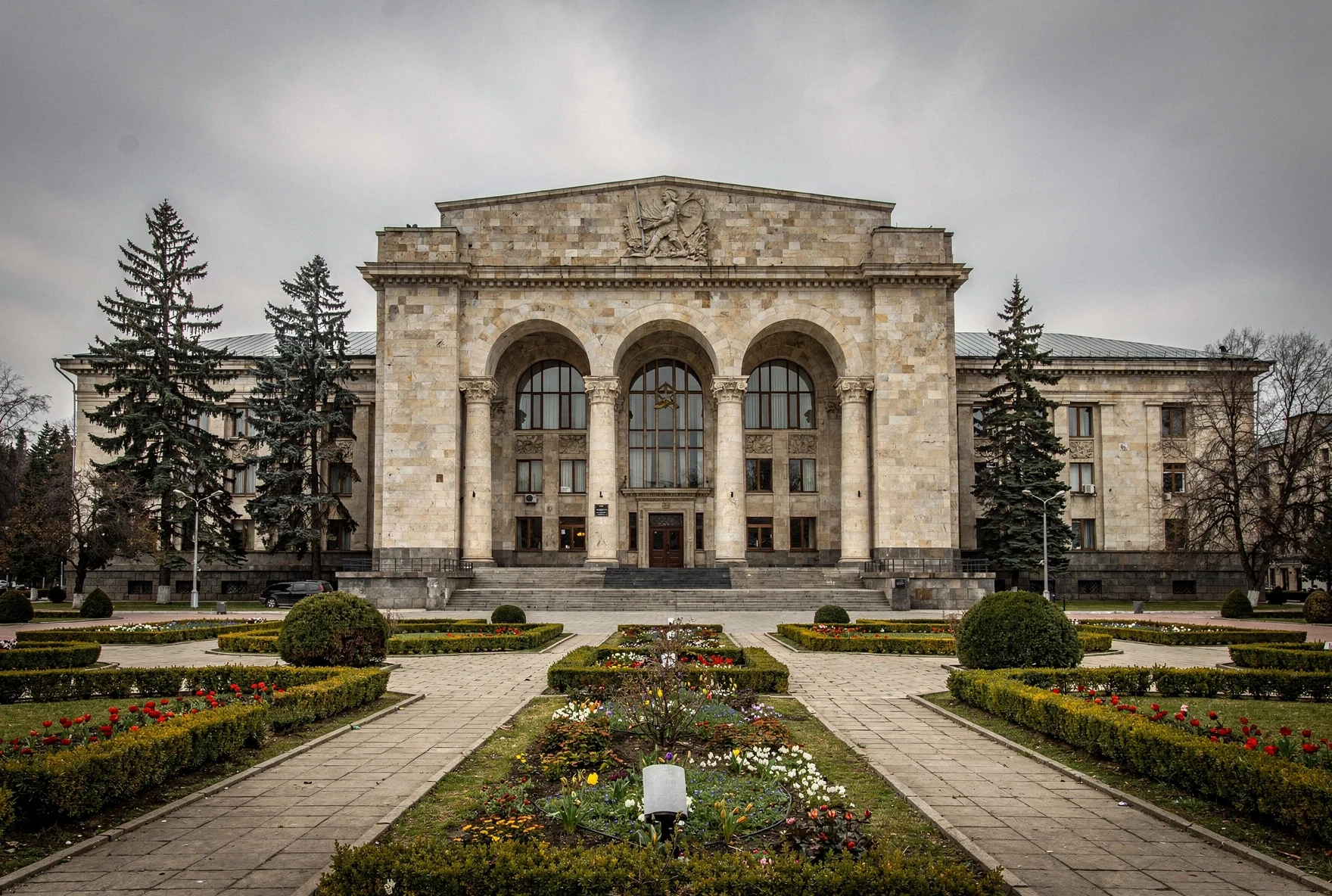
The Joseph Stalin Museum is one of the strangest museum experiences in the world, and that's not hyperbole. It occupies a palatial neoclassical building that was purpose-built in 1957 — four years after Stalin's death — and it's been barely updated since. Walking through its doors is like stepping into an alternate timeline where the full horrors of Stalinism either didn't happen or don't matter.
The museum complex has three parts: the main exhibition hall, Stalin's childhood home (a tiny stone dwelling preserved under a marble pavilion), and his personal armored railway carriage. You'll need separate tickets for the carriage, but it's absolutely worth the extra 5 GEL.
What You'll See
The main hall traces Stalin's life chronologically — from his childhood in this very neighborhood, through his years at the Tiflis Theological Seminary, his revolutionary activities, and his rise to absolute power. There are personal artifacts: his desk, his pipes, his death mask (deeply unsettling). Photographs, letters, gifts from world leaders. His seminary report cards. The documentation is extensive.
What the museum conspicuously avoids is the other side of the ledger. The purges that killed hundreds of thousands. The Gulag system. The forced deportations of entire ethnic groups — including Georgian communities. The famine in Ukraine. There's a small room added in recent years that acknowledges "repressions," but it feels like an afterthought bolted onto what is essentially a hagiography.
The Uncomfortable Question
Georgia's relationship with Stalin is complicated. Older generations sometimes express pride that a Georgian boy from Gori became one of the most powerful people in history — while simultaneously acknowledging the atrocities. Younger Georgians are generally more critical. The museum reflects this ambivalence: it's not exactly celebrating him, but it's certainly not condemning him either. It's worth going in with that context.
Practical Details
| Detail | Information |
|---|---|
| Museum Entry | 15 GEL (~$5.50 USD) |
| Railway Carriage | 5 GEL extra |
| Guided Tour | Included in ticket (English available) |
| Opening Hours | 10:00–18:00, closed Mondays |
| Time Needed | 1–2 hours |
Guided Tour Tip
The English guided tours run at set times and are included in your ticket. They're worth doing — many display labels are only in Georgian and Russian, and the guides provide context that the museum's signage deliberately leaves out. Ask when the next English tour starts when you buy your ticket.
The Railway Carriage
Don't skip this. Stalin famously refused to fly (he took a plane exactly once, to the Tehran Conference in 1943, and reportedly hated it). This green armored carriage was how he traveled across the Soviet Union — to Yalta, Potsdam, and back. Inside, you'll find his personal compartment with original furniture, a meeting room, and a bathroom. The wood paneling, the heavy curtains, the paranoid thickness of the armor plating — it tells you more about the man than a hundred museum plaques.
Uplistsikhe Cave City
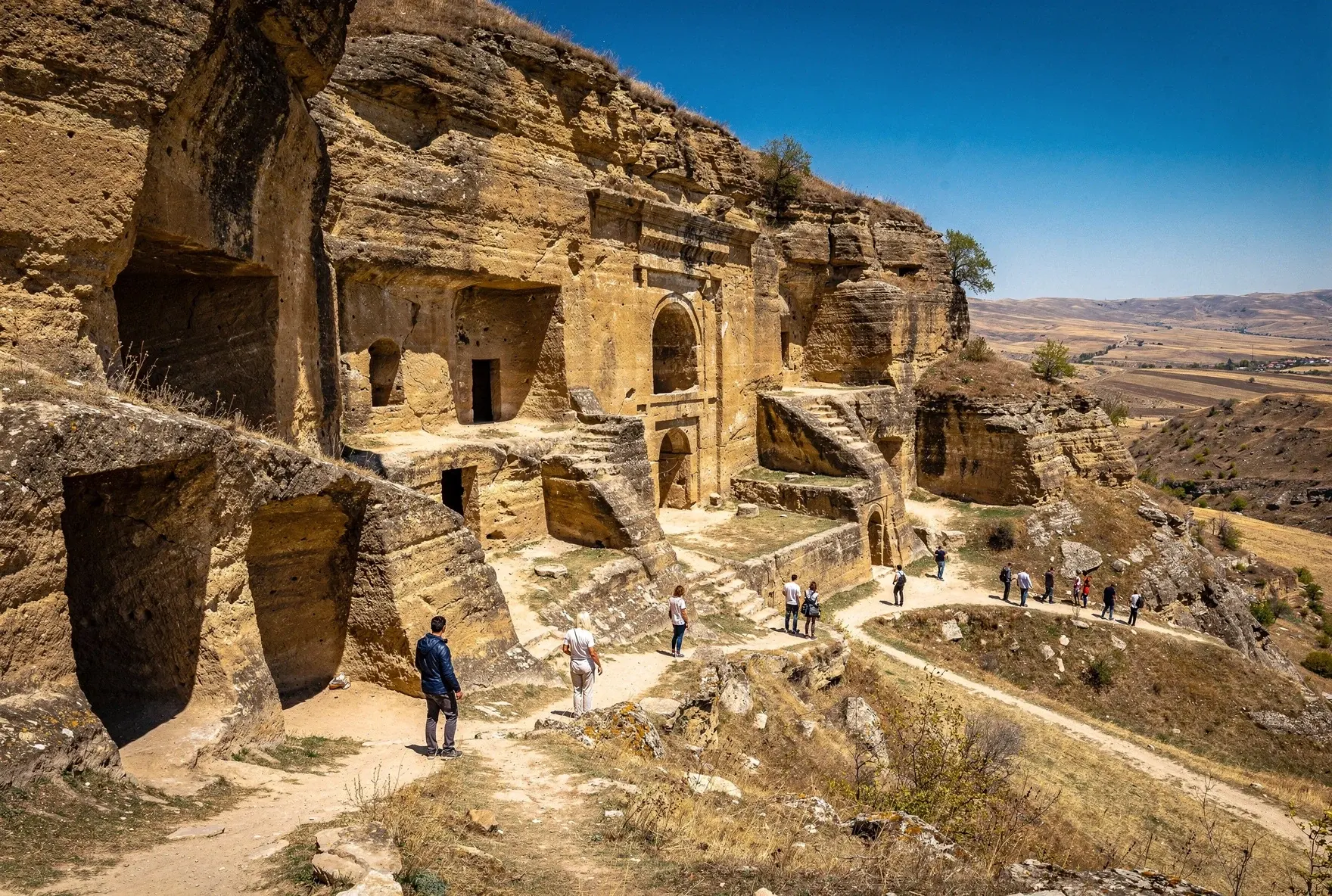
If the Stalin Museum is Gori's complicated headliner, Uplistsikhe is its timeless masterpiece. This rock-hewn city, carved into a sandstone ridge above the Mtkvari River about 15 km east of Gori, has been inhabited since the late Bronze Age — roughly 1000 BCE. That's a thousand years before the Roman Republic, for perspective.
At its peak, Uplistsikhe was a major religious and political center. It held temples, a theater, a pharmacy, wine cellars, and a sophisticated water drainage system — all carved directly from the rock. When Christianity arrived in Georgia in the 4th century, the pagan temples were gradually replaced by churches. The 10th-century basilica that still stands at the top of the site is one of the most photographed buildings in Georgia.
What to Expect
The site is essentially an open-air archaeological park spread across a hillside. You'll climb through carved tunnels, peer into chambers that once served as homes and shops, and walk streets that were carved from living rock three millennia ago. The "Tamara's Hall" — a large cave with a beautifully carved ceiling — is the standout interior space. The views from the top, overlooking the river valley and the Kartli Plain, are spectacular.
It's not small. Plan at least an hour, ideally more. The terrain is uneven — stone steps, slippery surfaces, steep climbs. Wear proper shoes, not flip-flops. In summer, there's almost no shade, and the stone absorbs heat like a furnace. Bring water and a hat.
| Detail | Information |
|---|---|
| Entry Fee | 15 GEL (~$5.50 USD), or 20 GEL with wine tasting |
| Distance from Gori | 15 km (~15 minutes by taxi) |
| Opening Hours | 10:00–18:00 (summer until 19:00) |
| Time Needed | 1–1.5 hours minimum |
| Difficulty | Moderate — uneven terrain, steep stairs, no shade |
The Wine Tasting Is Worth It
For just 5 GEL extra, you get a small tasting at the end of the trail — three wines, two different chacha (Georgian grape spirit), and some snacks. After climbing around in the sun, it's a perfect reward. Easily the best-value wine tasting in Georgia.
Historical Context
What makes Uplistsikhe so remarkable isn't just its age — it's the transition it represents. This was a major pagan religious center with temples dedicated to pre-Christian Georgian sun worship. When King Mirian III converted Georgia to Christianity in 337 CE, Uplistsikhe didn't go quietly. The tension between the new Christian capital at Mtskheta and the pagan stronghold at Uplistsikhe lasted centuries. Eventually, Christianity won. The pagan temples were destroyed or converted, and the basilica at the summit became the site's defining structure.
The city continued to be inhabited through the Middle Ages, serving as a refuge during invasions. The Mongols sacked it in the 13th century, and it was largely abandoned by the 15th century. What you see today is roughly 40% of the original site — the river has eroded the southern section, and earthquakes have taken their toll.
Gori Fortress (Goris Tsikhe)
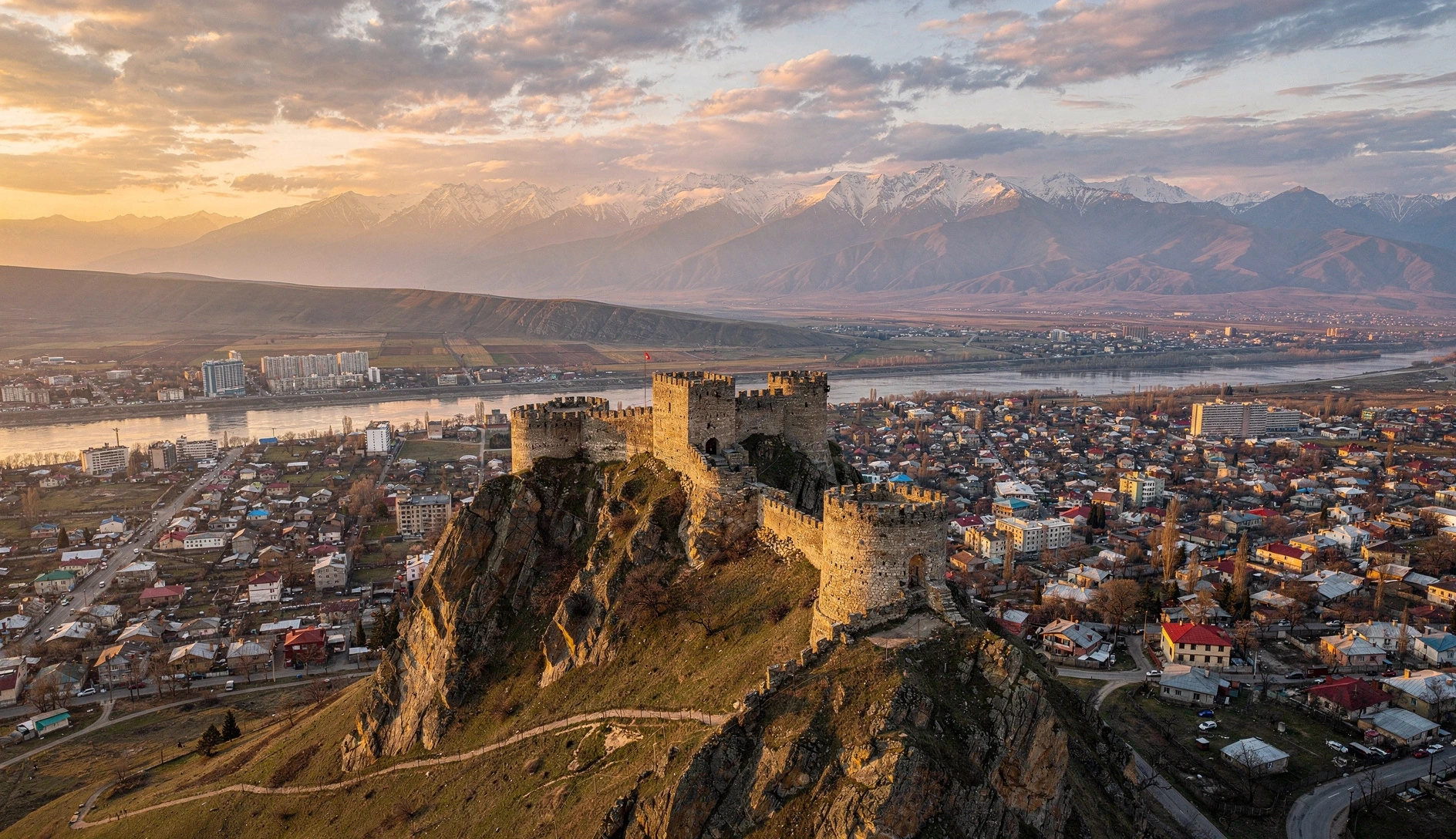
You can see it from anywhere in town: a rugged stone fortress crowning a steep rocky hill right in Gori's center. Goris Tsikhe (literally "Gori's fortress") has stood here in some form since at least the 7th century, though the current walls are mostly medieval.
The fortress itself is partially ruined — there's no museum inside, no exhibits, and limited signage. But that's part of the appeal. You climb the steep path from town (about 10 minutes), pass through the old gate, and you're standing in a crumbling citadel with panoramic views over the entire city, the river valley, and the surrounding mountains. On a clear day, you can see Uplistsikhe in the distance.
It's free to visit, takes about 30–45 minutes, and is best at golden hour when the light paints the stone walls amber. The approach from Stalin Avenue involves a steep but short climb — there are rough stone steps most of the way.
Best Photo Spot
The northwest corner of the fortress walls gives you the best view over Gori with the Caucasus behind. Late afternoon light is ideal. The fortress also looks dramatic from below — the best angle is from the park along the Liakhvi River.
The 2008 War: Gori's Modern Scar
You can't write about Gori honestly without mentioning the war. In August 2008, during the brief but devastating Russo-Georgian War, Russian forces occupied Gori for several days. The city — which sits just 25 km from the South Ossetian border — was bombed by Russian aircraft. An apartment block near the center was hit, killing civilians. The main square was shelled.
Russia's stated justification was protecting South Ossetian civilians from Georgian military action. Georgia and most Western governments saw it as a disproportionate invasion of a sovereign state. The geopolitics are beyond the scope of a travel guide, but the scars aren't. Some damaged buildings have been rebuilt; others still bear marks. The proximity to the occupied territories of South Ossetia remains a reality — the "border" (which Georgia doesn't recognize) is close enough that you'll see EU Monitoring Mission vehicles around town.
Locals don't shy away from the topic. If you ask, most Georgians in Gori have a story from August 2008. It's part of the city's identity now, alongside the fortress, the caves, and yes, Stalin.
Other Things to Do in Gori
🏛️ Shida Kartli Museum
The regional museum on the main square has archaeological finds from Uplistsikhe and the broader region. Small but well-curated. Good complement to the cave city visit.
⛪ Cathedral of the Blessed Virgin
A 17th-century Orthodox church near the fortress. Simple interior, peaceful courtyard. Worth a quick stop on your way up to the fortress.
🌳 Central Park
The park along the Liakhvi River is where locals hang out. It's pleasant for a walk and gives you good views of the fortress above. Street food vendors in summer.
🍽️ Gori Market
The bazaar behind the main square is a proper Georgian market — fruit, spices, churchkhela, fresh bread. More interesting than any restaurant for experiencing local life.
How to Get There
From Tbilisi
Gori is 86 km west of Tbilisi on the E60 highway — the main artery connecting eastern and western Georgia. You have several options:
| Transport | Duration | Cost | Notes |
|---|---|---|---|
| Marshrutka | ~1.5 hours | 7 GEL | Departs from Didube station every 30 min |
| Train | ~1.5 hours | 2–5 GEL | Several daily from Tbilisi Central. Cheap but less frequent. |
| Taxi / Bolt | ~1 hour | 50–70 GEL | Fastest option. Can include Uplistsikhe stop. |
| Day Tour | Full day | 80–150 GEL | Usually combines Mtskheta + Gori + Uplistsikhe |
| Rental Car | ~1 hour | From 80 GEL/day | Best for flexibility. Easy highway driving. |
The Smart Route
If you're traveling between Tbilisi and Kutaisi (or Batumi), Gori and Uplistsikhe are directly on the way. Stop for a few hours instead of making a separate day trip. This is the most efficient way to see both sites without backtracking.
Getting to Uplistsikhe from Gori
Uplistsikhe is 15 km east of Gori. A taxi from central Gori costs about 15–20 GEL one way (negotiate a round trip with waiting time for 40–50 GEL). There's no reliable public transport to the site. If you're driving, the road is well-marked and paved all the way.
Suggested Day Trip Itinerary
Here's how to structure a day that covers the highlights without feeling rushed:
| Time | Activity | Duration |
|---|---|---|
| 9:00 AM | Leave Tbilisi (marshrutka from Didube or taxi) | 1–1.5 hours |
| 10:30 AM | Stalin Museum (arrive for first English tour) | 1.5 hours |
| 12:00 PM | Walk to Gori Fortress for views | 45 min |
| 1:00 PM | Lunch in town (see recommendations below) | 1 hour |
| 2:00 PM | Taxi to Uplistsikhe | 15 min |
| 2:15 PM | Explore Uplistsikhe + wine tasting | 1.5 hours |
| 4:00 PM | Return to Gori, head back to Tbilisi | 1.5 hours |
This gets you back to Tbilisi by 5:30 PM with time to spare. If you're combining with Mtskheta (which is on the way), add it as a morning stop and start an hour earlier.
Where to Eat
Gori isn't a food destination. Let's be upfront about that. There are no Michelin contenders, no Instagram-famous cafes. What you'll find are straightforward Georgian restaurants serving honest food at local prices — which, honestly, is what you want.
Shin Da Gori
The most reliable restaurant in town. Good khinkali, solid grilled meats, pleasant terrace. Near the main square. Budget 20–30 GEL per person.
Restaurant Victoria
A local favorite with a big menu. The mtsvadi (grilled pork skewers) and lobiani (bean-filled bread) are the moves here. Very affordable.
The Market
Skip the restaurants entirely and eat at the bazaar. Fresh tonis puri (bread from a clay oven), churchkhela, seasonal fruit. More memorable than any sit-down meal.
Near Uplistsikhe
A couple of small restaurants near the Uplistsikhe parking lot serve basic Georgian food. Nothing fancy, but cold beer and khachapuri after climbing caves hits different.
Practical Tips
☀️ Best Season
Spring (April–May) and autumn (September–October) are ideal. Summers are brutally hot in Shida Kartli — 35°C+ and no shade at Uplistsikhe. Winter is fine for the museum but bleak for the caves.
🥾 Footwear
Uplistsikhe requires proper shoes. The rock surfaces are smooth and slippery, with steep carved stairs. Sandals and flip-flops are genuinely dangerous here.
💳 Cash
Bring cash. The museum and Uplistsikhe accept card payments, but taxis, the market, and smaller restaurants are cash only. There are ATMs on Gori's main street.
🗣️ Language
English is limited outside the museums. A few Georgian phrases go a long way. Younger people in town may speak some English, but don't count on it.
Is Gori Worth Visiting?
Yes, but with the right expectations. Gori is not Tbilisi or Kazbegi — it won't make your jaw drop with scenic beauty or cosmopolitan energy. What it offers is something different: layers of history that you can physically walk through, from Bronze Age cave cities to Soviet propaganda to 21st-century war. That combination doesn't exist anywhere else in Georgia.
The Stalin Museum alone justifies the trip. Love him, hate him, or (most accurately) both — seeing how Georgia presents this figure to the world is a genuinely thought-provoking experience. And Uplistsikhe is one of those places that makes you recalibrate your sense of time. When you're standing in a 3,000-year-old pharmacy carved from solid rock, the Stalin Museum starts to feel like it was built yesterday.
If you only have one day free from Tbilisi, the Mtskheta–Gori–Uplistsikhe loop is arguably the best day trip in the country. Three UNESCO-caliber sites, completely different from each other, all connected by an easy highway drive. That's hard to beat.
Frequently Asked Questions
Is the Stalin Museum propaganda?
Somewhat, yes — though not in a heavy-handed way. The museum was built during the Soviet era and has only been lightly updated. It focuses heavily on Stalin's personal story while downplaying the mass repression. Think of it less as "propaganda" and more as "selective curation." That selectivity itself is part of what makes it interesting to visit.
Can I combine Gori with Mtskheta?
Absolutely, and you should. Mtskheta is on the way from Tbilisi to Gori. Stop at Jvari Monastery and Svetitskhoveli Cathedral in the morning, then continue to Gori and Uplistsikhe in the afternoon. This is one of the most popular day trip routes in Georgia.
Is Gori safe? It's near South Ossetia...
Gori is completely safe for tourists. While the South Ossetian "border" is only about 25 km north, the city itself is a normal functioning Georgian city with no security issues. You'll see EU monitoring vehicles around, which is actually reassuring. Do not attempt to approach or cross into South Ossetia — it's illegal under Georgian law and potentially dangerous.
Should I stay overnight in Gori?
For most visitors, a day trip is enough. There are guesthouses if you want to stay, but Gori's nightlife is essentially nonexistent, and the main attractions can be comfortably covered in half a day. Your time is better spent sleeping in Tbilisi or continuing west toward Kutaisi.
Are the museums open year-round?
The Stalin Museum is open year-round except Mondays. Uplistsikhe is also open year-round but can be slippery and less enjoyable in rain or snow. Both have reduced hours in winter (closing at 17:00 instead of 18:00). Always check locally as hours can change.
Written by The Georgian Guide Team
We live in Georgia and write from personal experience. Our guides are based on actual visits, honest opinions, and a deep appreciation for this complicated, beautiful country. We update our content regularly to keep it accurate.
Last updated: February 2026.
Related Articles
Day Trips from Tbilisi
The best day trips from Georgia's capital — including Mtskheta, Gori, and beyond.
Mtskheta Guide
Georgia's ancient capital and spiritual heart — perfect to combine with Gori.
Vardzia Cave City
Georgia's other famous cave city — a medieval monastery carved into a cliff face.
Getting Around Georgia
Everything about marshrutkas, trains, taxis, and rental cars in Georgia.