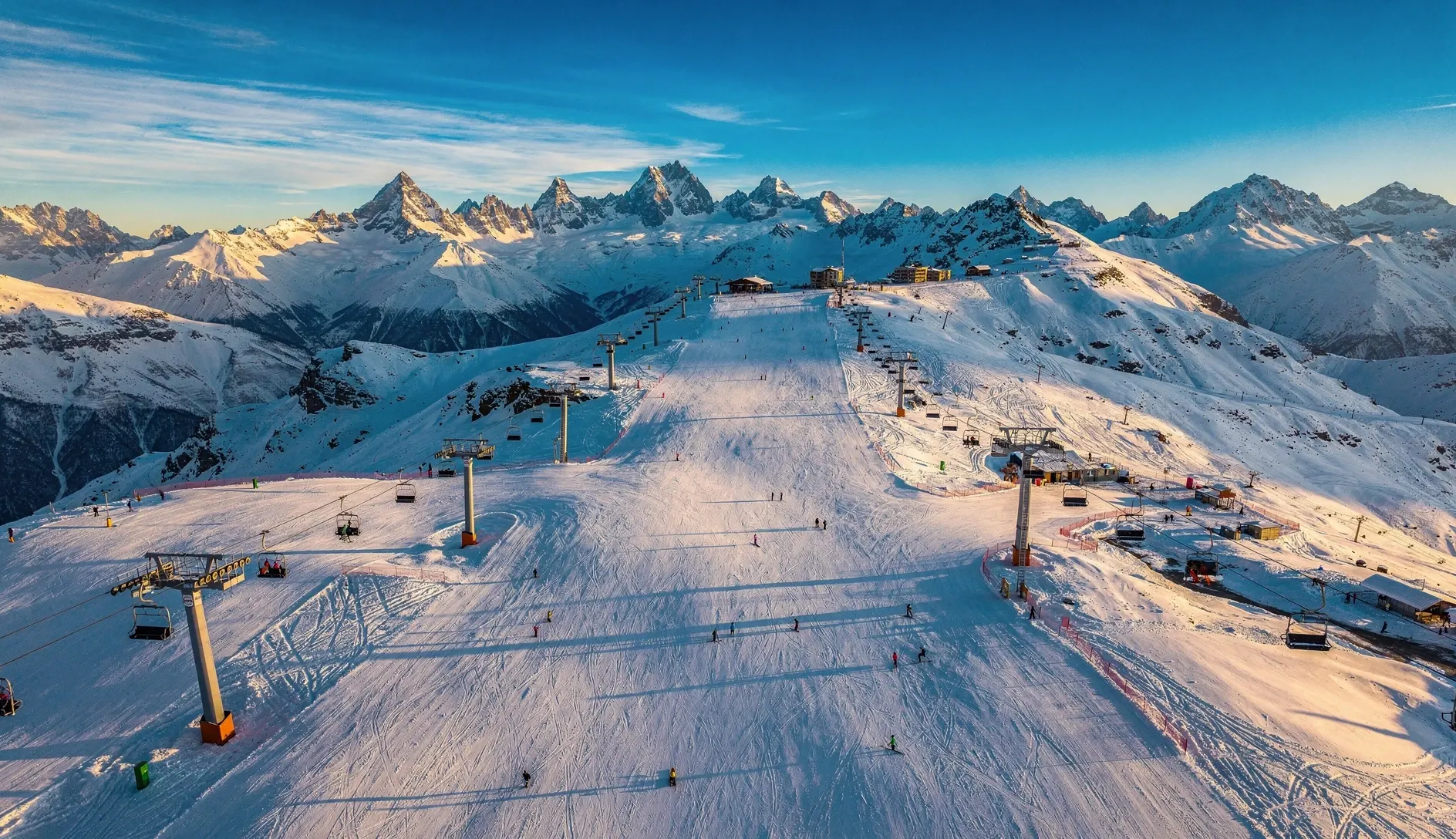
Gudauri is the reason people have started saying "Georgia" and "skiing" in the same sentence. Two hours north of Tbilisi, perched at 2,200 meters on the southern face of the Greater Caucasus, it's a purpose-built resort with 80 kilometers of groomed runs, world-class freeride terrain, and lift passes that cost less than a decent lunch in the Alps. The snow is reliable, the mountains are enormous, and on a powder day there's genuinely nowhere better for the price.
But here's the thing nobody tells you: Gudauri is not Chamonix. It's not Verbier. It's a post-Soviet resort that's been rapidly modernized over the past decade, and that means the skiing can be exceptional while the overall experience has some rough edges. The town is essentially a strip of apartment blocks and hotels along a mountain road. Après-ski means a handful of bars in building lobbies. The road up can close without warning. And peak season crowds — especially during Russian and UAE holidays — can turn those empty Caucasus slopes into a queue simulator.
None of that stops it from being one of the best-value ski destinations on earth. You just need to know what you're getting into. This guide covers everything — from which weeks to avoid to where the best freeride lines are — based on multiple winters spent here.
Quick Facts
Why Gudauri? The Honest Case
Let's start with what Gudauri does better than almost anywhere in Europe: value. A full day of skiing — lift pass, rental gear, lunch on the mountain — will run you about 150–200 GEL ($55–75). In Austria or France, that's just the lift pass. A week in Gudauri costs what a long weekend costs in the Alps.
Then there's the terrain. Because Gudauri sits entirely above the treeline, you get this extraordinary open-bowl skiing that feels more like the Rockies than Europe. On a clear day, you can see ridge after ridge of the Greater Caucasus extending in every direction. The vertical drop is over 1,000 meters. The freeride terrain is accessible directly from the lifts — no hiking required. And because Georgia still flies under the radar, you'll find untracked powder hours after a snowfall that would be skied out in minutes at a mainstream resort.
The downsides? Infrastructure is improving but still inconsistent. The town lacks character. Weather windows can be narrow. And the road access is a single route that occasionally closes. More on all of that below.
When to Go (and When to Avoid)
The season typically runs from late December through mid-April, though exact dates depend on snowfall. Recent seasons have opened between December 20–27 and closed around April 12–17.
| Period | Conditions | Crowds | Verdict |
|---|---|---|---|
| Late Dec – Jan 7 | Variable early snow | Very busy (New Year/Christmas) | Avoid unless you love crowds and high prices |
| Mid-Jan – Feb | Best snow, cold temps | Moderate | Sweet spot — best conditions, fewest people |
| March | Good snow, longer days, warmer | Busy (UAE spring break late March) | Great skiing but watch the late-March surge |
| April | Spring snow, slushy afternoons | Low | Corn snow mornings, T-shirt skiing, bargain prices |
The Sweet Spot
Mid-January through late February gives you the best combination of snow quality and empty slopes. Weekdays are dramatically quieter than weekends — many Georgian families drive up from Tbilisi on Saturdays.
Getting to Gudauri from Tbilisi
Gudauri sits 120 kilometers north of Tbilisi along the Georgian Military Highway, one of the most spectacular mountain roads in the world. The drive climbs through the Aragvi Valley, passes the ancient fortress at Ananuri, and winds up to the Cross Pass (Jvari Pass) at 2,379 meters before dropping into the resort.
| Option | Duration | Cost | Notes |
|---|---|---|---|
| Marshrutka | 2.5–3 hours | 15–20 GEL | From Didube station. Tell driver "Gudauri." Awkward with ski gear. |
| Shared taxi | 2–2.5 hours | 30–40 GEL/person | From Didube. Faster but still tight for gear. Negotiate trunk space. |
| Private transfer | 2–2.5 hours | 150–200 GEL total | Book through your hotel or Bolt. Best option with gear. |
| Rental car | 2–2.5 hours | 80–150 GEL/day | Winter tires mandatory. Chains recommended. Check insurance covers mountain roads. |
Road Closures Are Real
The Gudauri–Kobi section of the highway closes during heavy snowfall and avalanche risk. There is no alternative route. This can mean being stuck in Gudauri for an extra day (or stuck in Tbilisi unable to get there). Build flexibility into your schedule, especially in January–February. Check road status at police.ge or ask your hotel.
Understanding the Resort Layout
Gudauri isn't a single village with a central square. It's a long strip of development spread along the highway, divided into three loosely defined zones:
Old Gudauri
The original section, lower on the road. Older hotels, a few shops, and the cheapest accommodation. Furthest from the main lifts — you'll need to take a connecting lift or drive up.
New Gudauri
The modern hub. Apartment complexes, the main gondola base, most restaurants and rental shops. This is where you want to be for convenience — some buildings offer true ski-in/ski-out access.
Recreation Zone
Higher up from New Gudauri, near the top of the gondola. Snow parks, additional lifts accessing the upper mountain, and a cluster of on-mountain restaurants. The best skiing starts here.
Kobi Side (New)
North-facing slopes accessed via the Kobi lift. Colder snow that holds quality longer. The newest expansion area with serious vertical and fewer crowds.
The entire ski area is connected by 15 modern Doppelmayr lifts — a mix of gondolas, high-speed quads, and surface lifts. Once you're on the mountain, getting between zones is straightforward. It's the base logistics that take some figuring out.
Slopes and Terrain
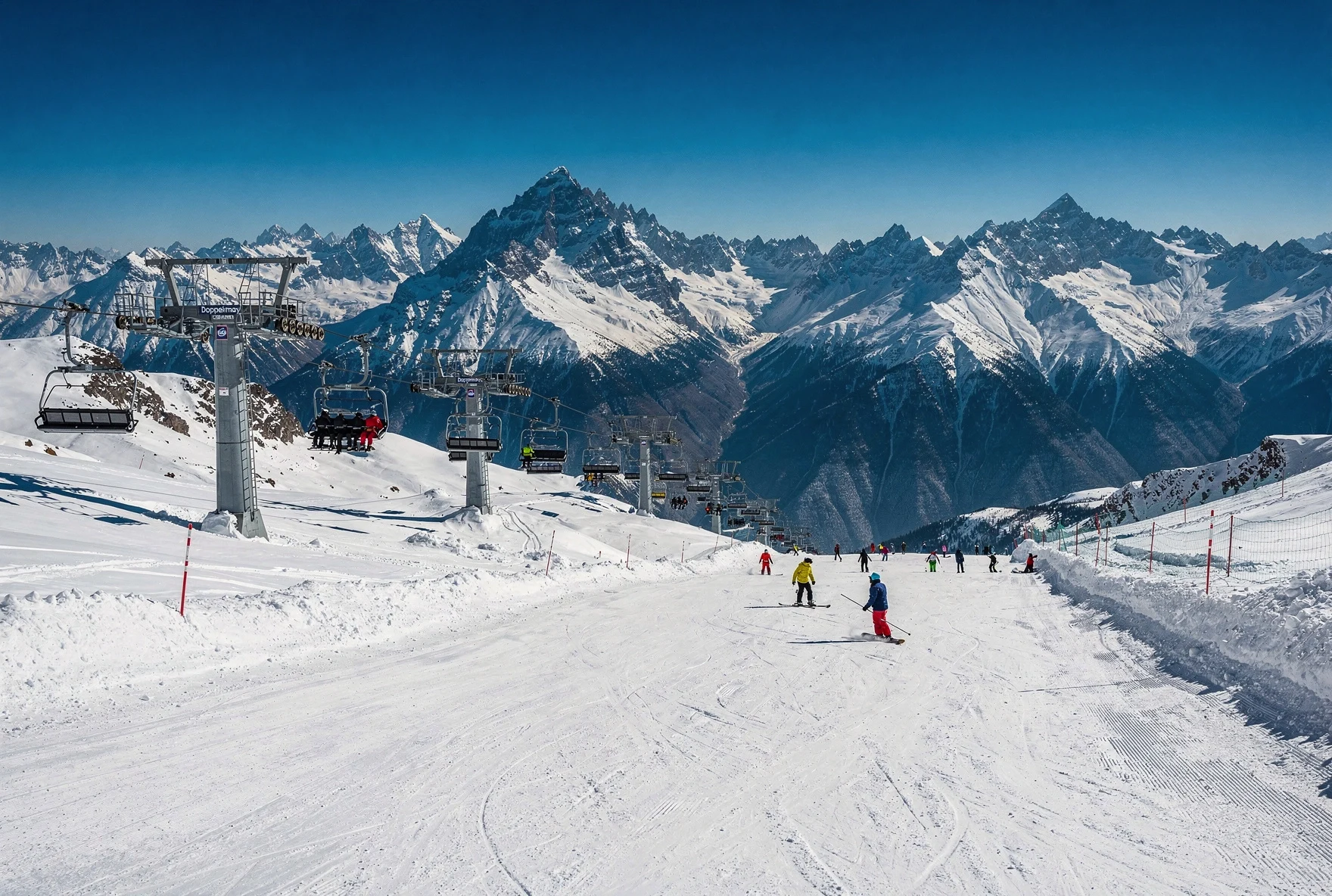
Gudauri has around 80 kilometers of marked runs across all ability levels. The terrain is overwhelmingly above-treeline, which means wide-open bowls, long cruising runs, and virtually no tree skiing. On a bluebird day, the visibility is extraordinary — you can see the entire ski area laid out below you from the top stations.
| Area | Difficulty | Best For | Notes |
|---|---|---|---|
| Pirveli slopes | Green/Blue | Beginners, families | Gentle gradients, ski school base, night skiing on weekends |
| Soliko/Gudaura | Blue/Red | Intermediate cruising | Long wide runs, the core of the resort for most skiers |
| Kudebi | Red | Confident intermediates | Higher elevation, consistent snow, stunning views |
| Sadzele | Red/Black | Advanced skiers | Steep pitches, mogul fields, the resort's most challenging marked terrain |
| Kobi side | Red/Black | Advanced, freeriders | North-facing, colder snow, big vertical, fewer crowds |
| Snow Park | Mixed | Freestyle | Jumps, rails, beginner boxes. Serviced by its own chairlift. |
One thing that consistently surprises visitors: the scale. Gudauri's vertical drop from the top of the Sadzele lift to the base is over 1,000 meters. Individual runs can stretch several kilometers. Coming from small European resorts, the sheer openness is breathtaking.
The flip side of above-treeline skiing: when weather moves in, visibility drops to zero. Gudauri can be a whiteout nightmare on bad days, with no trees to provide reference points. Always carry a phone with offline maps and don't venture off-piste without a buddy in flat light conditions.
Freeride and Off-Piste
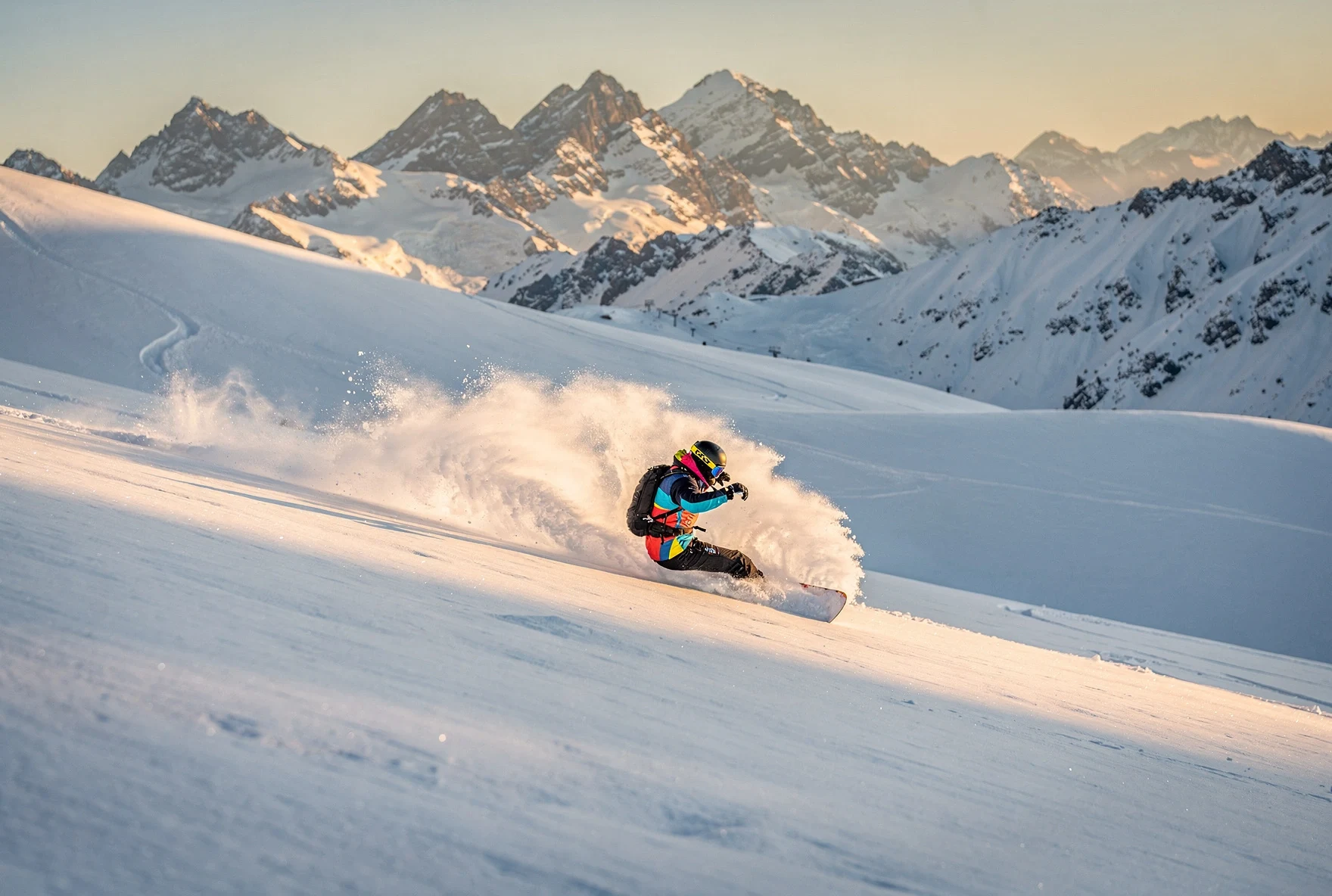
This is Gudauri's secret weapon, and the main reason advanced skiers and snowboarders keep coming back. The resort's above-treeline positioning means you can literally ski off the side of almost any run into untouched powder. No gates, no ropes, no stern lift operators shaking their heads — just open mountain.
The most popular freeride zones include the wide bowls dropping off the Sadzele ridge, the north-facing slopes on the Kobi side (which hold powder for days), and the long couloirs that funnel down from the ridgeline above the Recreation Zone. After a big snowfall, you can find untracked lines for hours — something unthinkable at a resort of similar quality in western Europe.
Avalanche Risk Is Real
Gudauri's open terrain means there is no natural tree barrier to slow avalanches. Fatal slides happen every season — usually involving people without proper equipment or experience. If you're heading off-piste, carry an avalanche beacon, probe, and shovel, and ideally go with a certified guide. The mountain rescue service exists but response times can be slow.
For the ultimate experience, several operators offer heli-skiing and cat-skiing from Gudauri, accessing backcountry terrain that would otherwise require hours of hiking. A full day of heli-skiing runs around $600–800 per person — expensive by Georgian standards, absurdly cheap by heli-skiing standards globally.
Guided freeride tours are another excellent option. Local guides know the terrain intimately — which aspects hold snow after which wind directions, where the hidden cliff bands are, and which lines are safe on any given day. Expect to pay 250–400 GEL ($90–150) for a full day of guided off-piste.
Lift Passes and Equipment Rental
| Pass Type | Adult | Child (6–12) | Notes |
|---|---|---|---|
| Daily | 70 GEL (~$25) | 35 GEL | Full access to all lifts. Under 6 free. |
| Half-day (after 12:30) | 50 GEL (~$18) | 25 GEL | Good value if you arrive late or want an easy day |
| 6-day | 350 GEL (~$130) | 175 GEL | Best per-day rate for a full week trip |
| Season | 1,200 GEL (~$440) | 600 GEL | Pays for itself in ~17 days. Tbilisi residents love this. |
| Night skiing (Fri–Sat) | 30 GEL (~$11) | 15 GEL | Pirveli slope only, 20:00–22:00 |
Lift passes are loaded onto RFID cards with a 5 GEL deposit (refundable). You can buy them at the ticket offices at the base of the main gondola in New Gudauri or at the Pirveli chairlift. Lines can be long on weekend mornings — arrive early or buy online through the MTA (Mountain Tourism Association) website.
Rental equipment is widely available in New Gudauri. A full ski or snowboard set (boots, skis/board, poles) runs 40–60 GEL per day for standard gear or 80+ GEL for premium brands. Helmets are 10–15 GEL extra and absolutely worth it. Quality varies between shops — the places inside the main New Gudauri buildings tend to have newer stock than the roadside rental shacks.
Ski School
Private lessons start from 100–120 GEL per hour, which is a fraction of what you'd pay in the Alps. English-speaking instructors are available but book ahead during peak periods. Group lessons are even cheaper. The Pirveli area is dedicated to learners with gentle gradients and its own chairlift.
Where to Stay
Accommodation in Gudauri falls into three categories: hotels, apartment rentals, and guesthouses. The overwhelming majority of visitors stay in apartment rentals booked through Booking.com or Airbnb — the New Gudauri apartment complexes are purpose-built for this and offer the best value.
| Type | Price Range | Best For | Location Tip |
|---|---|---|---|
| Budget apartment | 80–150 GEL/night | Solo travelers, groups | New Gudauri buildings. Basic but functional with kitchens. |
| Mid-range hotel | 200–400 GEL/night | Couples, comfort seekers | Hotel Gudauri Hut, Marco Polo, Carpe Diem are solid choices. |
| Upscale hotel | 400–800+ GEL/night | Luxury, families | Rooms Hotel Gudauri is the standout — great restaurant, pool, spa. |
| Old Gudauri guesthouse | 60–100 GEL/night | Budget travelers | Cheapest but furthest from lifts. Need transport to slopes. |
The single most important factor in choosing accommodation: proximity to the gondola in New Gudauri. Being able to walk out of your building and onto a lift changes the entire experience. Some New Gudauri apartments are genuinely ski-in/ski-out — you can glide right to the building entrance at the end of the day. This is worth paying extra for.
Book early for the New Year period (December 25–January 7) and late March — prices triple and availability dries up weeks in advance. For mid-January through February, you'll have plenty of options and much better rates.
Eating and Drinking
Gudauri's dining scene is limited but improving. You won't find anything approaching Tbilisi's restaurant diversity, but there's enough variety to keep you fed for a week without repeating.
On the mountain, a handful of restaurants near the Recreation Zone and at various lift stations serve standard Georgian fare — khachapuri, khinkali, grilled meat, soup. Prices are 20–40% higher than Tbilisi, which still means you'll spend 25–40 GEL on a full lunch with a drink. The Drunk Cherry restaurant is a local favorite for its cozy atmosphere and decent food.
Down in New Gudauri, more options have opened in recent years, including Indian food, sushi, and pizza alongside the Georgian staples. Grocery shopping is limited — there's a small supermarket near the gondola base but selection is modest and prices are elevated. If you're staying in an apartment and want to cook, buy provisions in Tbilisi before driving up.
Après-ski is Gudauri's weakest point. A few bars in the New Gudauri buildings — Black Dog Bar, Eskimos, Snow Time — host occasional DJ nights and serve beer and cocktails. It's not bad, exactly, but if you're coming from a resort with a proper bar scene, adjust expectations. Most people end up drinking wine in their apartments, which is arguably more Georgian anyway.
Beyond the Slopes
Gudauri is a dedicated ski resort, and off-slope activities are limited compared to more developed Alpine destinations. That said, there are some options worth knowing about:
🪂 Paragliding
Tandem flights over the Caucasus peaks are available when weather permits. Around 250–350 GEL for a 15–20 minute flight. Spectacular views even if you're not a skier.
🏔️ Snowshoeing
Several routes lead away from the resort into quieter valleys. You can rent snowshoes from some rental shops. A peaceful alternative to the slopes on a rest day.
🛷 Snowmobiles
Guided snowmobile tours are available, usually around 100–200 GEL for a 30–60 minute ride. Fun but loud — not everyone's thing.
🏨 Spa and Pool
Rooms Hotel Gudauri has the best spa facilities — pool, sauna, treatments. Some other hotels have small pools. Non-guests can sometimes pay for day access.
If you have a non-skiing day (or a non-skiing partner), the scenic gondola ride up the mountain is worthwhile on its own — the views from the top station are incredible even without skis. The Georgian Military Highway itself offers several stops worth visiting on the drive — Ananuri Fortress, the Jinvali Reservoir, and the Russia-Georgia Friendship Monument at the Cross Pass.
Insurance — New 2026 Requirement
As of January 1, 2026, health insurance is legally required for entering Georgia. Standard travel insurance policies typically exclude winter sports. If you're skiing or snowboarding, you need an "Adventure Sports" add-on that specifically covers:
- Mountain rescue and evacuation
- Winter sports injuries
- Medical treatment at Georgian hospitals
- Emergency repatriation
Don't skip this. Mountain rescue in Gudauri costs real money if you're not covered, and the nearest serious hospital is in Tbilisi — two hours away on a mountain road. Check your policy carefully and add winter sports coverage before you arrive.
What It Actually Costs
Budget Trip (per person/day in a group)
Comfortable Trip (per person/day, couple)
For context: a similar day of skiing at a mid-range Alpine resort would cost €200–300+ per person. Gudauri delivers comparable skiing at a third to a quarter of the price. That's the whole pitch.
Summer in Gudauri
Some of the lifts reopen from early July through mid-September, offering access to high-altitude hiking and mountain biking. Summer Gudauri is dramatically different from winter — green alpine meadows, wildflowers, and temperatures that rarely crack 25°C at altitude. It's a legitimate hiking base, though most serious hikers head to Svaneti or Kazbegi instead.
The main summer draw is paragliding — the thermals in the Gudauri area are some of the strongest in the Caucasus, and experienced pilots come from across Europe for cross-country flights. Even if you're not a paraglider, the scenic chairlift rides and high-altitude walks are worth the trip if you're already driving the Military Highway.
Common Mistakes
Coming for New Year's
Peak crowds, peak prices, often mediocre early-season snow. January 10–31 is better in every way.
No insurance
Mountain rescue, helicopter evacuation, and the ambulance ride to Tbilisi add up fast without winter sports coverage.
Staying in Old Gudauri
Cheaper, yes, but you'll waste time and money commuting to the lifts. New Gudauri is worth the premium.
Driving without winter tires
The road is steep, icy, and at altitude. Winter tires are mandatory and chains are strongly recommended. Don't risk it.
Off-piste without gear
The easy access to freeride terrain tempts people without avalanche equipment. People die here every season. Take it seriously.
Expecting Alpine après-ski
This is not Austria. Bring a good book, a bottle of wine, and enjoy the quiet evenings. Or go back to Tbilisi for nightlife.
Gudauri vs. Other Georgian Resorts
| Resort | From Tbilisi | Terrain | Best For |
|---|---|---|---|
| Gudauri | 2 hours | 80km, above treeline | All-rounders, freeriders, best infrastructure |
| Bakuriani | 3 hours | 30km, forested | Families, beginners, tree skiing, more village charm |
| Mestia (Hatsvali/Tetnuldi) | 8+ hours | 25km combined | Adventure seekers, backcountry, Svaneti culture |
| Goderdzi | 6 hours | 8km, developing | Deep powder, quietest resort, very basic facilities |
For most first-time visitors to Georgia who want to ski, Gudauri is the clear choice — best infrastructure, easiest access, most terrain. If you've already done Gudauri and want something different, Bakuriani offers a more relaxed, family-friendly vibe with actual tree skiing. Mestia is for adventurers willing to make the long journey — the skiing is more limited but the Svaneti setting is unforgettable.
Practical Tips
- Cash is still king for some smaller restaurants and rental shops. ATMs exist in New Gudauri but bring backup cash from Tbilisi. Cards are accepted at the lift ticket offices and larger hotels.
- Mobile signal is strong in the resort area (Magti and Geocell both work). Data speeds are adequate for maps and messaging. Bring a Georgian SIM card.
- Altitude — Gudauri's base is at 2,200 meters. Some people feel mild effects (headache, fatigue) on the first day, especially if exerting at the top station at 3,279 meters. Stay hydrated and take it easy on day one.
- Sunscreen is non-negotiable. The UV at altitude with snow reflection is brutal. Factor 50, reapply at lunch. Lip balm too.
- Lifts run 10:00–17:00 daily. Night skiing on Pirveli slope is Friday–Saturday, 20:00–22:00.
- The MTA website (mta.ski) has live lift status, webcams, and current conditions. Check it before heading up.
- Combine with Kazbegi — Stepantsminda is just 40 minutes further up the highway. In winter it's a beautiful snow-covered village with fewer tourists. Worth a day trip if the road is open.
Frequently Asked Questions
Is Gudauri good for beginners?
Yes. The Pirveli area has gentle slopes, its own chairlift, and affordable ski school. Beginners can have a great time without ever going above the intermediate areas. Just be aware that the top mountain can be intimidating in bad weather.
Can I do Gudauri as a day trip from Tbilisi?
Technically yes — Tbilisi residents do it every weekend. But the 2-hour drive each way means a short skiing day, and if the road closes you're stuck. For visitors, staying at least one or two nights makes much more sense.
Is Gudauri safe?
The resort itself is safe. The main risks are avalanche (off-piste), road closures (weather), and the usual ski injury potential. Theft is rare. The biggest safety concern is people venturing into freeride terrain without proper equipment or experience.
Do I need to speak Georgian?
No. Gudauri is tourist-oriented and most staff in hotels, restaurants, and rental shops speak enough English. Ski instructors are available in English. A few Georgian phrases will always be appreciated though.
What's the best way to check conditions?
The MTA website (status.mta.ski) has live webcams, lift status, and weather forecasts. Several snow-cam feeds are also available. For road conditions, check police.ge or call your hotel — they'll know if the pass is open.
Written by The Georgian Guide Team
We live in Georgia and have spent multiple winters at Gudauri — from bluebird powder days to whiteout disappointments. This guide is based on firsthand experience, not a single press trip.
Last updated: February 2026.
Related Articles
Georgian Military Highway
The drive to Gudauri is half the experience — every stop along one of the world's greatest mountain roads.
Kazbegi (Stepantsminda) Guide
Just 40 minutes past Gudauri — Georgia's most iconic mountain town and the gateway to Mount Kazbek.
Renting a Car in Georgia
Everything about self-driving in Georgia — including winter driving tips for mountain roads.
Best Time to Visit Georgia
Season-by-season breakdown of weather, crowds, and what to expect throughout the year.