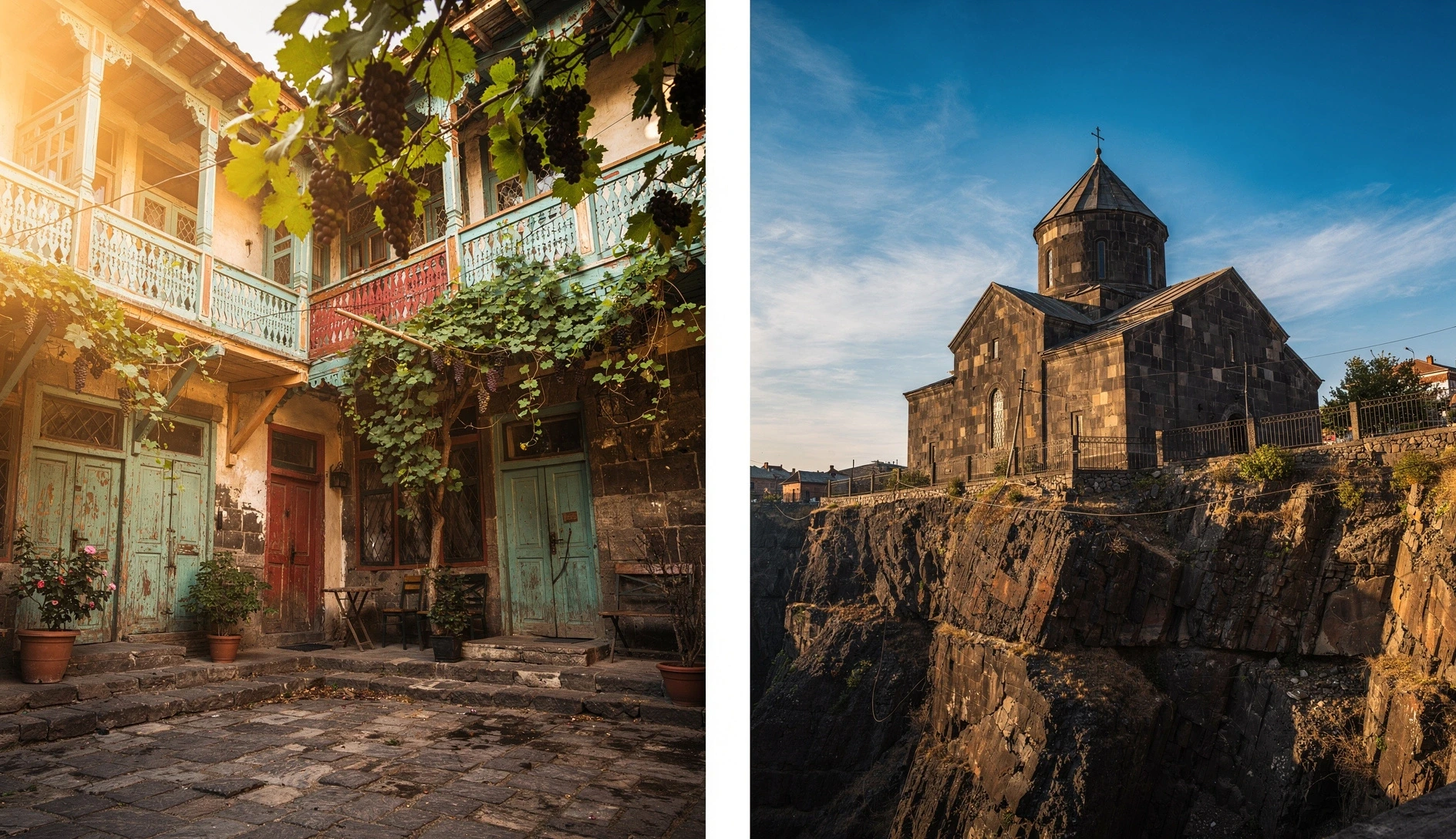
People planning a Caucasus trip always ask the same question: Georgia or Armenia? The honest answer is both — they're only five hours apart by car. But if you genuinely have to pick one, the choice comes down to what kind of traveler you are. This guide compares the two countries across every category that matters, with real opinions instead of diplomatic non-answers.
The Short Answer
🇬🇪 Choose Georgia If You...
- • Love food and wine
- • Want vibrant nightlife and café culture
- • Prefer developed tourist infrastructure
- • Plan to do multi-day hikes
- • Want a beach option (Black Sea)
- • Travel with kids or prefer easier logistics
🇦🇲 Choose Armenia If You...
- • Are passionate about ancient history
- • Prefer fewer tourists and raw authenticity
- • Love dramatic monastery settings
- • Want a more compact, manageable trip
- • Are interested in the Armenian diaspora story
- • Prefer a quieter, more contemplative pace
Quick Comparison
| Category | Georgia | Armenia |
|---|---|---|
| Food | World-class, diverse, instantly lovable | Good but more limited variety |
| Wine | 8,000-year tradition, qvevri, Kakheti | Growing scene, Areni region |
| History | Rich, but less concentrated | Extraordinary — first Christian nation |
| Hiking | World-class multi-day treks | Good day hikes, less infrastructure |
| Nightlife | Tbilisi is legendary (techno, wine bars) | Yerevan has a scene, but smaller |
| Budget (per day) | $30–50 mid-range | $25–45 mid-range |
| Tourist Infrastructure | Well-developed, English widely spoken | Developing, more Russian than English |
| Getting There | Cheap flights (Wizz Air via Kutaisi) | Fewer routes, generally pricier |
| Visa | Visa-free 1 year (most nationalities) | Visa-free or e-visa (varies) |
| Best For | Foodies, hikers, nightlife seekers | History buffs, culture seekers |
Food and Wine
This is where Georgia wins decisively, and it's not even close.
Georgian cuisine is one of those rare food traditions that everybody loves on first contact. Khachapuri (cheese-filled bread in a dozen regional varieties), khinkali (soup dumplings you eat with your hands), mtsvadi (smoky grilled pork), lobio (spiced bean stew), badrijani (walnut-stuffed eggplant) — the list goes on and on. A casual lunch at a hole-in-the-wall in Tbilisi will be one of the best meals of your trip. The flavors are bold, the portions are absurd, and a full dinner for two with wine rarely tops $25.
Armenian food is solid — lavash flatbread, khorovats (barbecue), dolma, and manti (dumplings) are all good. But the variety is noticeably smaller. After a week in Armenia, you'll start feeling like you've eaten everything on offer. After a month in Georgia, you're still discovering new dishes.
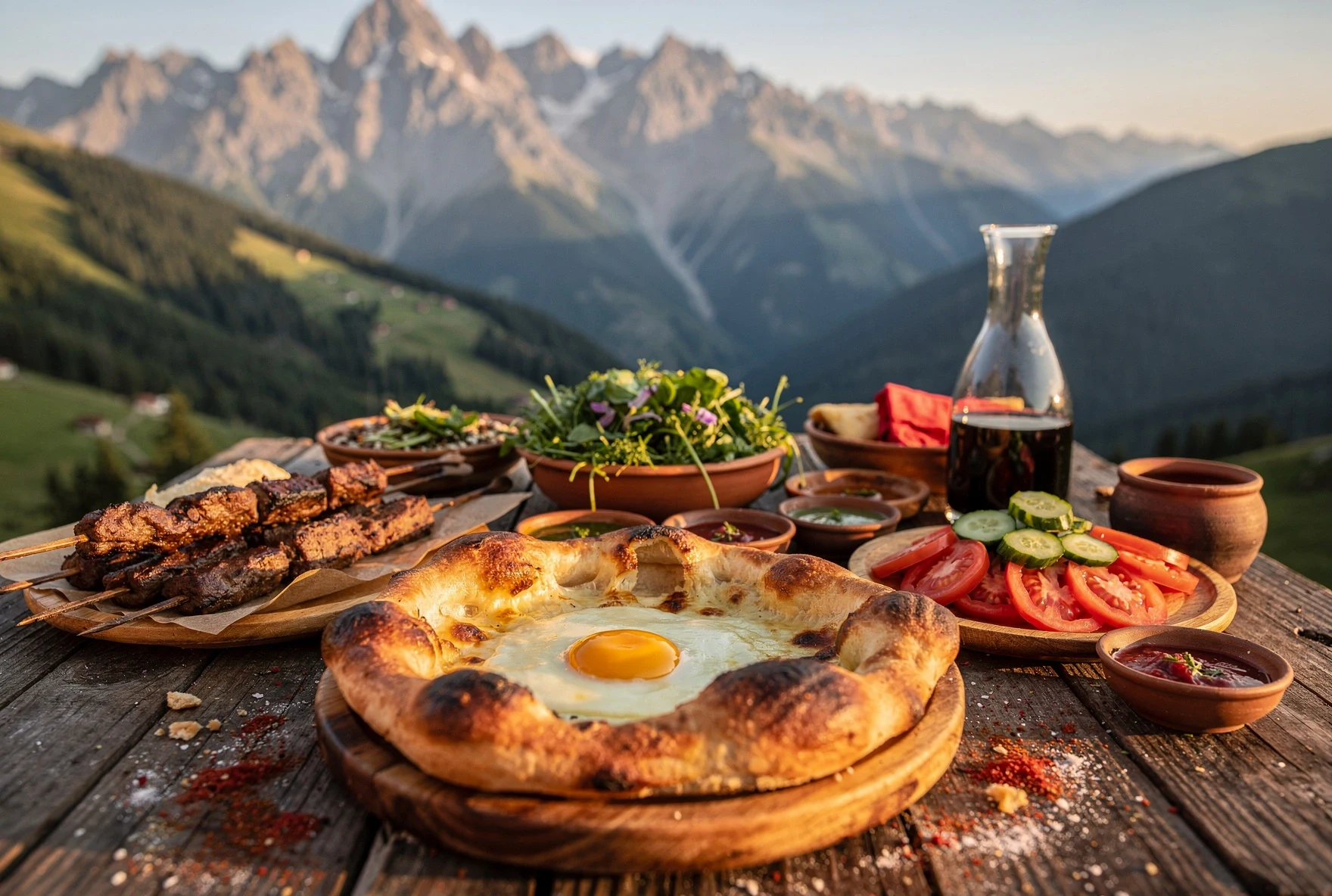
Then there's wine. Georgia has been making wine for 8,000 years — literally the oldest wine tradition on Earth. The traditional qvevri method (fermenting in giant clay vessels buried underground) produces amber wines unlike anything you've tasted. The Kakheti wine region is a legitimate wine destination. You can spend days hopping between family cellars, boutique wineries, and centuries-old monasteries that still produce wine.
Armenia has a smaller but growing wine scene. The Areni region produces respectable reds, and the Areni-1 cave yielded the world's oldest known winery (6,100 years old). But in terms of sheer variety, accessibility, and wine tourism infrastructure, Georgia is miles ahead.
The Wine Verdict
If wine is a major reason for your trip, Georgia wins by a landslide. Armenia has an interesting wine story but Georgia has an entire wine culture — supras (feasts), toastmasters, qvevri cellars in every village, and an almost spiritual relationship with the grape.
History and Culture
Armenia edges ahead here. Not because Georgia lacks history — it's one of the oldest civilizations in the region — but because Armenia's historical sites are more concentrated, more dramatic, and more emotionally powerful.
Armenia adopted Christianity in 301 AD, making it the first nation to do so. This isn't just a factoid — it defines the country. Everywhere you go, you encounter 1,500-year-old monasteries carved into impossible cliff faces, churches perched on canyon edges, and khachkars (cross-stones) with mesmerizing carved patterns that are unique to Armenian art. Sites like Geghard Monastery (partially carved from rock, UNESCO-listed), Tatev (reachable by the world's longest aerial tramway), and Noravank (set in a red-rock canyon) are genuinely jaw-dropping.
Georgia has incredible churches too — Jvari overlooking the confluence of two rivers, Gergeti Trinity below Mount Kazbek, and cave monasteries like David Gareja and Vardzia. But Georgian historical sites tend to be more spread out, and the story they tell is different — more about resilience against invasions than a single defining identity.
The Armenian Genocide Memorial in Yerevan is one of the most moving museum experiences in the world. It adds an emotional weight to Armenia that Georgia doesn't quite match. You leave understanding why the diaspora is so passionate about Armenian identity.
Georgia's Historical Highlights
- • Vardzia cave city (12th century, 6,000 rooms)
- • Uplistsikhe rock-hewn town (3,000 years old)
- • Svan towers of Mestia and Ushguli
- • Gergeti Trinity Church below Kazbek
- • Tbilisi Old Town (Persian, Art Nouveau mix)
- • Mtskheta — ancient capital (UNESCO)
Armenia's Historical Highlights
- • Geghard Monastery (rock-hewn, UNESCO)
- • Tatev Monastery + Wings of Tatev tramway
- • Noravank in its red canyon setting
- • Echmiadzin — oldest cathedral (301 AD)
- • Garni — only Greco-Roman temple in the Caucasus
- • Armenian Genocide Museum, Yerevan
Scenery and Nature
Both countries are stunningly beautiful, but in different ways.
Georgia has more variety. The Greater Caucasus mountains in the north are among the most dramatic peaks in Europe — snow-capped, glacier-carved, with alpine meadows that rival the Swiss Alps at a fraction of the tourist density. Then you've got the lush subtropical Black Sea coast, the semi-arid canyons of the south, the wine-draped valleys of Kakheti, and the otherworldly limestone formations of Prometheus Cave. One country, five completely different landscapes.
Armenia is smaller and drier, but it has a stark, volcanic beauty that's utterly unique. Mount Ararat (technically in Turkey, but dominating the Armenian skyline) is one of the most iconic mountain views anywhere. Lake Sevan, sitting at 1,900 meters, is eerily beautiful. The red canyons around Noravank look like they belong in Utah. And the plateau landscapes — vast, open, treeless — have a contemplative quality that grows on you.
The Nature Verdict
Georgia wins on variety and raw mountain drama. Armenia wins on volcanic otherworldliness and the constant, almost spiritual presence of Ararat. If you want to hike, Georgia is the clear choice. If you want to photograph vast, austere landscapes, Armenia delivers.
Hiking and Trekking
Georgia, and it's not even a contest.
The Caucasus mountains offer some of the best trekking in the world. The Mestia to Ushguli trek in Svaneti is a four-day walk through valleys dotted with medieval stone towers, with glaciers looming overhead. Juta to Roshka crosses the dramatic Chaukhi Pass with views that would make the Dolomites jealous. Even casual day hikes — Truso Valley, Koruldi Lakes, the trails around Kazbegi — are world-class.
Georgia also has a developing but functional trekking infrastructure: marked trails (improving yearly), guesthouses along popular routes, and GPS tracks available for most hikes. It's nowhere near as organized as the Alps, but it works.
Armenia has beautiful hikes too — the Transcaucasian Trail passes through both countries, and spots like Dilijan National Park are lovely. But the trails are less developed, less marked, and the mountain scenery, while beautiful, doesn't reach the jaw-dropping heights of the Greater Caucasus. Most Armenia hikes are day trips from Yerevan or Dilijan, not multi-day adventures.
| Aspect | Georgia | Armenia |
|---|---|---|
| Multi-day treks | Excellent (Svaneti, Tusheti, Chaukhi) | Limited options |
| Trail marking | Improving, GPS tracks available | Sparse, bring your own GPS |
| Mountain height | 5,000m+ peaks (Kazbek, Shkhara) | 4,090m (Aragats) |
| Guesthouses on trails | Yes, along popular routes | Fewer, more self-sufficient needed |
| Best for | Serious trekkers, alpine scenery | Day hikers, gentle walks |
Capitals: Tbilisi vs Yerevan
Tbilisi and Yerevan are both great cities, but they have very different personalities.
Tbilisi is chaotic, layered, and full of surprises. The Old Town is a maze of leaning wooden balconies, Persian-era sulfur baths, and crumbling Art Nouveau facades. Every neighborhood has its own character — Sololaki for wine bars, Vera for hipster cafés, Marjanishvili for the alternative scene. The nightlife is serious: Tbilisi has one of the best techno scenes in the world, anchored by clubs like Bassiani (in a Soviet-era swimming pool under a football stadium). The food scene is exploding. You can easily spend a week in Tbilisi and never get bored.
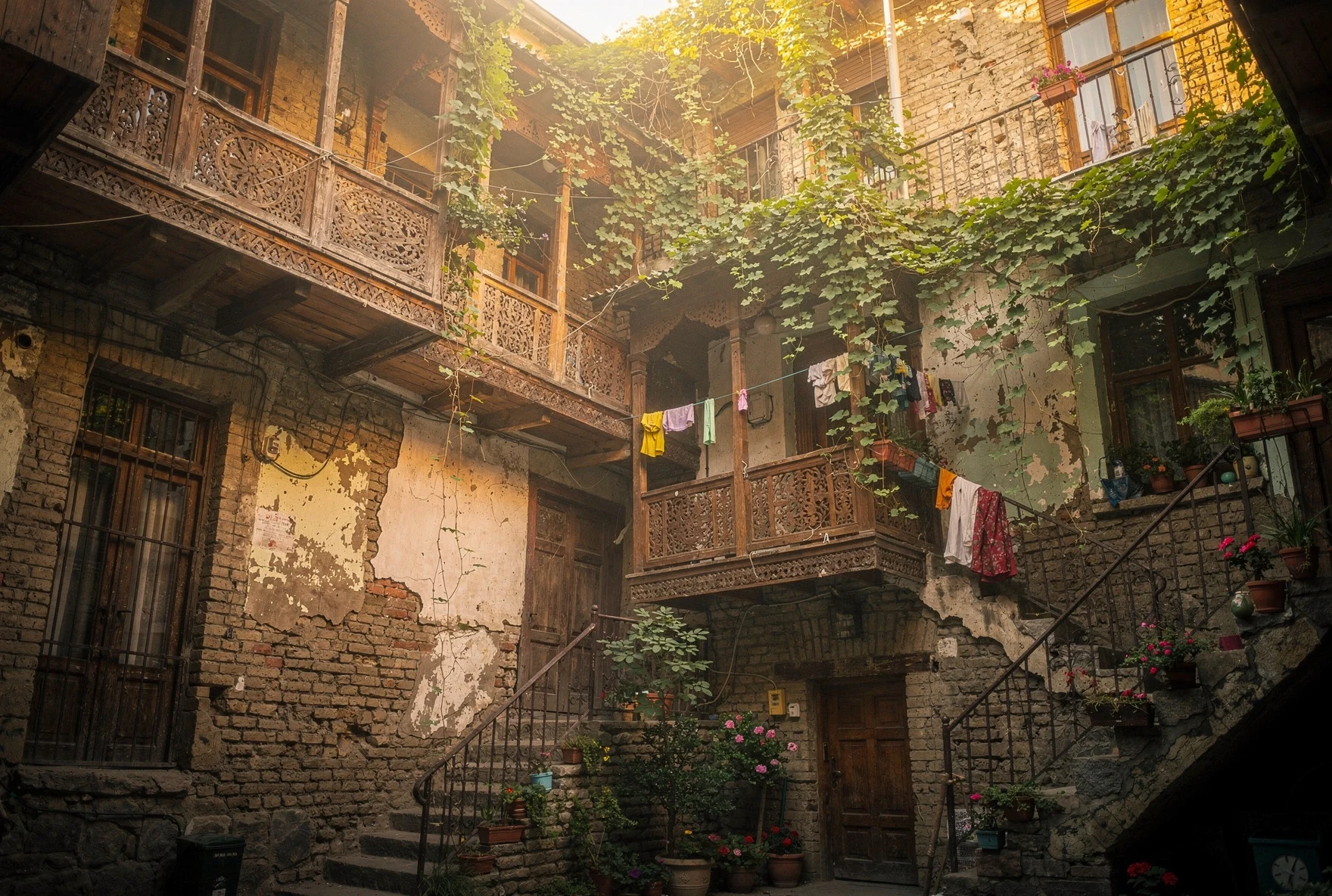
Yerevan is more organized, cleaner, and arguably more cosmopolitan in a traditional sense. The pink tuff stone buildings give the city a warm, unified look. The Cascade — a massive stone stairway with modern art installations — is genuinely impressive. The cafés along Northern Avenue are polished. Yerevan feels like a smaller, calmer European capital with a distinctly Middle Eastern edge in its food markets and spice shops.
The vibe difference: Tbilisi feels like it's inventing itself in real time — messy, creative, occasionally frustrating. Yerevan feels like it knows exactly what it is — proud, compact, a little melancholy. Both are great. Tbilisi has more to do; Yerevan is easier to navigate.
Getting There and Around
Georgia is significantly easier and cheaper to reach from Europe.
Wizz Air flies to Kutaisi from dozens of European cities at absurdly low prices — sometimes under €30 one way. Tbilisi airport has connections to most major hubs via Turkish Airlines, FlyDubai, Air Arabia, and LOT. Budget airlines have made Georgia one of the cheapest destinations to reach from Western Europe.
Armenia has fewer flight connections and they tend to be pricier. Yerevan's Zvartnots Airport is served by fewer budget carriers. Most European travelers end up connecting through Istanbul, Dubai, or Vienna, which adds cost and time. If you're coming from Russia or the Middle East, Armenia is more accessible — but from Europe, Georgia has the edge.
Once you're on the ground, both countries are manageable. Georgia has better intercity transport: regular marshrutkas (minibuses), an improving train network, and Bolt/Yandex taxis everywhere. English is more widely spoken in Georgia, especially in Tbilisi and tourist areas.
Armenia relies more heavily on taxis and private transfers for getting between sights. Marshrutkas exist but are less frequent. Russian is more useful than English outside Yerevan. Many visitors hire a driver for the whole trip — affordable (around $50–70/day) and eliminates the logistics headache.
Combining Both Countries
The most popular combo: fly into Tbilisi, explore Georgia, take a shared taxi or bus to Yerevan (5 hours, ~$20–30), explore Armenia, fly out of Yerevan (or vice versa). The Sadakhlo border crossing is straightforward. Many travelers do 7–10 days in Georgia + 5–7 in Armenia for a perfect two-week Caucasus trip.
Costs
Both countries are genuinely cheap by European standards. Armenia is marginally cheaper in some categories, but the difference is small enough that it shouldn't drive your decision.
Daily Budget Comparison (Mid-Range)
A few cost nuances worth knowing: Georgia's tourist hotspots (Batumi in summer, Kazbegi on weekends) see price spikes. Armenia's monastery entrances are mostly free, while some Georgian sites charge small fees. Alcohol is slightly cheaper in Georgia. Both countries have excellent value for money compared to anywhere in Western Europe.
Safety
Both countries are very safe for tourists. Violent crime targeting foreigners is essentially nonexistent in either country. Petty theft is low in both (though use normal city precautions in Tbilisi and Yerevan).
A few differences worth noting:
🇬🇪 Georgia Safety Notes
- • Driving is aggressive — be cautious on roads
- • Stray dogs are everywhere (rarely aggressive)
- • Avoid Russian-occupied South Ossetia and Abkhazia
- • Mountain roads can be treacherous in bad weather
- • Political protests happen occasionally — avoid centers
🇦🇲 Armenia Safety Notes
- • Avoid the Nagorno-Karabakh border area
- • Border with Azerbaijan and Turkey is closed
- • Driving standards are poor outside Yerevan
- • Some geopolitical tension (Azerbaijan, Turkey)
- • Fewer English speakers outside the capital
Language and Communication
Georgia has better English penetration, especially in Tbilisi. Young Georgians in the capital speak decent English, and restaurants, hostels, and tour companies generally communicate in English without issues. Outside Tbilisi, English drops off quickly — but you can usually get by with gestures and Google Translate.
Armenia relies more on Russian as the second language. Younger Armenians in Yerevan increasingly speak English, but it's noticeably less common than in Tbilisi. In rural Armenia, you'll need Russian or Armenian. If you speak Russian, Armenia is actually easier to navigate than Georgia (where younger people increasingly resist speaking Russian for political reasons).
Both countries use unique alphabets — Georgian and Armenian scripts are completely different from each other and from anything else on Earth. Neither is easy to learn quickly, though both are phonetic once you crack the code. Restaurant menus in tourist areas usually have English translations in both countries.
Nightlife and Social Scene
Georgia wins this one convincingly. Tbilisi has emerged as one of Europe's most exciting nightlife cities. Bassiani (techno in a brutalist swimming pool), Mtkvarze (overlooking the river), and a constantly rotating cast of underground clubs have put Tbilisi on the global clubbing map. The wine bar scene is equally impressive — natural wine bars in converted cellars, rooftop spots overlooking the Old Town, live jazz in Vera.
Yerevan has a pleasant bar and café scene, particularly along Northern Avenue and in the Cascade area. There are good restaurants, craft cocktail bars, and some clubs. But it's a smaller, quieter scene. If nightlife matters to you, Tbilisi wins by several rounds of chacha.
How Much Time Do You Need?
| Trip Length | Georgia | Armenia |
|---|---|---|
| 3–4 days | Tbilisi + 1 day trip | Yerevan + Garni/Geghard |
| 1 week | Tbilisi + Kazbegi + Kakheti | Yerevan + Tatev + Sevan + Dilijan |
| 10 days | Add Svaneti or Batumi | You've seen the highlights |
| 2 weeks | Comprehensive tour, still more to see | Very thorough, some slow days |
| 2+ weeks | Perfect — do both countries | Perfect — do both countries |
The key difference: Georgia has more depth. You could spend three weeks exploring and still miss entire regions (Tusheti, Racha, the remote parts of Svaneti). Armenia is more compact — a determined traveler can hit all the major sites in 7–10 days. This isn't a flaw; if you're short on time, Armenia is actually the better choice because you'll feel like you've seen the country rather than just scratched the surface.
When to Visit
The seasons work similarly for both countries, with some important differences.
🌸 Best Times: Georgia
- May–June: Perfect weather, green mountains, fewer crowds
- September–October: Wine harvest (rtveli), golden light, ideal hiking
- December–March: Skiing in Gudauri, quiet cities
- Avoid: August in Tbilisi (40°C heat) unless headed to mountains
🌸 Best Times: Armenia
- May–June: Wildflowers, pleasant temperatures
- September–October: Wine harvest, great light for photography
- Avoid: July–August in Yerevan (extreme heat, 38°C+)
- Winter: Cold and grey — fewer reasons to visit than Georgia
Who Should Skip Which
Let's be honest about the downsides too.
Skip Georgia if: You hate crowds and Tbilisi's growing tourism buzz annoys you. If you want a truly off-the-radar feel, parts of Georgia (Old Town, Kazbegi) are past that point. Also skip if you have zero tolerance for chaotic driving — Georgian roads are genuinely stressful.
Skip Armenia if: You get frustrated by limited tourist infrastructure. If you need menus in English, well-marked hiking trails, and reliable public transport, Armenia will test your patience. Also skip if you're expecting Georgia-level food variety — you'll be disappointed.
The Verdict
If you can only pick one: Georgia is the better first trip. It has more variety, better food, easier logistics, cheaper flights from Europe, and enough depth to fill any trip length. Most first-time Caucasus visitors go to Georgia and don't regret it.
But Armenia is the better second trip — or the better choice if you specifically care about ancient history, want fewer tourists, or prefer a more contemplative travel style. It rewards patient travelers who don't mind doing a bit more planning.
The best option? Do both. They're right next to each other, the border crossing is easy, and two weeks split between the countries gives you one of the most rewarding trips in this part of the world.
The Recommended Combo
Fly into Kutaisi (cheap Wizz Air), explore Georgia for 7–10 days, take a shared taxi from Tbilisi to Yerevan ($25, 5 hours), spend 5–7 days in Armenia, fly home from Yerevan. Two countries, one trip, under $1,000 total if you're budget-conscious.
Frequently Asked Questions
Can I visit both in one trip?
Absolutely. Tbilisi to Yerevan is a 5-hour drive or bus ride. Most travelers combine them into a 2-week trip. The border crossing at Sadakhlo/Bagratashen is straightforward.
Which is cheaper?
Armenia is marginally cheaper day-to-day, but Georgia has cheaper flights from Europe. Overall, the cost difference is negligible — both are very affordable.
Is either country in the EU?
Neither is in the EU. Georgia has candidate status and is working toward accession. Both offer visa-free or easy visa access for most Western nationalities.
Can I drive between them?
Yes. The drive takes about 5 hours via the Sadakhlo border. You can rent a car in one country and drop it in the other with some rental companies, though it's usually easier to use shared taxis.
Which is better for solo travelers?
Georgia, slightly. Tbilisi has a bigger hostel/backpacker scene and more English speakers. But both countries are very safe and welcoming for solo travelers of any gender.
What about Azerbaijan?
You can add Azerbaijan to the trip, but it requires a separate visa (e-visa), is more expensive, and has less to offer tourists. Most travelers find Georgia + Armenia is the sweet spot for a Caucasus trip.
Written by The Georgian Guide Team
Based in Tbilisi with years of experience traveling both countries. We've crossed the Georgia-Armenia border more times than we can count and have strong opinions about which khachapuri beats which dolma.
Last updated: March 2026.
Related Articles
Georgia Itinerary (1–3 Weeks)
How to plan the perfect Georgia trip, from a long weekend to a full three weeks.
Best Time to Visit Georgia
Month-by-month breakdown of weather, festivals, and what to expect.
Georgia Travel Budget & Costs
What everything actually costs in Georgia — accommodation, food, transport, activities.
Tbilisi First-Time Visitor Guide
Everything you need to know for your first visit to Georgia's capital.