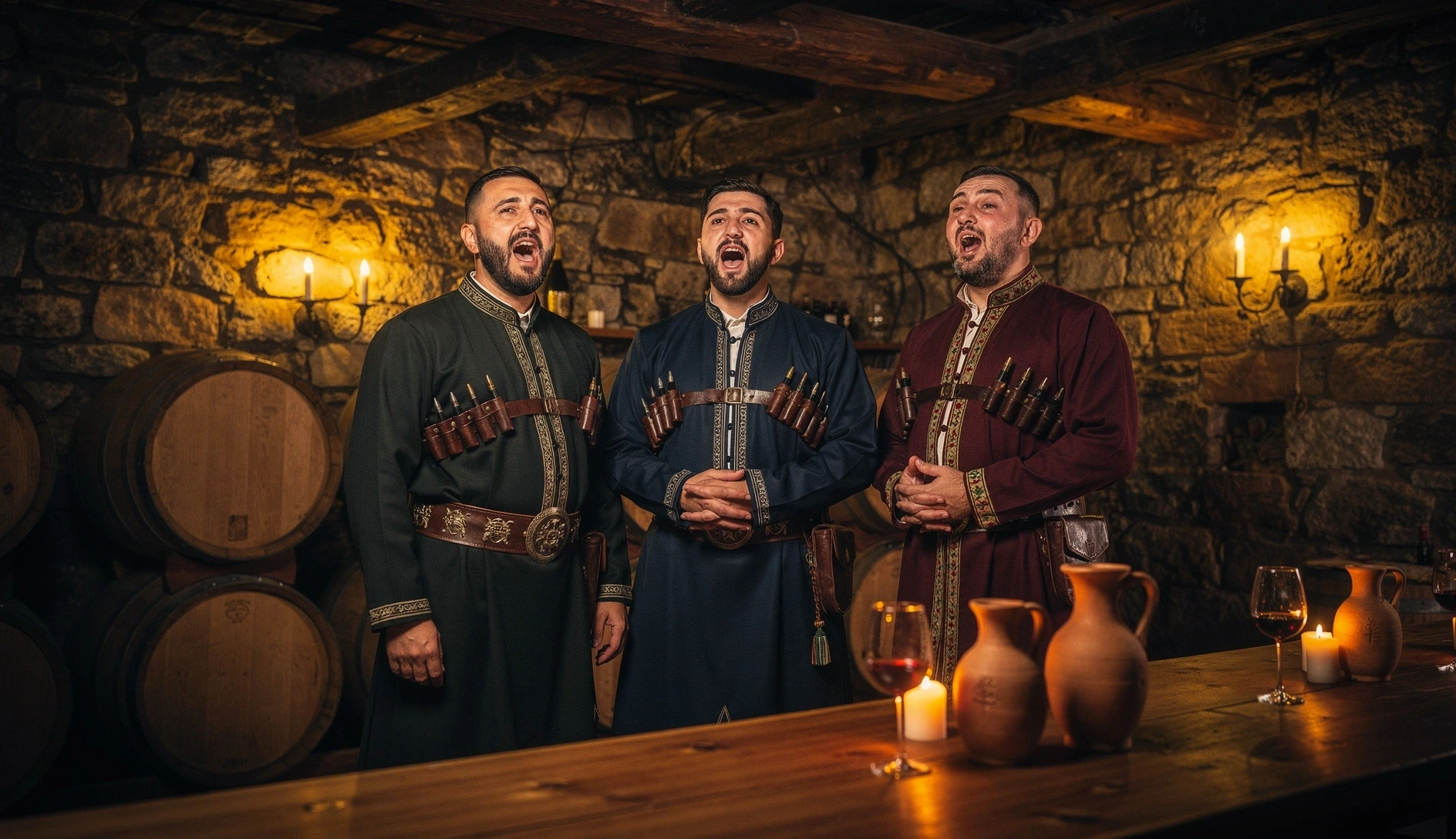
You're sitting in a restaurant at midnight. Four guys at the next table have been drinking wine for hours. Then — without any signal you can detect — they start singing. Three independent melodies weave together over a bass drone so deep it vibrates in your chest. The harmonies are unlike anything you've heard in Western music. No instruments. No conductor. Just human voices doing something that predates Christianity.
This is Georgian polyphonic singing, and hearing it for the first time is one of those travel moments that genuinely rearranges something in your brain. It was one of the first traditions inscribed on UNESCO's Intangible Cultural Heritage list, it was sent into space on the Voyager Golden Record, and it's still alive in everyday Georgian life — at weddings, funerals, feasts, and yes, random restaurants at midnight.
Georgian dance is equally extraordinary. Men spinning on their toes (on pointe, like ballet dancers, but in leather boots), women gliding as if the floor were made of silk, war dances with real swords and daggers. If you've never seen it, nothing I write will prepare you. If you have, you're already nodding.
Here's everything you need to understand both traditions — and how to experience them during your trip.
Polyphonic Singing: Georgia's Gift to Human Music
Most music you know is homophonic — one melody with harmonic accompaniment. Georgian polyphony is fundamentally different: multiple independent melodic lines happening simultaneously, each voice following its own path while creating harmonies that Western music theory would call "wrong." Seconds, fourths, sevenths, ninths — intervals that European composers avoided for centuries. Georgian singers have been using them for millennia.
The tradition is overwhelmingly male, though female ensembles exist and are growing. Performances are typically a cappella — no instruments, just voices — which makes the harmonic complexity even more striking. Most songs use three main vocal parts:
| Part | Georgian Name | Role | Western Equivalent |
|---|---|---|---|
| Top voice | Modzakhili | Ornamented melody, sometimes improvised | First tenor |
| Middle voice | Mtkmeli | The "teller" — carries the main narrative | Second tenor |
| Bass | Bani | Foundation drone or moving bass line | Baritone/bass |
| Yodel voice | Krimanchuli | High falsetto ornament (Western Georgia) | No equivalent |
Historically, Georgian singing has eight distinct vocal parts — krini, krimanchuli, gamqivani, modzakhili, mtkmeli, shemkhmobari, bani, and dvrini. Most modern performances use the simplified three-part structure, but you'll still hear the more complex arrangements at traditional events, especially in Svaneti and Guria.
The Song That Left Earth
In 1977, when NASA selected music to represent humanity on the Voyager spacecraft, they chose the Georgian song "Chakrulo" — a Kakhetian table song featuring complex polyphony over a sustained bass drone. It's currently about 24 billion kilometers from Earth, still traveling. If intelligent extraterrestrial life ever finds it, their first impression of human music will be three Georgian men singing over wine.
Regional Styles: Every Valley Has Its Own Voice
Georgia has at least fifteen distinct "musical dialects" — regional singing styles as different from each other as Scots English is from Jamaican patois. The country's mountainous geography created natural isolation, and each valley developed its own harmonic language over centuries. The styles are broadly split between eastern and western traditions.
🏔️ Svaneti — Complex Polyphony
The most archaic style. Multiple voices weave independent melodies over one another in dense, almost dissonant layers. Some Svan singers still use the original non-tempered tuning system — intervals that sound "off" to Western ears but are mathematically intentional. Haunting, powerful, and like nothing else on Earth.
🍷 Kakheti — Drone Polyphony
Two highly ornamented soloists sing over a sustained bass drone. This is the style you'll hear at supras — long, meditative table songs that accompany wine and toasting. The Chakrulo sent to space is Kakhetian. Emotional, contemplative, and deeply tied to the supra tradition.
🎭 Guria — Contrapuntal Polyphony
The showpiece of Georgian vocal music. Three or four completely independent melodic lines, highly individualized, with the famous krimanchuli — a male falsetto yodel that sounds otherworldly. Gurian trios are considered the peak of Georgian polyphonic complexity. Fast, virtuosic, and jaw-dropping.
🏰 Kartli — Choral Tradition
The capital region's style is more measured and choral than the west. Strong unison passages contrast with polyphonic sections. Kartlian songs often have a patriotic or religious character — less spontaneous than Gurian or Kakhetian styles but with a grand, choir-like power.
The "Georgian Triad"
Georgian music uses a distinctive chord called the "Georgian triad" by ethnomusicologist Dimitri Arakishvili — a fourth with a second stacked on top (like C-F-G played together). This chord appears constantly in Georgian folk music and sounds strange to Western ears raised on major and minor triads. It's the sonic fingerprint of Georgian harmony.
When You'll Hear It (It's Everywhere)
Georgian singing isn't a museum piece. It's a living part of daily life, and you don't need to buy a ticket to hear it:
| Setting | What You'll Hear | When |
|---|---|---|
| Supras (feasts) | Table songs between toasts — the most authentic setting | Whenever you're invited (say yes) |
| Weddings | Full-scale polyphony with dozens singing the bass parts | Mainly spring through autumn |
| Church services | Polyphonic chanting — no instruments, incredible acoustics | Sunday mornings, ~10:00 AM |
| Restaurants (spontaneous) | Groups of friends breaking into song after enough wine | Late evenings, especially weekends |
| Funeral processions | "Zamtari" and memorial songs — haunting and deeply moving | Any time |
| Harvest festivals | Work songs, celebration songs, wine-making songs | September–October in Kakheti |
The best way to hear authentic polyphony isn't a show — it's a supra. If you spend more than a few days in Georgia, someone will invite you to one. The singing happens organically between toasts, and at large gatherings (especially weddings), the bass parts can have dozens or even hundreds of voices. The building shakes.
The Dances: Every Region, Every Story
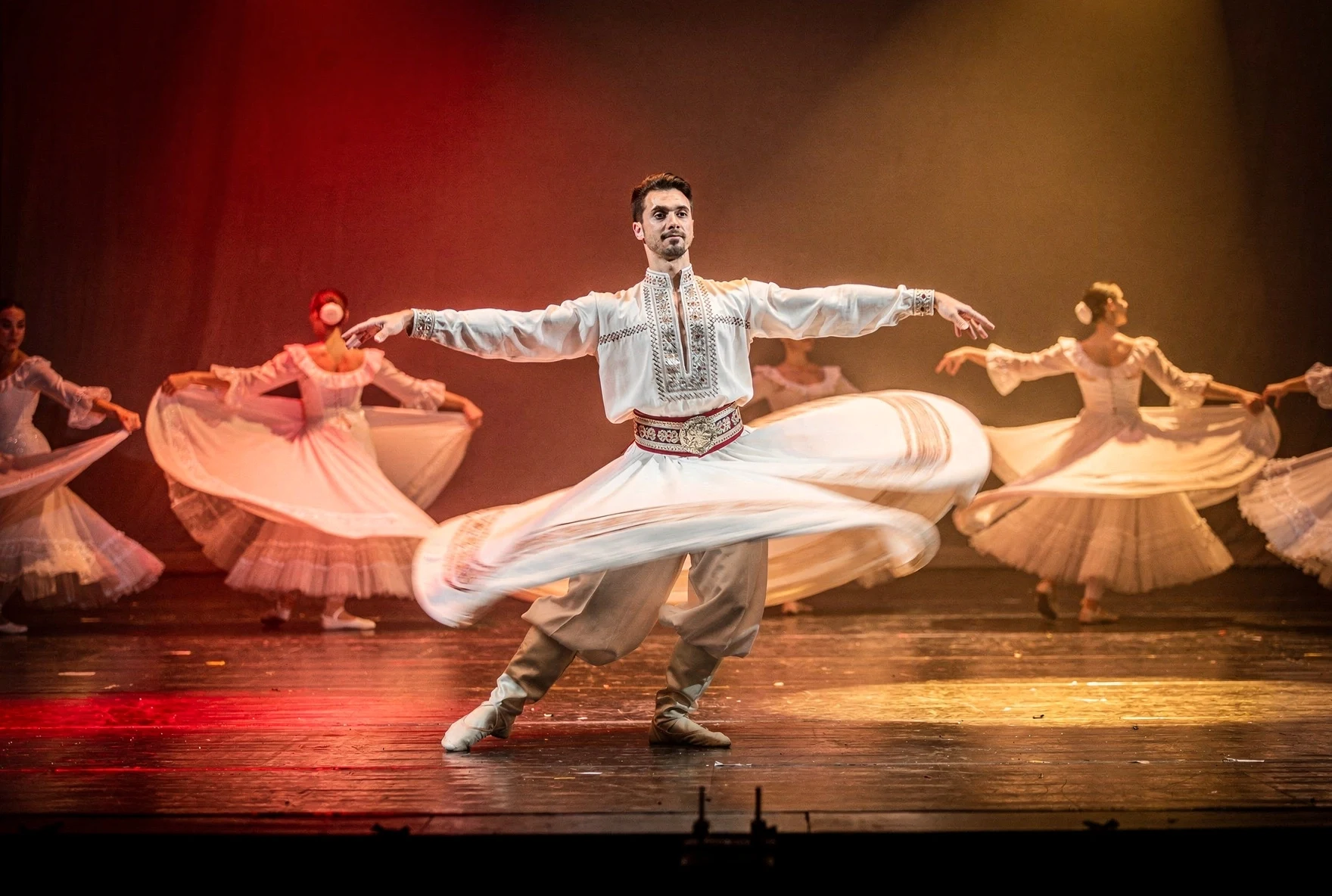
Georgian dance is physical storytelling — love, war, competition, celebration, all told through movement. Each region has its own dances, each with centuries of history behind them. The athleticism is extraordinary: men dance on their toes (not in pointe shoes — in soft leather boots), women appear to float, and sword fights are choreographed with real steel.
Here are the dances you'll see at any professional performance:
| Dance | Region | Type | What to Watch For |
|---|---|---|---|
| Kartuli | All Georgia | Romantic/wedding | Man never touches woman, eyes locked on her; she glides with downcast eyes |
| Khorumi | Adjara / Guria | War dance | 30–40 men in four acts: searching, scouting, battle, victory. Unique 5-beat rhythm (3+2) |
| Acharuli | Adjara | Flirtation | Bright red costumes, playful mood. Unlike Kartuli, men and women interact freely |
| Khevsuruli | Khevsureti | Sword fight / love triangle | Two men fight with swords over a woman. She throws her veil to stop them — fighting pauses, then resumes |
| Khanjluri | Various | Dagger competition | Shepherds in red chokhas competing with real daggers. Requires years of practice |
| Kazbeguri | Kazbegi | Mountain dance | All-black costumes, vigorous stomping. Portrays harsh mountain life |
| Partsa | Guria | Festival / acrobatic | Blazing speed, human towers, the most physically demanding Georgian dance |
| Samaia | Various | Women's trio | Three women dancing in perfect synchronization — grace, elegance, otherworldly gliding |
Kartuli: The Dance You'll Never Forget
Kartuli deserves its own section because it's the emotional centerpiece of any performance. It's a courtship dance, traditionally performed at weddings, with rules that reveal everything about Georgian values.
The man never touches the woman — not her hand, not her shoulder, not even the hem of her dress. His upper body remains motionless while his feet perform impossibly complex movements. His eyes never leave her face. She keeps her eyes downcast at all times, never meeting his gaze, gliding across the floor as if gravity is optional. The tension between them is enormous precisely because of what doesn't happen.
It's a dance about desire controlled by respect. Even in love, a man must show restraint. The woman's grace is her power. When it's performed well — by dancers who understand what they're communicating — it's one of the most beautiful things you'll ever see on a stage.
On Their Toes — Without Pointe Shoes
Male Georgian dancers rise onto their toes (en pointe) in soft leather boots — not the rigid pointe shoes that ballet dancers use. The strength and balance required is extraordinary. Georgian dancers have been doing this for centuries, long before European ballet codified similar techniques. Watch for it during Kartuli and the more acrobatic mountain dances.
Traditional Instruments
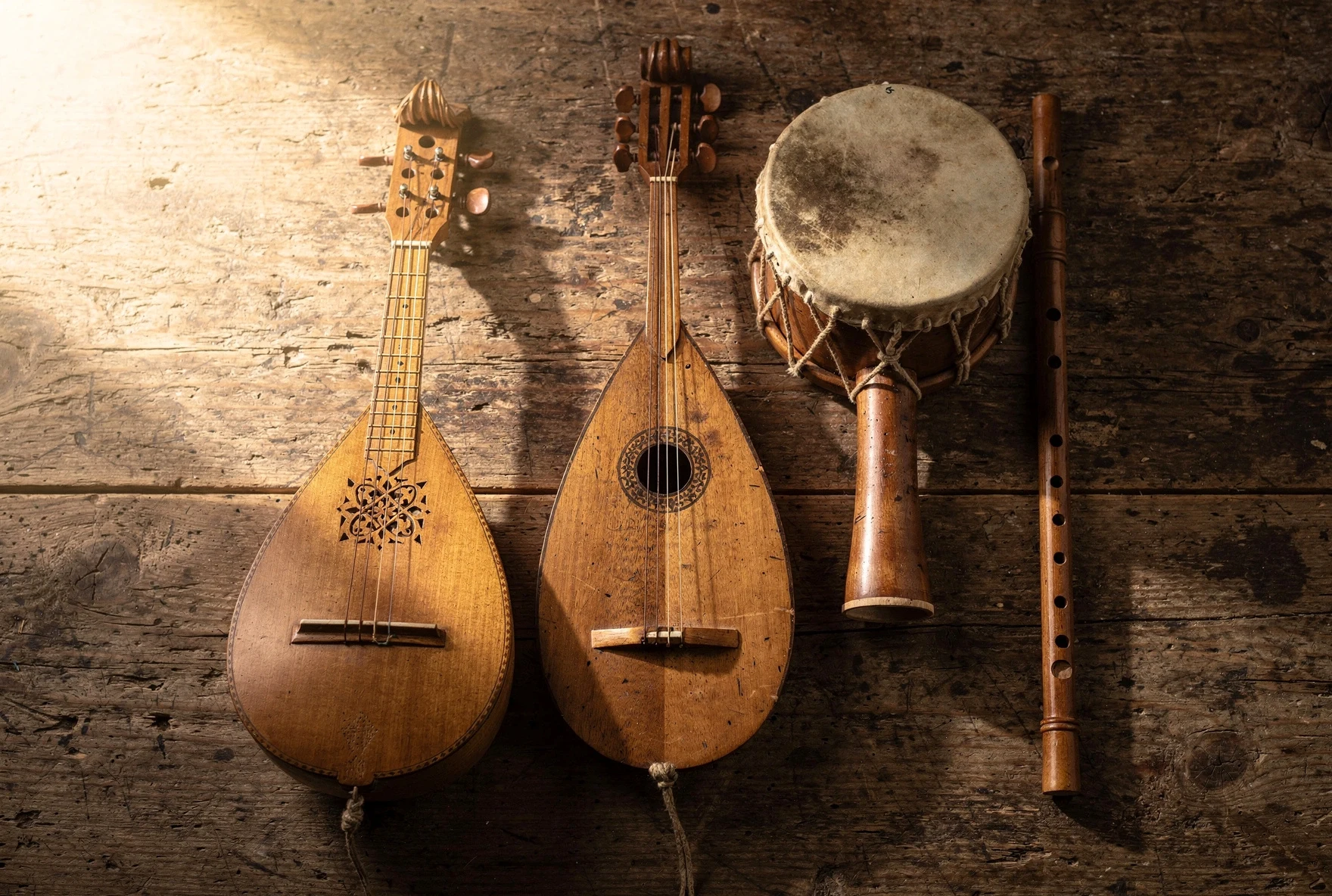
While polyphony is the star, Georgia has a rich instrumental tradition too. Most traditional songs are a cappella, but instruments accompany dances and some regional singing styles. Here are the ones you'll encounter:
| Instrument | Type | Region | Sound / Role |
|---|---|---|---|
| Panduri (ფანდური) | 3-string lute | Eastern Georgia | Accompanies solo singing and storytelling. Georgia's most recognizable folk instrument |
| Chonguri (ჩონგური) | 4-string lute | Western Georgia | Plucked accompaniment for polyphonic songs. Softer, more melodic than panduri |
| Doli (დოლი) | Double-headed drum | All Georgia | The heartbeat of Georgian dance. Provides rhythm for Khorumi, Acharuli, and all dance performances |
| Salamuri (სალამური) | Wooden flute | All Georgia | Shepherd's instrument. Haunting, plaintive solo melodies. Often played outdoors |
| Chiboni (ჩიბონი) | Bagpipe | Western Georgia | Georgian bagpipe — drone-based, used in processions and to accompany Khorumi |
| Changi (ჩანგი) | Harp | Svaneti | Small traditional harp. Rare now but being revived. Delicate, ethereal sound |
| Duduki (დუდუკი) | Double-reed pipe | Eastern Georgia | Warm, nasal tone. Shared with Armenian tradition but with Georgian playing style |
You'll hear the doli (drum) at every dance performance — its rhythm is the engine that drives Georgian dance. The panduri and chonguri are what you'll encounter at more intimate settings: a guesthouse host playing and singing after dinner, or a street musician in Tbilisi's Old Town.
The Big Names: Sukhishvili & Erisioni
Two companies dominate Georgian dance at the professional level, and seeing either one is a highlight of any Georgia trip:
Sukhishvili Georgian National Ballet
Founded in 1945 by Iliko Sukhishvili and Nino Ramishvili. They essentially codified Georgian dance for the stage, creating the choreographed versions of traditional dances that the world now knows. The company has performed in over 100 countries. Their shows in Tbilisi are spectacular — full orchestra, elaborate costumes, incredible athleticism. Still family-run (fourth generation).
🌐 sukhishvili.net · Performances at Griboedov Theatre and touring venues
Erisioni Georgian National Ballet
Founded in 1885, making it even older than Sukhishvili. Erisioni combines dance with live polyphonic singing — their choir performs alongside the dancers, which gives the show a different energy than Sukhishvili's orchestra-accompanied performances. They're the ensemble featured at most state ceremonies and international cultural events. Some purists consider them more "authentic."
🌐 erisioni.ge · Regular performances at their own venue in Tbilisi
Which One to See?
Both are extraordinary. Sukhishvili is more theatrical and polished — better production values, bigger spectacle. Erisioni is more musically immersive because of the live singing. If you can only see one, check who's performing during your visit — both tour internationally and aren't always in Tbilisi. Tickets typically cost 30–80 GEL ($10–30) depending on seating. Book through tkt.ge, Georgia's main ticketing platform.
Where to See Performances in Tbilisi
You have three tiers of options, from "polished show" to "stumble upon the real thing":
Dinner-and-a-Show Restaurants
The tourist-friendly option, and honestly, not a bad one. These large restaurants stage nightly performances combining Georgian dance and polyphonic singing with dinner. The food is hit-or-miss, but the performances are genuine — real dancers, real singers, real swords.
| Venue | Location | Show Time | Notes |
|---|---|---|---|
| Ethnographer | Dighomi (30-40 min from center) | ~8:00 PM nightly (summer) | Best food of the group. Beautiful decor, dramatic lighting. Book 3-5 weeks ahead in peak season |
| Ethno Tsiskvili | Dighomi | 8:00 PM – midnight | Most over-the-top — fire swords, opulent costumes. Dress code enforced (business casual). Reservations essential |
| In the Shadow of Metekhi | Avlabari (riverfront) | ~8:00 PM | Best views — Tbilisi city panorama. Shows range from vocal quartets to full dance. Central location |
| Mravaljamieri | Didube (riverside) | Evenings (high season) | Named after a folk song ("long life"). Large outdoor area in summer. 15 min by taxi from center |
Theaters and Concert Halls
For Sukhishvili, Erisioni, and other professional ensembles. Check tkt.ge for schedules — performances aren't daily and both companies tour extensively. The Jansug Kakhidze Tbilisi Center for Music and Culture and the Tbilisi Conservatoire also host folk music concerts throughout the year.
The Real Thing: Churches and Chance Encounters
Sunday morning Divine Liturgy at any active Orthodox church features polyphonic chanting — three to six men singing without instruments, the sound bouncing off centuries-old stone walls. It's not a performance; it's worship. But it's some of the most beautiful music you'll hear anywhere.
⛪ Anchiskhati Basilica
Tiny 6th-century church in Old Tbilisi. Incredible acoustics — the polyphony reverberates off every stone. Notable ensemble. The intimate size makes it feel like a private concert.
⛪ Sioni Cathedral
Larger venue near the Mtkvari River. Beautiful polyphonic chanting during Sunday service. More space to stand comfortably and listen.
⛪ Sameba Cathedral
Georgia's largest church. Big crowds, grand atmosphere. The sheer scale of the interior amplifies the polyphony. Sunday mornings draw the biggest gatherings.
🎶 Random Restaurants
Honestly the best option. Stay out late, sit near Georgian tables, drink wine. At some point, someone will start singing. It's spontaneous, unpolished, and infinitely more moving than any staged show.
Church Etiquette
Visitors are welcome at Sunday services. Dress modestly (cover shoulders and knees; women may want a headscarf, though it's not always enforced). Stand towards the back, stay quiet, and don't take photos. People come and go throughout the service, so it's fine to step in for 20–30 minutes. Services usually begin around 10:00 AM.
Outside Tbilisi: Where Music Lives Deepest
Tbilisi gives you polished performances. The regions give you the raw, unmediated tradition:
| Region | Musical Tradition | When to Go | How to Experience It |
|---|---|---|---|
| Svaneti | Most ancient polyphony, non-tempered tuning | June–September | Guesthouse hosts, village feasts. Ask in Mestia or Ushguli |
| Guria | Krimanchuli yodel, virtuosic trios, Khorumi dance | Year-round | Ozurgeti area. Village events, local ensembles |
| Kakheti | Table songs, drone polyphony, supra singing | Sept–Oct (harvest) | Rtveli (harvest) celebrations, family wine cellars, Alaverdoba festival |
| Racha | Mountain songs, liturgical chanting, village celebrations | June–October | Guesthouse evenings, religious holidays |
The Best Time for Music: Rtveli Season
If you want to hear Georgian singing at its most alive, visit during rtveli (grape harvest) in September–October. In Kakheti especially, families gather to pick grapes, crush them, and fill qvevri — and they sing the entire time. Work songs, celebration songs, toasting songs. The Alaverdoba festival at Alaverdi Monastery is a particular highlight. It's the closest thing to time travel.
The Modern Scene
Georgian music isn't frozen in the past. A vibrant contemporary scene draws on traditional roots while pushing into new territory:
🎤 Revival Ensembles
Groups like Mtiebi and Anchiskhati (named after the basilica) have been working since the 1980s to revive the original non-tempered tuning systems that were being lost to Western musical influence. They perform songs as they would have sounded centuries ago — and the difference from "modernized" versions is striking.
🎧 Electronic Fusion
Tbilisi's electronic music scene (which put the city on the global clubbing map) has increasingly incorporated polyphonic samples and traditional instrumentation. You'll hear panduri riffs over techno beats at venues across the city. It's controversial among purists but undeniably creative.
🎼 The Opera Connection
Georgia produces opera singers wildly out of proportion to its population. The vocal training that comes from growing up in a polyphonic tradition creates a technical foundation that translates directly to operatic performance. Georgian singers are represented in opera houses worldwide.
🌍 International Spread
Georgian polyphony has inspired vocal groups worldwide. The American ensemble Kavkasia performs Georgian songs in traditional tuning, and polyphonic singing workshops happen regularly across Europe and North America. The music is finding new audiences far beyond Georgia's borders.
Practical Tips for Music-Lovers
📱 Booking Tickets
tkt.ge is the main ticketing platform for theater and concert events. Book Sukhishvili and Erisioni performances here. For restaurant shows, contact venues directly through their Facebook pages — this is the standard booking method in Georgia.
💰 Costs
Theater performances: 30–80 GEL ($10–30). Dinner-show restaurants: 100+ GEL per person including food. Church services: free. Random restaurant singing: just buy wine and be patient.
📅 Best Season
Summer (June–September) for the widest range of performances — restaurant shows are seasonal. Autumn for harvest festivals. Theater performances happen year-round. Sunday church services are always available.
🎵 What to Listen For
In polyphony: the bass drone (feel it in your chest), the krimanchuli falsetto yodel (you'll know it when you hear it), and the moments where the harmonies resolve from dissonance into consonance. In dance: watch the men's feet (toe work) and the women's gliding movement.
Frequently Asked Questions
Do I need to book performances in advance?
For Sukhishvili and Erisioni theater shows, yes — book through tkt.ge. For dinner-show restaurants in peak season (June–September), book 2–4 weeks ahead. For church services and spontaneous restaurant singing, just show up.
Is Georgian polyphonic singing really that different from other music?
Yes. Most of the world's music traditions are monophonic (single melody) or homophonic (melody plus accompaniment). Georgian polyphony predates Western harmony by centuries and uses harmonic intervals that European classical music avoided until the 20th century. It's genuinely unique.
Can I learn Georgian singing or dance while visiting?
Several organizations in Tbilisi offer short workshops. The Georgian Polyphonic Singing Center and various cultural centers host visitor-friendly sessions. For dance, ask at tourist information about classes or workshops — they're occasionally available through cultural programs.
What's the Chokha costume the dancers wear?
The chokha (ჩოხა) is the traditional Georgian men's garment — a long, fitted coat with gazyr cartridge holders across the chest (originally functional, now decorative). Each region has slight variations. It's the national dress of Georgia and is worn at weddings, holidays, and performances.
Sukhishvili or Erisioni — which is better?
Neither is "better" — they're different. Sukhishvili is more theatrical with an orchestra. Erisioni pairs dance with live polyphonic singing, which some consider more authentically Georgian. See whichever is performing during your visit. Both will leave you speechless.
Written by The Georgian Guide Team
We've lived in Georgia long enough to have heard polyphonic singing break out in restaurants, taxis, and once memorably in a dentist's waiting room. We've seen Sukhishvili and Erisioni multiple times, attended more supras than we can count, and still get goosebumps every time Chakrulo starts.
Last updated: February 2026.
Related Articles
The Georgian Supra
The legendary feast where most polyphonic singing actually happens.
Georgian Culture & Etiquette
Understanding the culture behind the music and traditions.
Churches & Monasteries of Georgia
The architectural context where polyphonic chanting comes alive.
Tbilisi Nightlife & Bars
Live music venues and the bar scene beyond traditional performances.