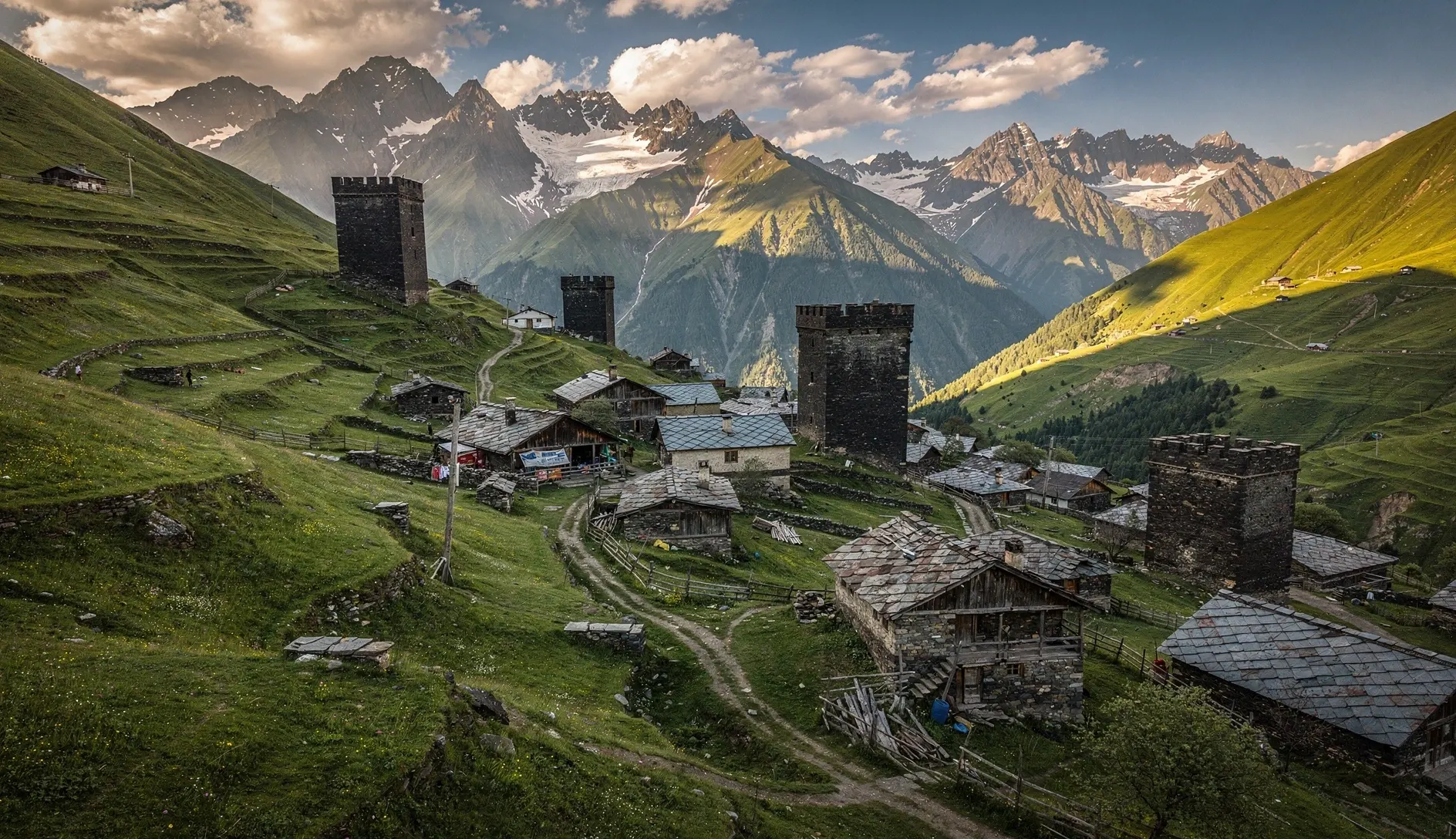
Tusheti is the place Georgians talk about the way travellers talk about Bhutan or Mongolia — with reverence, a bit of longing, and the unspoken admission that most of them haven't actually been. It sits in the far northeast corner of the country, separated from the rest of Georgia by the Caucasus mountains and accessible by a single terrifying dirt road that's only open four months a year. If you haven't been to Tusheti, a local in Diklo once told me, you haven't really been to Georgia.
That's a bold claim in a country with Svaneti, Kazbegi, and thousands of years of history visible around every corner. But after spending time in the region, I understand what she meant. Tusheti isn't just remote — it's a completely different world. The villages look like they were built a thousand years ago because they were. The traditions aren't preserved for tourists; they persist because the geography makes change almost impossible. And the landscape is, without exaggeration, some of the most beautiful mountain scenery in the Caucasus.
This guide covers what to do once you're actually in Tusheti. For getting there — the road, transport options, the Abano Pass — see our dedicated Road to Tusheti guide.
Quick Facts
| Detail | Info |
|---|---|
| Location | Far northeast Georgia, bordering Dagestan & Chechnya |
| Administrative region | Kakheti (technically — though it feels nothing like it) |
| Main settlement | Omalo (1,880 m elevation) |
| Protected area | Tusheti National Park — 113,000 hectares (est. 2003) |
| Winter population | Nearly zero — families relocate to Alvani in the lowlands |
| Summer population | ~2,000 (residents + guesthouse operators + shepherds) |
| Mobile coverage | Patchy — Magti works in Omalo, nearly nothing elsewhere |
| ATMs | None. Bring cash (GEL) from Tbilisi or Alvani |
| Minimum days needed | 3 days (5–7 ideal for trekking) |
| Fuel | No gas stations. Fill up in Pshaveli or Alvani |
Why Tusheti Is Worth the Effort
Georgia has no shortage of beautiful mountain scenery. Svaneti has the iconic towers and glaciers. Kazbegi has that one church on the hill everyone photographs. But Tusheti occupies a different category entirely — not because the mountains are taller (they're not) but because the isolation changes everything.
When you're in Kazbegi, you're two hours from Tbilisi on a paved road. In Svaneti, budget airlines land in Mestia. In Tusheti, you're genuinely cut off. The road that brings you in is so dangerous that experienced Georgian drivers approach it with visible anxiety. There are no ATMs, no pharmacies, no grocery stores in most villages, and phone signal is a happy accident rather than an expectation. This isn't curated wilderness — it's the real thing.
What does that isolation preserve? A lot, it turns out:
🏔️ Untouched Landscapes
Alpine meadows with zero development. Wildflower-covered hillsides. Valleys where the only sound is wind and sheep bells. Tusheti feels like Switzerland before tourism happened.
🗼 Medieval Towers
Defensive stone towers dot almost every village — some 800+ years old. Unlike Svaneti's towers (increasingly surrounded by guesthouses), Tusheti's towers stand in near-empty landscapes.
🐑 Living Pastoral Culture
Shepherds still move thousands of sheep up from the lowlands each summer — an ancient transhumance tradition. You'll share trails with flocks and camp near shepherd huts.
🍺 Tushuri Beer & Cheese
Tusheti has its own beer (brewed in homes, with hops gathered from the hillsides) and its own cheese — guda — aged in sheepskin. You can't get these anywhere else.
The Honest Truth
Tusheti is not comfortable travel. Roads between villages are rough. Guesthouses are basic. Hot water is unreliable. Food options are limited to what your host cooks. If you need predictable Wi-Fi, hot showers, and restaurant menus, this isn't the trip for you. But if you're willing to trade comfort for something genuinely extraordinary, Tusheti delivers in a way few places on earth still can.
A Brief History (That Explains Everything)
You can't understand Tusheti without understanding its history, because the history explains why the region exists the way it does — suspended between medieval and modern, inhabited and abandoned, sacred and pragmatic.
The Tushetians (Tushebi in Georgian) have inhabited these mountains since at least the Bronze Age. Archaeological finds suggest the earliest settlements — Lower Omalo and Shenako — go back thousands of years. The region has always been defined by geography: surrounded by the Greater Caucasus, bordering present-day Chechnya and Dagestan, Tusheti existed in a constant state of both isolation and contact with North Caucasian peoples.
This contact went both ways. Some historians point to the prevalence of Vainakh (Chechen/Ingush) surnames among Tushetian families as evidence of deep cultural exchange. Tusheti was also historically a place of refuge — people fleeing religious persecution or forced Christianisation from other Georgian regions would escape into these mountains. The result was a unique religious blend: pagan shrines, animist traditions, Islamic influences, and Orthodox Christianity all coexisting in the same villages.
The tradition of newcomer observation lasted until relatively recently. Outsiders arriving in Tusheti were separated from the community and watched for up to a year before being accepted. This sounds extreme, but in a mountain region where a single bad actor could devastate a small, isolated community, it made survival sense.
The Soviet Displacement
Everything changed in the 1940s. Soviet policy encouraged — and then forced — Tushetian families to relocate from the mountains to the lowlands of Kakheti, specifically to the town of Alvani. By the 1950s, the displacement was compulsory. Homes were abandoned. High mountain pastures emptied. An entire way of life was disrupted by decree.
In the late 1960s and 1970s, restrictions loosened. Families could return for religious festivals and summer grazing. In 1981, the road was built — the same road that exists today, virtually unchanged. A library, medical center, and telegraph station went up in Omalo. A cable car was planned to connect Lower Omalo with the opposite valley. It was never finished. You can still see the abandoned station.
After the USSR collapsed in the 1990s, state services in Tusheti were shut down — including a new electricity network. People left again, this time out of economic necessity rather than government orders. The Tusheti Protected Areas were established in 2003, and gradual restoration work has since brought some families and tourists back.
This is the context for what you see today: villages that are inhabited only four months a year, where families maintain two lives — winter in Alvani, summer in the mountains — because the alternative is letting centuries of heritage disappear entirely.
The Villages You Should Visit
Tusheti has 48 historic villages, but most are abandoned or barely accessible. The ones worth targeting fall into two groups: the easily reached (by Tusheti standards) and the ones requiring a proper hike or horseback ride. Here's what each one actually offers.
Omalo — The Hub
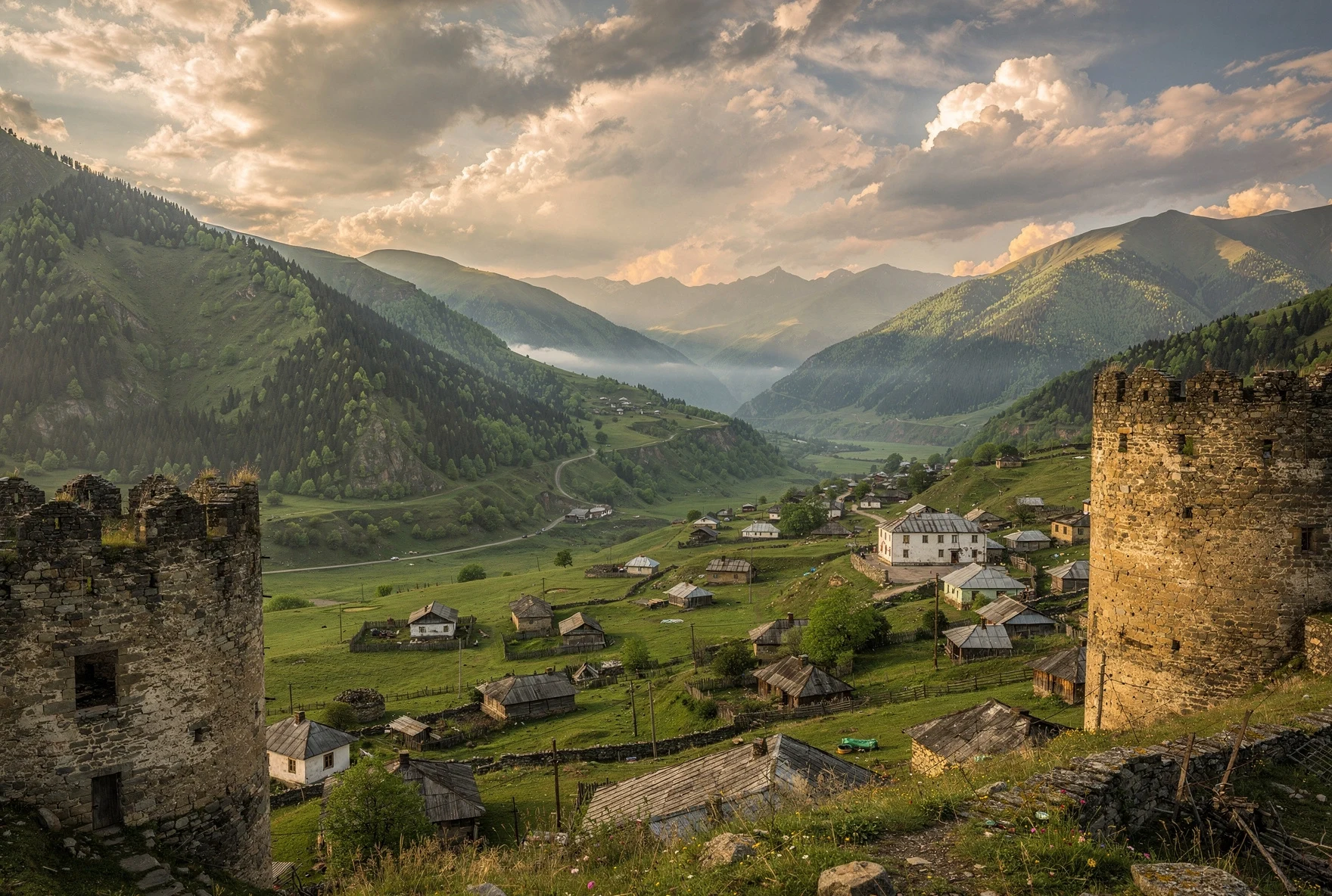
Omalo is where most people base themselves, and for good reason — it has the most guesthouses, the most reliable phone signal (relative term), and is the starting point for most hikes and day trips. It's divided into two parts: Lower Omalo, where the guesthouses, ranger station, and helipad are; and Upper Omalo (Keselo), a fortified cluster of medieval towers on the hill above.
The walk from Lower to Upper Omalo takes about 30 minutes uphill and is the single most worthwhile thing you can do with limited time. Keselo fortress served as a defensive outpost against North Caucasian raiders, and later as a Persian garrison in the 1650s until rebelling Georgians captured and demolished it. The views from the towers — looking down into the valley and across to the peaks — are extraordinary. Several towers have been partially restored and you can climb inside them.
Omalo Practicalities
Omalo has a national park ranger station where you can get trail maps and register for longer hikes. There's a small shop with basic supplies (instant noodles, beer, chocolate — don't count on more). Magti mobile signal works intermittently. Most guesthouses offer meals for 30–50 GEL per person per day (full board). Altitude: 1,880 m.
Dartlo — The Showpiece
If Omalo is the hub, Dartlo is the destination. About 16 km from Omalo along a rough mountain road, Dartlo is a stone village built into a narrow gorge that looks like it belongs in a Tolkien illustration. The architecture here is the best-preserved in Tusheti — multi-story stone houses with carved wooden balconies, defensive towers with intricate stonework, and a layout that hasn't changed in centuries.
Dartlo has become the most photographed village in Tusheti, and it's earned the attention. The whole settlement is a UNESCO tentative list site. Walk through slowly — look for the carved slate facades, the traditional machubi (gathering houses) with their massive stone hearths, and the sacred khati shrines at the village edge. Don't enter the shrines without permission; some have strict rules about who can approach.
There are several guesthouses in Dartlo (fewer than Omalo) and the atmosphere is noticeably quieter. Getting here requires a 4WD vehicle or a solid hike from Omalo.
Shenako — The Church Village
Shenako is one of the oldest settlements in Tusheti and home to the region's most photographed church — a stone Orthodox church perched on a hillside with the full sweep of the mountains behind it. The village itself is smaller than Omalo and Dartlo, with a handful of functioning guesthouses and a deeply residential feel.
What makes Shenako special is the vibe. It's quieter than Omalo, less photographed than Dartlo, and has a slightly melancholy beauty — many of the stone houses are empty, slowly being reclaimed by grass and weather. This is where you feel the reality of Tusheti's seasonal abandonment most acutely. The church, originally built in the 19th century and restored in recent years, is worth visiting for the setting alone.
Diklo — The Borderland
Diklo sits near the Russian (Dagestani) border and feels more militarized than other villages — you'll see Georgian border patrol presence. The village has a dramatic fortress ruin and some of the longest-range mountain views in the region. Fewer tourists make it here, which gives it a raw, unpolished quality that Omalo and Dartlo have started to lose.
The road from Omalo to Diklo passes through Shenako and is drivable in a 4WD, though "drivable" in Tusheti means something different than what you're used to.
Remote Villages: Parsma, Chesho, Girevi
Beyond the accessible villages lie places you can only reach on foot or horseback. Parsma, above Dartlo, is an almost completely abandoned village with intact tower complexes — eerie, beautiful, and silent. Chesho sits above Shenako with similar abandoned grandeur. Girevi, deeper into the mountains, is one of the most photogenic ghost villages in the Caucasus.
Reaching these requires proper hiking — half-day to full-day trips from the nearest accessible village. Bring water, snacks, and a healthy respect for the terrain. There are no marked trails, no signage, and no help nearby if something goes wrong.
| Village | From Omalo | Access | Best For |
|---|---|---|---|
| Omalo | — | 4WD road | Base camp, Keselo fortress, logistics |
| Dartlo | 16 km / 1.5 hr drive | 4WD or hike | Architecture, photography, UNESCO towers |
| Shenako | 7 km / 30 min drive | 4WD or hike | Historic church, quiet atmosphere |
| Diklo | 15 km / 1 hr drive | 4WD | Border fortress, remote feel |
| Parsma | ~20 km | Hike or horse | Ghost village, tower complexes |
| Chesho | ~12 km | Hike or horse | Abandoned village, solitude |
| Bochorna | ~25 km | 4WD (rough) | Highest village in Europe (2,345 m) |
What to Do in Tusheti
Hiking & Trekking
This is why most people come. Tusheti offers everything from gentle half-day walks between villages to multi-day wilderness treks through uninhabited mountain passes. The trails aren't marked like European long-distance paths — you'll rely on GPS tracks downloaded beforehand, occasional cairns, and the general principle that valleys lead somewhere.
The best treks:
| Trek | Duration | Difficulty | Highlights |
|---|---|---|---|
| Omalo to Dartlo | 5–6 hours | Easy–Moderate | Valley walking, river crossings, village approach |
| Dartlo to Parsma | 3–4 hours | Moderate | Ghost village, wildflower meadows, towers |
| Omalo to Shenako to Diklo | Full day (7–8 hrs) | Moderate | Three villages, church, border fortress |
| Atsunta Pass (to Shatili) | 3–4 days | Hard | 3,400 m pass, wild camping, Khevsureti crossing |
| Girevi Loop | 2 days | Moderate–Hard | Remote valley, abandoned villages, no people |
| Keselo Fortress (Omalo) | 1 hour round trip | Easy | Best views in Tusheti, restored towers |
The Atsunta Pass Warning
The Atsunta Pass trek from Tusheti to Khevsureti (Shatili) is the marquee multi-day hike, but it's serious. The pass tops 3,400 m, weather changes fast, there's no shelter above treeline, and river crossings can be dangerous after rain. Don't attempt it without GPS navigation, proper gear, and ideally a local guide. People have died on this route. It's spectacular — but it demands respect.
Horseback Riding
Horses are a practical transport tool in Tusheti, not a tourist novelty. Most guesthouses can arrange multi-day horseback trips to remote villages that would take much longer on foot. Expect to pay 80–150 GEL per day for a horse with a guide. The riding is mountain riding — steep, uneven, sometimes on paths that barely exist — so prior experience helps, though beginners can manage shorter rides.
Sheep Migration (Transhumance)
Twice a year — late May/early June and late September/October — Tushetian shepherds move thousands of sheep between the lowland winter pastures near Alvani and the high mountain pastures of Tusheti. This is one of the last surviving large-scale transhumance traditions in Europe, and watching it is hypnotic: rivers of sheep flowing along mountain trails, guided by shepherds and dogs, following routes that haven't changed in centuries.
If your timing is right (ask locally — dates shift based on weather and grass conditions), you can walk alongside the migration for a few hours or a few days. There's no formal way to join; you just show up on the trail and fall in step. The shepherds are generally friendly, if bemused by tourists who voluntarily walk alongside sheep.
Tushetian Food & Drink
Tusheti has its own food culture, distinct from lowland Georgia. The star ingredients are guda cheese (aged in sheepskin, pungent and funky — you'll either love it or find it aggressively strong), homemade beer brewed with wild hops, and khinkali made with a local filling style that's denser and more heavily spiced than the Tbilisi version.
Meals at guesthouses follow the standard Georgian home-cooking pattern: a table full of dishes appears, you eat, there's too much food, and refusing second helpings is a losing battle. But the ingredients are different up here — mountain herbs, fresh cheese made that morning, meat from animals that grazed the hillside you can see from the table. It's simple food, but the raw ingredient quality is hard to beat.
🧀 Guda Cheese
Aged in a sheepskin bag (guda), this semi-hard cheese has a funky, sharp flavor that intensifies with age. The sheepskin imparts a distinctive taste you won't find in any store-bought cheese. Try it at any guesthouse.
🍺 Tushetian Beer (Aludi)
Homebrew made from barley and wild hops gathered from the hillsides. It's flat, slightly sweet, mildly cloudy, and nothing like commercial beer. Each family's recipe is different. Drink it because it exists nowhere else.
🥟 Khinkali
Tushetian khinkali uses a filling that's heavier on herbs and spices than the Tbilisi version. Made with mutton rather than mixed beef/pork, reflecting the region's pastoral economy. Eaten by the handful at guesthouses.
🍯 Mountain Honey
Wildflower honey from hives kept in the alpine meadows. The flavor changes with the season and the flowers. Available from some guesthouse owners — ask, and they'll produce a jar from somewhere.
Sacred Sites & Khati Shrines
Tusheti's religious landscape is unlike the rest of Georgia. While the country is overwhelmingly Orthodox Christian, Tusheti preserves pagan traditions that predate Christianity. Khati shrines — sacred sites dedicated to local deities and spirits — exist at the edges of villages and on mountain passes. Some are small stone structures; others are marked by animal horns, flags, or wooden totems.
The rules around khati are strict and real. Some shrines prohibit women entirely. Others are restricted to specific families or clans. Don't enter, touch, or photograph a khati without explicit local permission. This isn't a museum — people actively worship at these sites.
Respect the Shrines
The pagan-Christian syncretism in Tusheti is fascinating, but approach it with the respect you'd give any active place of worship. Ask before photographing. Don't enter shrines marked with flags or horns without a local telling you it's okay. Gender restrictions at certain sites are not negotiable — they're centuries old and deeply held. Your curiosity doesn't override their tradition.
When to Visit
Tusheti's season is brutally short. The Abano Pass road typically opens in mid-June (sometimes later, depending on snowmelt) and closes by late October. Outside this window, the region is physically inaccessible by road — buried under meters of snow with no maintained winter route.
| Month | Conditions | Crowds | Notes |
|---|---|---|---|
| Mid-June | Road may just be opening. Snow patches on high trails. | Very low | Risky — road could close again. Guesthouses not all open. |
| July | Warm (20–25°C days). Wildflowers peak. Trails clear. | Moderate | Best for wildflower photography. Some afternoon rain. |
| August | Warmest month. Best weather window. All facilities open. | Highest | Peak tourist season (still quiet by normal standards). |
| September | Cooler. Golden light. Autumn colors starting. | Low | Sweet spot — great weather, few people, autumn migration. |
| October | Cold nights. Snow possible. Guesthouses closing. | Very low | Road may close early. Check conditions before going. |
The sweet spot is mid-July to mid-September. September is ideal if you can manage it — warm enough for hiking, the summer crowds (such as they are) have thinned, the light turns golden, and you might catch the autumn sheep migration back to the lowlands.
Where to Stay
Accommodation in Tusheti means guesthouses. Full stop. There are no hotels, no hostels, no Airbnbs (the internet required for Airbnb barely exists). Guesthouses are family-run, typically offering a private room (or shared room in busy periods), three meals a day, and whatever hot water the solar heater managed to produce that afternoon.
| Village | Guesthouses | Full Board Price | Notes |
|---|---|---|---|
| Omalo | 10–15 | 60–100 GEL | Most options, best phone signal, ranger station |
| Dartlo | 5–8 | 70–100 GEL | Best architecture, quieter, book ahead in August |
| Shenako | 3–5 | 60–80 GEL | Quiet, fewer tourists, church nearby |
| Diklo | 2–3 | 50–70 GEL | Most remote option, near border |
Booking Guesthouses
Booking.com has a few Omalo guesthouses listed, but most operate by phone only. The national park ranger station in Omalo keeps an informal list and can help you find a bed if you arrive without a reservation. In July–August, calling ahead is wise — especially for Dartlo. Your driver from Alvani will also know guesthouse owners and can call ahead.
Camping
Wild camping is allowed throughout Tusheti National Park and is the standard approach for multi-day treks. There are no official campsites — you pitch where the ground is flat. Popular spots include meadows near Dartlo, the valley between Shenako and Diklo, and along the Atsunta Pass route. Bring everything you need; there are no facilities.
A few notes: nights get cold even in August (5–10°C at altitude), so bring a proper sleeping bag rated to at least 0°C. Water from mountain streams is generally drinkable, but use a filter if you're downstream from any village or sheep pasture. And carry out all your trash — this is a national park, and the rangers take it seriously.
What It Costs
Budget Trip (5 days)
Comfort Trip (5 days, with horse/guide)
For context: a five-day trip to Tusheti costs about the same as a two-night stay in a mid-range Tbilisi hotel. It's one of the best value adventure trips in Europe.
Practical Information
Money
There are no ATMs in Tusheti. None. Zero. The nearest ATMs are in Alvani (the last town before the mountain road) or Telavi. Bring all the cash you'll need in Georgian Lari. Budget generously — you'd rather return with extra cash than run out on day three. Some guesthouses might take bank transfers, but don't count on it.
Phone & Internet
Magti has the best coverage, but "coverage" in Tusheti means you might get 2G signal in Omalo if you stand in the right spot and hold your phone up. Expect to be offline for most of your trip. This is part of the appeal — or the horror, depending on your relationship with your phone. Download offline maps (maps.me or OsmAnd) before you leave Tbilisi. Seriously, do this.
Health & Safety
The nearest hospital is in Akhmeta, a 5-6 hour drive from Omalo (in good conditions). There's a small medical point in Omalo with basic first aid, but anything serious requires helicopter evacuation or a very long drive out. Bring a solid first aid kit, any prescription medications you need, and travel insurance that covers helicopter evacuation. Check that your policy explicitly includes "remote area evacuation" — many standard policies don't.
Getting Around Within Tusheti
Between villages, your options are: 4WD (your own or hired locally), horseback, or walking. There's no public transport within Tusheti. If you arrived by shared jeep from Alvani, you'll need to arrange village-to-village transport separately. Most guesthouse owners can call someone with a car, or you can hire a horse.
Essential Downloads Before You Go
Download these while you still have internet: offline maps (Maps.me or OsmAnd with Georgia map pack), GPS tracks for any treks you're planning (Wikiloc has good Tusheti routes), and the emergency number 112 saved in your phone. Screenshot your guesthouse booking details and any phone numbers you might need. Once you're past Alvani, the internet age effectively ends.
What to Pack
| Category | Items | Why |
|---|---|---|
| Layers | Fleece, down jacket, rain shell | Temperature swings from 25°C to 5°C in one day |
| Footwear | Hiking boots (ankle support), sandals | Rocky trails, river crossings, evening relief |
| Navigation | Offline maps, GPS tracks, power bank | No signal, no trail markers, no charging points |
| Health | First aid kit, sunscreen, water filter | Nearest hospital is 5+ hours away |
| Cash | 800–1500 GEL (depending on trip length) | No ATMs, no card machines |
| Camping | Tent, sleeping bag (0°C), mat, stove | Only if trekking — guesthouses don't require these |
| Snacks | Trail mix, energy bars, chocolate | Omalo shop has very limited selection |
Suggested Itineraries
3 Days: The Essentials
5–7 Days: The Full Experience
Common Mistakes
❌ Not Bringing Enough Cash
The single most common mistake. No ATMs means no cash means no guesthouse, no food, no horse. Bring 50% more than you think you'll need.
❌ Only Planning One Day
The road in takes half a day. Driving all that way for one night in Omalo is a waste. Three days minimum, five is better.
❌ Arriving in June Without Checking
The road opening date varies year to year. Snow can keep the Abano Pass closed until late June. Check conditions before leaving Tbilisi.
❌ Skipping Offline Maps
Your phone's map won't load without signal. Download everything in advance. This isn't optional — it's a safety issue on mountain trails.
❌ Entering Khati Shrines
Some sacred sites have strict rules about who can enter. Ignoring these isn't just rude — it will genuinely upset the community that hosts you.
❌ Expecting Hotel Comforts
Guesthouses are family homes, not hotels. Hot water is sometimes. Wi-Fi is never. Adjust your expectations and you'll love it.
Frequently Asked Questions
Is Tusheti safe?
Yes, in terms of crime — it's one of the safest places in Georgia. The risks are environmental: the road in, mountain weather, remote trails with no cell service, and the distance from medical help. Treat it like any backcountry mountain trip and you'll be fine. Also see: Is Georgia Safe?
Can I drive my own car to Tusheti?
Only with a proper 4WD with high clearance. The Abano Pass road is narrow, unpaved, and has no guardrails at cliff edges. Most rental companies prohibit their vehicles on this road. If you're not experienced with mountain driving, hire a local driver. See our full Road to Tusheti guide.
Do I need a guide?
For village-hopping around Omalo, Dartlo, and Shenako — no, you can manage independently. For multi-day treks (especially the Atsunta Pass), a guide is strongly recommended. They know the trails, can arrange horses, and will get you out if weather turns bad.
Is Tusheti worth it if I've already been to Svaneti?
Absolutely. They're completely different experiences. Svaneti is more accessible, more developed, and (increasingly) more touristic. Tusheti is rawer, quieter, and more isolated. If Svaneti felt too busy, Tusheti is the antidote. If you loved Svaneti's towers and mountains, Tusheti takes those same ingredients and strips away the infrastructure.
Can I visit Tusheti in winter?
No. The road closes completely and the entire region is inaccessible by vehicle from roughly November through May. There are no winter residents in most villages. Some extreme backcountry skiers have reached Tusheti on foot/ski, but this is expedition-level mountaineering, not tourism.
Written by The Georgian Guide Team
We're a small team based in Georgia, writing travel guides based on personal experience and local knowledge. We visit every place we write about and update our guides regularly. No sponsored content, no affiliate-driven recommendations — just honest advice from people who live here.
Last updated: February 2026.
Related Articles
The Road to Tusheti
Everything about driving the Abano Pass — transport options, safety, and what to expect.
Svaneti Travel Guide
Georgia's other iconic mountain region — towers, glaciers, and the Mestia to Ushguli trek.
Best Hikes in Georgia
From day hikes near Tbilisi to multi-day mountain treks across the Caucasus.
Kazbegi (Stepantsminda) Guide
Georgia's most iconic mountain town — Gergeti Trinity Church, hikes, and practical tips.